It was fine. It wasn’t terrible, or infuriating, or laughably bad. It also wasn’t amazing. However, with the benefit of a few weeks to sit with it I think Christopher Nolan’s Odyssey was both very impressive and a generally enjoyable experience. Anytime a story is retold, whether it is a film adaptation of a book, or a re-boot of a Hollywood classic, comparison against the original is inevitable. When the retelling involves a 3000 year old text that is generally considered foundational to western culture the stakes for the filmmaker and discourse scale up exponentially. I’ve intentionally avoided these types of discussions regarding this film because I wanted to enjoy it (or not) on my own terms, so pardon me if my take is unoriginal.
There’s an Italian maxim, “traduttore, traditore” which translates to “translator, traitor”. I’ll give you a moment to decide whether or not you trust that sentence. There are many possible applications of the phrase, but the implication of distrust is clear. The fact of the matter is that anything short of having someone chanting Ancient Greek on screen is a translation of Homer and therefore subject to interpretation and concerns of fidelity, bias, and personal or corporate agenda naturally follow. The question of literal fidelity is reasonable and warranted, but I don’t think it is the only metric by which an adaptation should be judged. I think the question of whether or not a translator’s choices help the audience enter the story’s world and identify with the culture, experiences, motivations, and conflicts navigated by its characters is arguably more relevant. Overall I think Christopher Nolan did an admirable job and I will primarily discuss how some of his choices to remove, combine, or add material successfully created a world the audience could inhabit, however I think two choices genuinely harmed his efforts.
Addition by Subtraction
I think Nolan did a good job of whittling an enormous volume of material down to a 3 hour film. It’s estimated that an oral rehearsal of Homer’s Odyssey requires about 24 hours. Even with an exchange rate between picture and words of 1:1000, there’s a lot of action, dialogue, and scene changes to get through, and the bottom line is that even a very long movie cannot capture the entirety of the text. Choices must be made about what to leave out. Reducing the content without harming character development or emotional impact of a complex wide ranging narrative is not easy, and I think Christopher Nolan made some creative choices that preserve much of what is great in the original.
Homer has Odysseus stay with Circe in Aeaea for an entire year, and return there after his trip to the underworld so that she can interpret some of the information and counsel Odysseus about how to proceed. Nolan transforms what in Homer feels like a “boys trip” where the men enjoy what can be euphemistically described as “island hospitality” before gradually getting on their way home, into an element of the journey that is streamlined, but preserves the encounter’s impact, while maintaining momentum in the narrative. Is it reasonable to spend a year sleeping with the woman who transformed your crew into swine? In my opinion Homer’s Odysseus makes a bizarre choice. Christopher Nolan’s Odysseus shows his intelligence and wisely gets the hell out of dodge once peace has been established. This decision didn’t do Circe any favors, but anyone looking for a different/more complete apologetic for her motivations and actions is welcome to enjoy Madeleine Miller’s novel.
Odysseus’ trip to the Phaeacians was completely eliminated from the movie. This is understandable; the characters and events on the island aren’t essential to the main plot, except that the most famous part of the Odyssey is embedded in this visit. Odysseus is not recognized when he washes up on shore following the shipwreck of his raft and the Phaeacians graciously welcome the stranger. They feed and clothe him. They hold games where the youth of the island display their prowess, but are humbled by this mysterious stranger’s abilities. He cuts such an impressive figure they even offer their princess to him in marriage. It is during one of several feasts that mark this outpouring of generosity that Odysseus breaks down in tears at the words of the blind bard Demodocus and reveals his identity. It is in this context that he tells of his experiences with the Lotus Eaters, the Cyclops, Circe, the trip to the underworld, Scylla & Charybdis, the Sirens, and the cattle of the Sun God. You know, all the stuff everyone instantly thinks of when they think of The Odyssey. The decision to move The Great Wanderings from the Phaeacians to a solicitous Calypso on Ogygia is a great way of abridging the plot that doesn’t impoverish the audience’s experience. Do I love the relatively lighthearted comedy elements among the Phaeacians? Definitely. But maybe that’s a pleasure best reserved for those who actually read it.
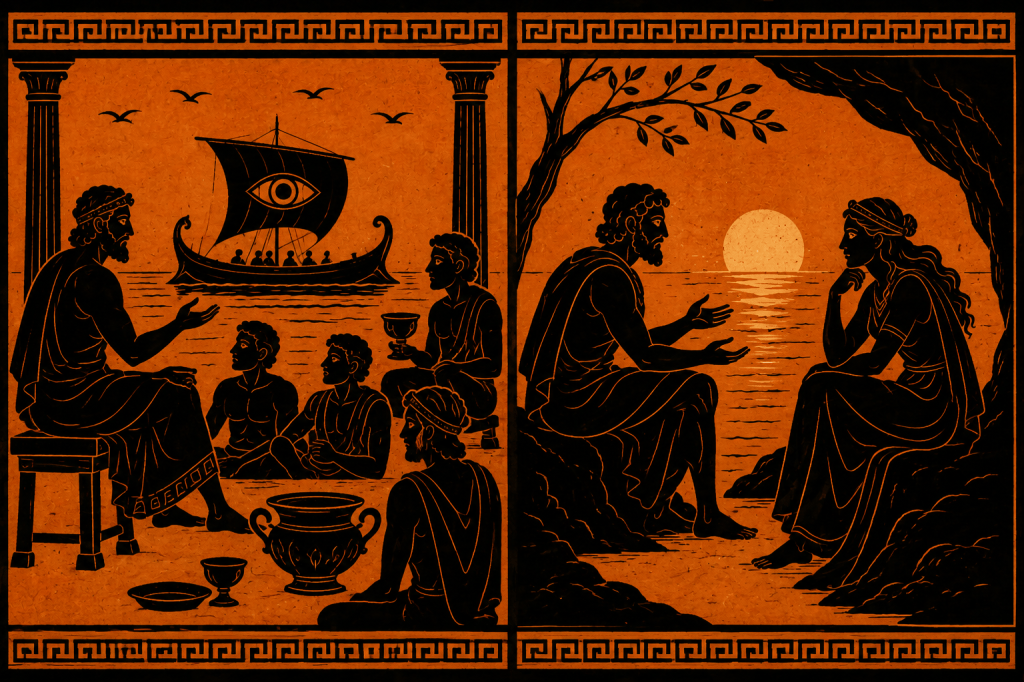
Similarly, the traditional Lotus Eater encounter is shifted to Ogygia. I think the aggregate effect of these decisions is a net positive. They re-cast Odysseus’ 7 years with Calypso from an extended extramarital affair on a tropical island that establishes an off-putting double-standard of behavior when contrasted with the expectation of chastity and fidelity from Penelope, into a prolonged recovery from the trauma of war and the loss of his entire crew. Every man, young and old, who sailed with Odysseus to Troy died on foreign soil or in the deep. With a single exception, every family on Ithaca who sent someone off to war lost a son, brother, or father. Losing a sense of purpose and direction while self medicating this sort of emotional pain is a suboptimal therapeutic response, but something with which viewers can probably sympathize. Nolan removed or combined many other story elements, but in my opinion most were negligible or net neutral. I think that two actually did a bit of harm, and I’ll tackle those in a bit.
Addition Through Embellishment
In addition to having to make choices about what to remove, to fully engage his audience Nolan had to bring in additional information not present in the text into his narrative. The evidence suggests Homer’s original/intended audience was awash, or at least well versed, in stories about the Olympian pantheon and their roles in shaping mortal “history” and society. There’s evidence to support the idea that there were many stories about the Trojan War in circulation, and Homer’s audience would have come to the text or performance aware of the war’s alleged origins, various subplots, and knowing the major players like Helen, Paris, Priam, Hector, Agamemnon, Menelaus, Achilles, Ajax, Nestor, and Odysseus. We don’t know the specifics of what they brought to the table, but when you read Homer the volume of allusions to stories that we have, and even those we don’t, is intimidating and can be overwhelming. The first time I read The Iliad I became increasingly aware of my ignorance and was conscious that I wasn’t fully “getting” it. It seems very reasonable to assume Homer’s original 8th century BCE audience had a breadth and depth of subject matter/ cultural knowledge that Nolan’s global audience in the 21st century CE does not.
The obvious consequence of this reality is that a filmmaker must make decisions about what to do with this discrepancy. One path would be to ignore it and just tell the story as written. I think that choice would be to leave a lot “on the table” in terms of audience engagement with the narrative and characters. A storyteller could try to “update” the tale to have it align with current cultural norms. This choice has the potential to make a retelling resonate with a specific audience: think Virgil’s Aeneid, or Strange Brew. This sort of translation runs the risk of losing timelessness and demands courage to own specific editorial decisions. Another path is to incorporate signals that help the audience understand the elements of the story, characters, and culture that are foreign to them. Nolan chose all three paths, but his addition of a few “signposts” stood out to me.
Making Sense of That Outrageous Helmet
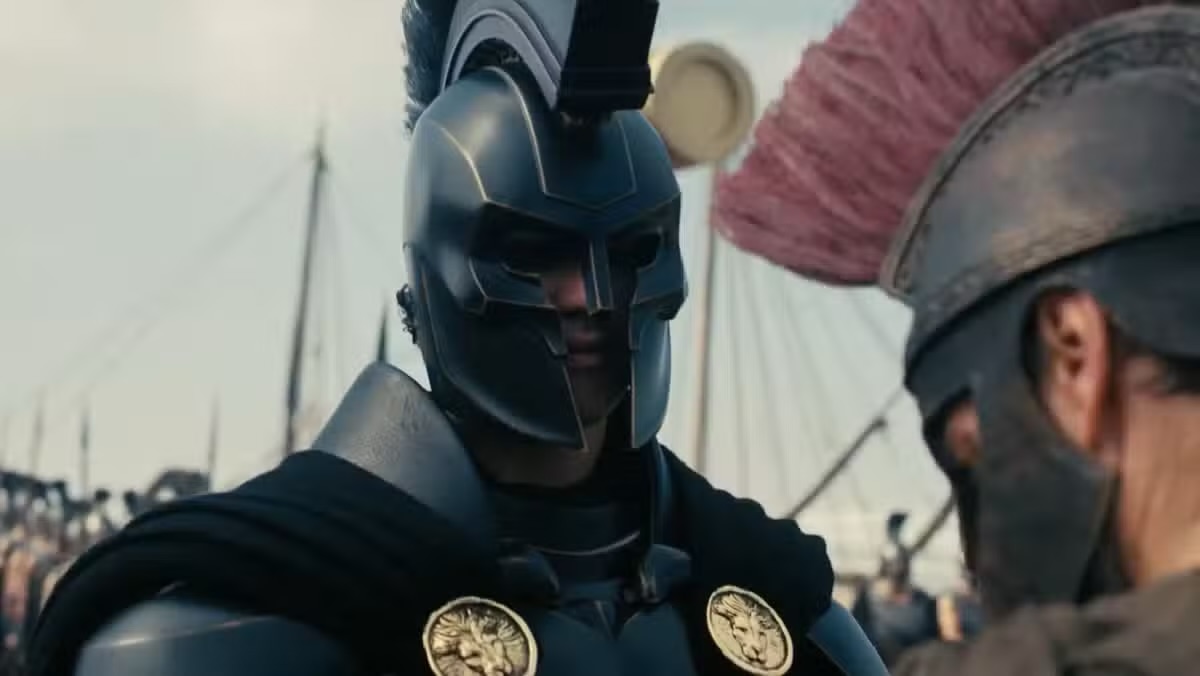
Consider Agamemnon. He wears that highly controversial, very intimidating helmet in the movie. We rarely glimpse his face. All the symbolism speaks to darkness and power. In Homer’s Odyssey he isn’t portrayed in that way. In the Odyssey his character is not well developed and I can think of only one mention of him that isn’t focused on the fact that he was killed upon returning home. In The Iliad he’s almost comically indecisive. I think the choice to present him as an intimidating and menacing presence fits with his alleged role in the story of the Trojan war. If the tough guy in the scary helmet can fall victim to household treachery following an absence of only a decade, how much higher are the stakes for Odysseus? The visual of the helmet itself does some emotional heavy lifting, but Nolan’s inclusion of the sacrifice of Iphigenia strengthens the case substantially.
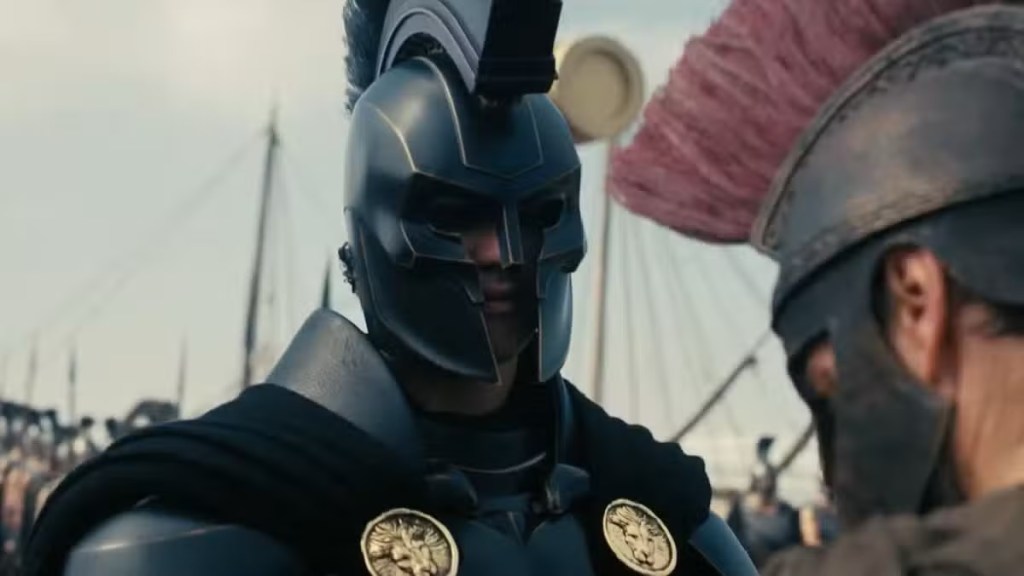
Homer doesn’t directly reference the sacrifice of Iphigenia at Aulis in The Iliad or The Odyssey. The opening scene of The Iliad offers circumstantial evidence that Homer’s audience may have been familiar with that story, but it’s never explicitly mentioned. In fact, in The Odyssey it is Clytemnestra’s lover, Agamemnon’s cousin Aegisthus, who kills him, and avenging her child is not even hinted at as motivating the murder. If one confines oneself strictly to the text the reason for Agamemnon’s death is unclear. Is it misogyny? Women are inherently untrustworthy? Agamemnon’s words suggest this perspective. Is it treachery common to infidelity and power politics? After all, leadership of a powerful kingdom is at stake. One could also invoke the multigenerational violence and family feud of The House of Atreus, but Homer doesn’t directly reference that either, and most of Nolan’s audience is likely ignorant of that history as well. By importing the sacrifice of Iphigenia at Aulis, Christopher Nolan not only provides a rationale for Agamemnon’s murder, but also establishes his bona fides as a man who could lead a civilization destroying war and for whom that silly helmet fits perfectly. Sure, Bronze age Mycenaeans/ Achaeans may not have worn anything of the sort, but it is a striking visual and I think it’s fine. The audience experience is arguably enriched by both additions: we have a better understanding of the version of Agamemnon Nolan wants us to know, we are given a relevant backstory supported by the ancient canon, and we appreciate the potential risk of returning home to treachery faced by even the most hardened of warriors. I think it’s a great use of extra-Homeric material to improve the audience experience.
I Sea Dead People
Stepping further away from original source material is the invocation of The Sea Peoples and by extension The Bronze Age Collapse. Perhaps you’ve never heard of either. However, if you have an interest in the ancient Mediterranean, you know that once you hear about them, they’re everywhere. There are multiple educational YouTube series and popular works written by scholars on the subject, so I’ll try to be brief.
There’s evidence that in the late second millennium BCE Egypt, The Levant, Mesopotamia, what is now Turkey, even Crete and Mainland Greece were all connected through layers of international trade and diplomacy. We have documents and contents of shipwrecks that support the idea of extended networks that crossed borders, languages, and cultures. Then, about 1200 BCE, the connections were abruptly and substantially disrupted. Several empires involved in the network ceased to exist. The documentary and archeological records demonstrate waves of destruction and immigration. For many years the only explanation available was found on an inscription made at the behest of Ramses the Second of Egypt. He names several groups which he collectively terms The Sea Peoples who overran some of his allies, but whom he, in his greatness, defeated. There is still a lot of debate about what exactly happened. Eric Cline’s work is an enjoyable read and examines a lot of the available evidence in the context of possible theories of why and how. I doubt there will ever be a full consensus, but it seems that, like dominoes, a few things went wrong, and then things got a lot worse. So what?
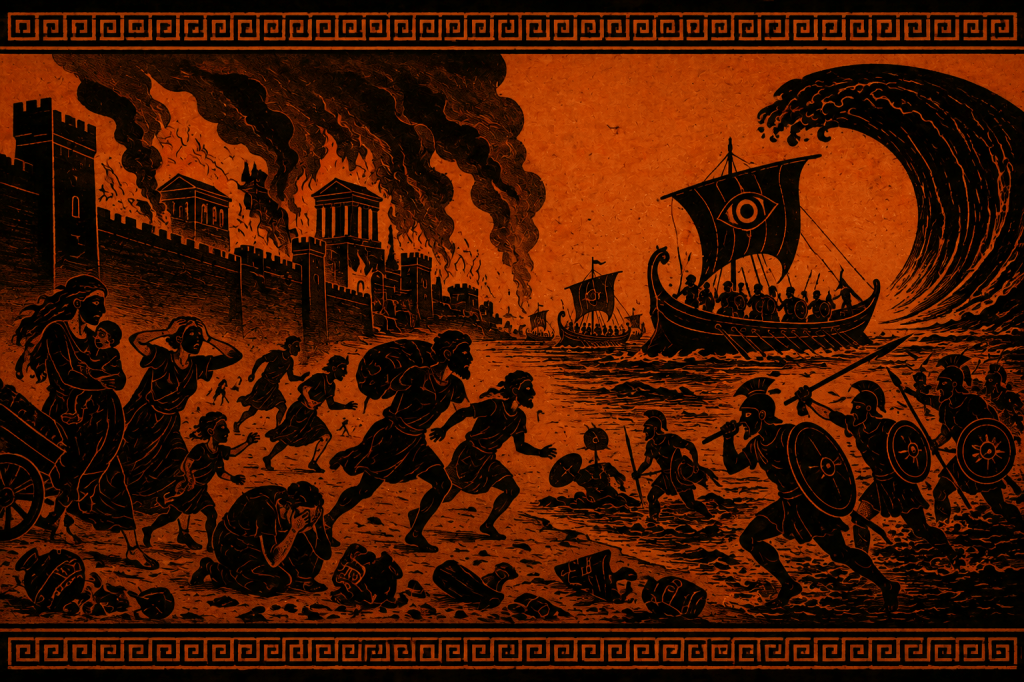
The reason this matters for the Odyssey is that based on available sources Eratosthenes, the Librarian of Alexandria, determined that Troy fell April 24, 1184 BCE. Coincidence? Maybe. Later, the German archeologist Heinrich Schliemann decided to look for evidence for the fictional Trojan War at the site where Troy was traditionally believed to be located and he found evidence of a city and extensive destruction right around 1200 BCE in what are termed Troy layers VI and VIIa. How very interesting. The obvious speculative jump a dramatist could make is that an army arriving in their “black ships” pillaging settlements in the eastern Mediterranean while prosecuting a decade long war could fit the description of “The Sea Peoples”. Homer’s Odyssey highlights the personal and social disruption driven by war and the violation of Xenia, and was written after the post Bronze Age collapse about a conflict that coincides with the historic dates of the aforementioned geopolitical landmark, so I can see the appeal of making the inferential leap of incorporating the actual history into the fictional text to support these themes.
Why I Think the Sea Peoples Subplot Works
Presenting Odysseus as suffering and recovering from emotional trauma due to the violence against the non-combatant citizens and shared gods of Troy, as well as the personal turmoil of the loss of all his men may feel like some “woke” interpretation of Homer, but I assure you it is not. Homer consistently describes Odysseus as a man who suffers more than any other. There’s even a flashback to how he got his name which is said to imply suffering. He breaks down in tears among the Phaeacians when he hears of the “glory” of his exploits. For some reason, when describing his journey home, he never seems to tell the same story twice. There are lots of reasons for him to conceal his history, could one of those reasons be to spare himself? If you were disappointed that our hero was made to appear vulnerable rather than endlessly confident, you’re asking for something Nolan can’t deliver while staying true to the text because Homer doesn’t give it to us either. The occasional mention of the phantom menace of The Sea Peoples which culminates in the reveal that they are not “the friends (or in this case: enemies) we made along the way”, but that “the call is coming from inside the house”, serves to underline the point that there are penalties to war even in victory; one of the primary themes of the text.
Making the Invisible Visible
The last “addition” worthy of mention isn’t really an addition, it’s more of how Christopher Nolan chose to emphasize something from the text in such a way that the audience could not overlook it. I think both The Iliad and The Odyssey can be seen as dramatic presentations of the destructive power of violating Xenia and the healing power of its practice. If you are familiar with the concept of “The Fear of The LORD” in the Old Testament, especially in the Book of Job, or the parables of The Sheep and The Goats or The Good Samaritan from the New Testament, then you have a feel for Homeric Xenia. Christopher Nolan chose to call it “Zeus’ Law” in the movie. Zeus was the patron deity of Xenia so this is a reasonable way of conveying the cultural concept without invoking Ancient Greek vocabulary.
The prefix “xen”, like xenophobia, implies it has to do with foreigners or strangers, and it is often presented as the “guest/ host relationship”, but it extends beyond just receiving visitors. I’ve written tens of thousands of words on this subject, so I’ll spare the reader a long diatribe. The idea of treating any visitor or stranger as an honored guest, and knowing that such behavior will be reciprocated has some obvious benefits for forming and maintaining relationships and creating a world in which it is more enjoyable to live. As I noted above, the concept is not unique to the Homeric world or Ancient Greece, but in the 21st century it is often an ancillary concept in how we discuss our moral lives, or even explicitly rejected. Our discourse often focuses on specific principles of good and evil, defined philosophical perspectives, or religiously inspired doctrines and dogmas, so a single word to describe a whole host of imperatives doesn’t fit with a modern conceptual framework. I’m of the view that tribalism (including its religious and intellectual manifestations) is the exact sort of thing Xenia is meant to break down, so to define it through a specific moral nomenclature that is designed to make distinctions kind of defeats the purpose. Xenia is a moral grammar that frames a host of thoughts and behaviors, not a specific vocabulary.
Anyway, the fact that the principle defies simple definition and direct translation makes it easy for the uninitiated to overlook it as the dominant moral benchmark of the story. If you’re unaware that Xenia involves the rituals of washing and anointing weary travelers, ensuring that physical comforts and needs are met, like eating and clothing before any “business” including the simple act of self-identification is to be transacted (Book 1: 120-200, Book 4: 20-75, Book 7:140-260), then you’ll miss out on how Homer uses these rituals as signals for a trustworthy person or properly functioning social order. If you don’t know that the host is obliged to receive a guest for as long as they need to stay, that the guest has a duty to not overstay their welcome, and the host shouldn’t detain their guest, then you won’t see that the violation of Xenia is a consistent red flag for a monster and social dysfunction. When you know these things the parallels between the monsters Odysseus encounters on his wanderings and the threat posed by the suitors on Ithaca become painfully obvious. Once you see it, you can’t help but observe how Telemachus leaving Ithaca and being welcomed into multiple homes where Xenia is properly practiced correlates with him developing confidence and conviction and returning to Ithaca as an adult ready to save his home and family. Such is the power Homer gives to the concept in his text that a modern audience could easily miss.
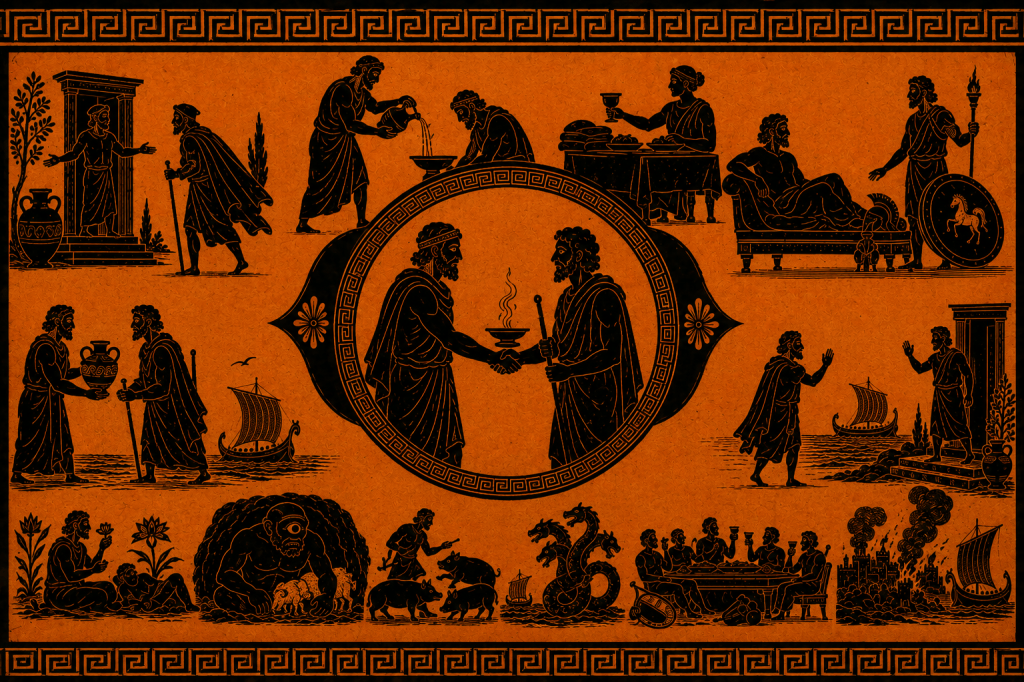
Including a didactic primer on Xenia isn’t really how Hollywood cinema works, but by having a named character mention “Zeus’ Law” in more scenes than I could count, Nolan hammers home that transgression of this law is a big deal and should draw the audience’s attention. If it felt like he was battering us with constant invocations of “Zeus’ Law”, it’s because he was, and it was almost certainly intentional; not as a crutch, but in an effort to make something obvious to a modern audience that would have been obvious to Homer’s original audience as well.
What He Stole From Us
Homer’s Odyssey has delighted audiences for 3000 years. The evidence suggests it’s pretty hard to screw it up badly enough that people won’t enjoy it, but if anyone could, it’s a major Hollywood studio. A lot of people have criticized the film for not being what they wanted or expected. They’re entitled to their opinions. I am on the side that a storyteller should be allowed to tell the story they want to tell. I think it’s funny that so many people complain about a lack of originality from Hollywood productions, but will also criticize any departure from canonical materials. This is to say that the critiques I’m about to offer, while textual, aren’t necessarily about departure from the original, but are about choices that I think harm the characters and the audience experience without any redeeming advantages.
The story of a wealthy family that nearly lost everything and the one son who had no choice but to try and save them…

One thing that bothered me was the lack of significant changes in Telemachus after his return to Ithaca. There is a very clear distinction between how Homer describes him before his trip to Pylos and Sparta, and his character after his return. Telemachus is openly mocked by the suitors before his trip, and he breaks down crying when others will not take action on his behalf. When he returns his appearance consistently impresses and intimidates those he meets including the suitors. His thinking and speech is described as “clear headed” and powerful. In the battle against the suitors he proves to be a capable ally fighting alongside his father. Christopher Nolan has Odysseus rescue Telemachus at Pylos and he spends almost the entirety of the fight against the suitors combatting a single foe. To be clear, missing out on Spider-Man slaughtering his enemies isn’t what bothers me, it is the lack of any evident change or growth in the character.
He may have his reasons for these changes. This may be an artifact of the decision to truncate what I think of as Telemachus’ “study abroad” program in Books 2-5. It is part voyage of self-discovery as search for father, it is also road trip/ wedding crashers college dude fun, and part manual of the proper practice of Xenia. While the attendant changes in the young man are prodigious and borderline miraculous, if Telemachus comes home unchanged it’s a huge digression without redeeming value to the plot. Telemachus doesn’t gather any intel that helps Odysseus, Penelope, or himself. These events were almost certainly removed from the film for the sake of time and to keep the primary narratives in focus. It’s a genuinely tall order for a director to not only signal the existence of Xenia and its role in society at large, but to then also make the case that it is a cornerstone of personal development. Demonstrating all that in a visual medium may have been a bridge too far. Perhaps the goal is to signal that a mature Telemachus, while capable of violence, is his own man, has learned from the loss and disruption and that the future will be different from the past? To be honest this change irks me, but like I said it may be stretching the boundaries of what a film can achieve. It doesn’t bother me the way his choices regarding Penelope do.
An Unpardonable Sin
Penelope was robbed of a character defining scene that denied her of agency and that redefined the terms of the showdown between Odysseus and the suitors, while also depriving the audience of a potentially great insight into her character and relationship with her husband. That’s me claiming a single decision imposed a pretty big penalty, let’s see if I can back it up.
It is my recollection that in the movie Telemachus declares at the feast that his mother will choose a suitor the next day, and later Penelope chooses the contest with the bow after her conversation with Odysseus in disguise. The discussion of the brooch and the fact that “the beggar” actually has the item provides Penelope with near certainty that Odysseus has returned and sets up the contest perfectly. It’s a satisfying way to close the loop from earlier in the film when the brooch was established as a kind of shibboleth. While the timing and the nature of the suitor trial/combat are the same in the movie as the poem, the path that Homer uses to get us there is different and in my opinion a bit more fun than what Christopher Nolan chose.
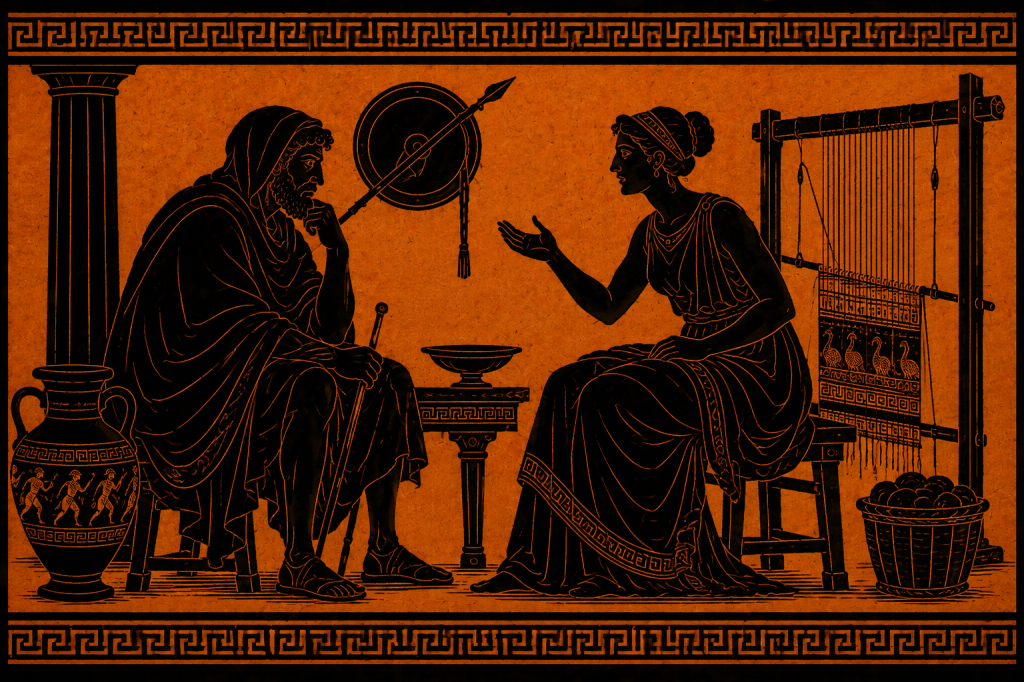
In Homer, when Odysseus returns in disguise he has an exchange with Penelope where she tells him of a recurring dream which he interprets as her husband returning home and killing all the suitors. The beggar’s claims are bolstered by the fact that he recalls the brooch for Penelope in conversation. He tells her Odysseus is definitely coming home and even gives her a time frame for his arrival: before the end of the next lunar cycle; about a month. Rather than being satisfied, she repeatedly pushes the timeline up before announcing that she has made her mind that she’ll choose a suitor the next day forcing the action on her initiative and terms. The “beggar” then assures her Odysseus will make the deadline. Homer leaves significant ambiguity about how much Penelope knows during this exchange. There’s no language of positive identification or confirmation from either party. Does she recognize her long lost husband, but withholds this from him because she is testing him? Is the exchange a display of her own cleverness? The man for whom she has been waiting for 20 years is present and asking for a bit of time, but she negotiates a significant departure from his plan, and also provides him with the means to exact his revenge by choosing a weapon only he can wield. Yet, even after he strings the bow and kills the suitors she conducts the olive tree bed post test. How much does she know, and when does she know it? The answers to these questions Homer leaves open to interpretation.
The way Penelope tells about her dream, Odysseus’ interpretation, and the back and forth about the timing of Odysseus’ arrival present a storyteller with a variety of options about how the exchange plays out in performance. Homer not only gives Penelope a voice in a narrative and culture in which Women’s voices are frequently stifled, but provides the substrate for a very powerful scene. It can display the anxiety, longing, recognition, relief, and intimacy of two people who are well suited for one another and are finally reunited, but who also find themselves in enormous peril. There is huge potential for comedy, romance, and tragedy swirling through the whole thing. The script was already written and two skilled actors like Matt Damon, and Anne Hathaway could certainly pull this off. It surprises me that a writer and director would fail to recognize this and choose to alter such a pivotal scene with so much potential. Not only does Nolan’s alteration do an injustice to Homer’s Penelope, but it robs him, his actors, and his audience of potential brilliance on the big screen. In my opinion this was the single worst decision Nolan made. Traduttore, traditore.
The Book is Always Better Than The Movie
All things considered, I enjoyed the film. As someone who loves this story I wanted something more and a little different, but I was impressed with what I got. It’s difficult for any director to match what a person imagines in their mind, so a level of disappointment is almost inevitable.
The challenge of translation from ancient text to modern film is not trivial and the competing demands of factions of the audience will inevitably put a filmmaker’s vision at odds with theirs. While Nolan’s rendering wasn’t a perfect literal visualization of Homer, I think that many of his choices served the audience well. I would have preferred a film in which we have the comic relief of Nestor, enjoy the effervescent and intelligent Nausicaa, and the road trip antics of Telemachus and Pisistratus, we can’t always get what we want. I do think it was a mistake to deny Penelope her greatest moment, but was it bad enough for me to throw a fit or put up whatever Elon Musk and Grok come up with? Absolutely not. I think there’s a non-zero chance this movie inspires people to read and think about Homer’s Odyssey and that’s probably a good thing. In the end it was a pretty good adaptation of a story I love. 7.5/10 will probably watch again.
 MaximumKungFu