Have you ever given much thought to the concept of hope? I haven’t. Not really. What is it exactly? Is it substantially different from wishful thinking or a simple expression of desire? It is often enumerated as a virtue, is it genuinely virtuous to develop? If so, why and how? Some folks are capable of learning these types of things without overthinking them. I am not. I’ve assigned myself the task of contemplating hope for the past month and, as part of my ongoing effort to actually publish more, I’m gonna share some of my thoughts.
I’m sure history and literature are filled with great explorations of hope, but there is one story that jumps to my mind when I consider hope. Pandora and her jar.
After man and the other beasts were created, Epimetheus, a son of the titans and a cousin of Zeus, was given the task of bestowing gifts: speed, strength, flight, sharp teeth and claws, protective furs and hides, all of these were distributed among the animals, but when Epimetheus got to man there was nothing left to give. It would be easy to blame poor Epimetheus for this oversight, but in all honesty anyone involved in the design process should have seen this coming, the guy’s name means “afterthought”, planning was never his forte. His brother Prometheus had a bit of a soft spot for humans and decided to give us something to help us survive, and decided to bring down fire from Mount Olympus and give it to mankind. The ability to make, and control fire, the ability to release vast quantities of energy granted humans power over much more than fire. It offered light in darkness, heat in time of cold, protection from fierce creatures, a method for rapidly clearing land for agriculture, a way of solidifying creations of clay into pottery and brick, and of course the means of preparing sweet sweet barbeque. In short it was an indispensable tool for remaking the world and manifesting our desires. Fire is also dangerous, it can injure and kill, and without careful tending can push beyond the bounds within which we desire to keep it and destroy all that we use it to create.
Upon witnessing the power the gift of fire granted to humans Zeus grew concerned. With such a powerful tool would humans neglect the gods? He certainly hoped they’d forever send the aroma of sizzling beef towards Olympus. More alarming still was the question: would they seek to overthrow the gods? Now that thought worried the great and powerful king of the heavens, wielder of the thunderbolt, for he had overthrown his father to gain the throne high up on Olympus, and his father, Kronos, before him had overthrown his grandfather Ouranos. Bottom line: Zeus was intimately familiar with the impulse and potential benefits of usurpation of authority. Zeus didn’t want to be seen to fear his own creations, but this was a troubling turn of events and something had to be done. An investigation was undertaken and Prometheus was identified as the light bringer, lucifer to you Latin speakers, and his punishment consisted of being chained to the side of Mount Olympus and having his liver eaten by an Eagle (sacred symbol of Zeus) everyday for eternity, or until Heracles showed up. Prometheus really should have seen this coming for his name means “forethought”.

Peter Paul Reubens “Prometheus Bound” 1611-1612
Nonetheless this punishment didn’t address the risk humans posed with their control of fire. Zeus thought hard, he consulted with his children and they formulated a plan, they’d make a kalon kakon, a good/evil, a beautiful/hideous thing. They made a woman. Pandora’s name has become synonymous with the source of uncontainable trouble or mischief, but that reputation, as we shall see, may not be fully warranted. She was beautifully made and dressed in a gown fit for a goddess, and the Olympians bestowed upon her gifts and curses: Athena gifted her abilities in needlework and weaving, Aphrodite gave her grace and the ability to provoke longing and desire, Hermes endowed her with a mind capable of deceit and guile, The Graces gave her necklaces of charm, beauty, goodwill, creativity, and fertility. There’s a lot to unpack here about what this story says about misogyny in ancient Greece and how these attitudes echo through the ages, but that’s not my goal here. They sent her to mankind with a dowry, a sealed jar, and instructions that it should never be opened. Well, we all know what happens when you hand someone a sealed container and tell them “whatever you do, don’t open it”. It’s like putting a tree bearing fruit that is delicious to the taste and very desirable in the middle of a garden and saying “whatever you do, don’t eat the fruit of that tree”. She opened the jar, or maybe it got knocked over in a moment of distraction, maybe someone goaded her into it? However it happened, when the jar was opened a bunch of stuff came flying out. The most common version of the story claims that all the evils we experience, hate, frustration, deceit, fear, pain, sorrow, and perhaps even death itself came streaming out of the jar. There is at least one version that says all the virtues we long for: love, kindness, trust, loyalty, and courage came pouring out instead. Regardless, everything that was once contained inside escaped and could never be reclaimed and controlled. Except for one. One lonely evil or good was caught on the lip of the jar and Pandora was able to put the lid back on and capture it. One virtue or vice that mankind can still fully possess. Elpis. Hope.
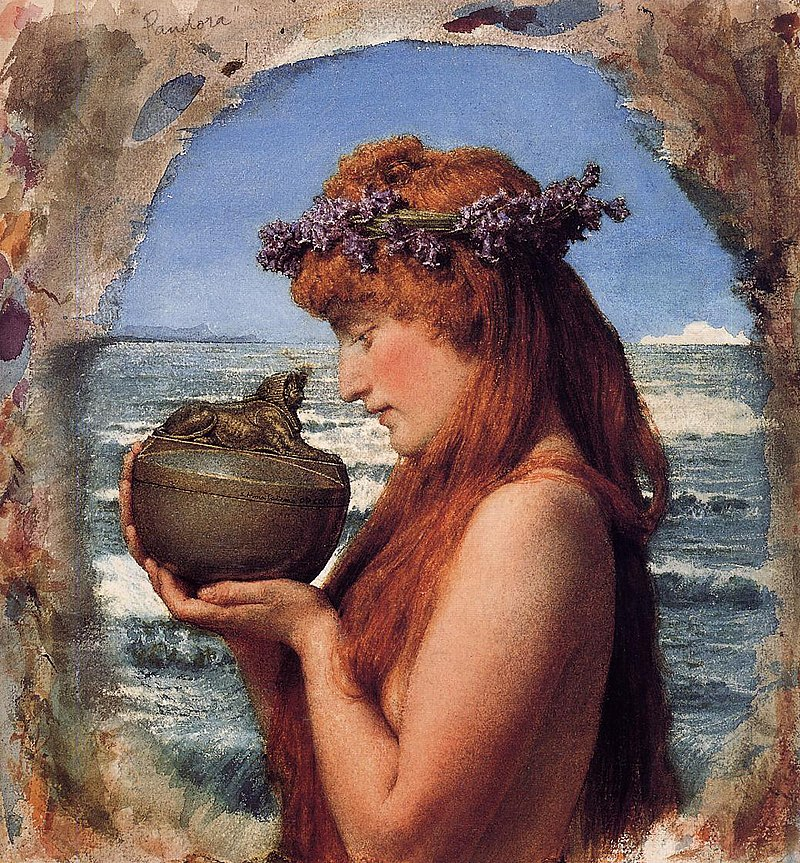
Lawrence Alma-Tadema “Pandora” 1881
When I consider the common usage of the word, the sense that comes to mind is that hope represents a desired outcome, that, when the available information is considered, is uncertain, perhaps very unlikely, but which is anticipated nonetheless. Thus, hope plays host to desire and uncertainty, two of the more vexing aspects of human life. It makes sense to me that the ability to successfully and productively manage these two challenges would definitely be a virtue worthy of cultivation. To that end, a closer examination of what we’re dealing with seems in order.
I’ll start with desire. I am firmly of the opinion that the ability to assess differences in various states of reality and develop a preference for one over the other is a good and useful thing. My dog clearly prefers one type of snack cracker over another, she will spit out bits of one variety if I try to sneak it into her food, and she will sit like a patient and dignified princess when she knows I have the other in my hand. Our ability to not only develop a preference, but to combine ideas, imagine something novel, develop a plan, share it, and execute it in cooperation with other humans as a manifestation of desire is one of the defining features of humanity. Like fire from Olympus, the tools we’ve developed in an effort to remake our existence based on our desires are impressive. The point is that our desires are integral parts of our individual and collective identities that prompt behaviors that can very literally change the world.
Of course, desire is not an unalloyed good. Conflict between desires and those who have them can be violent and deadly. The Buddha famously diagnosed the desire for things to be different from what they are as forming the root of human emotional suffering. I’m told the word tanha is literally translated as thirst, but can be thought of as greed, craving, grasping, and attachment. The path toward nirvana and release from this form of suffering requires either the elimination, relinquishing, circumscription, or some form of control over desires. The truth of this assessment is readily apparent in our lives. How many times have you felt disappointed, frustrated, or angry when you didn’t get what you wanted? Are you ever anxious about losing something you already have? A comfortable home, a loving companion, a prosperous occupation. Our desires may be modest, and focused on healthy, good things, but these facts do not change the reality that if/when we fail to obtain them, or when we inevitably lose them, that we also experience anguish. To desire is to welcome suffering into one’s life.
Perhaps this is where my ignorance of the Buddha’s teachings becomes obvious, or we simply part ways, but it seems to me that if the path to liberating oneself from emotional pain is to relinquish all desire, then denying a fundamental part of our humanity is included in the price and if so, then I’m not certain I find the argument for nirvana to be compelling. This talk of the inescapability of suffering may not feel hopeful, but I think to be fully conscious of the inevitability of the pain that accompanies desire, and to pursue something nonetheless fits the common conception of hope very well. The relevant insight is that genuine hope seeks neither to wholly avoid, nor to be completely delivered from pain or discomfort, but embraces the realities of our existence as part of the price we pay for a worthy desire.
Uncertainty generally has a negative connotation. To a degree the business of survival is the work of minimizing and mitigating uncertainty. Will there be enough grain to last through the winter? Is that rustling in bushes the wind, an edible beast of prey, or a predator hunting me? Is this rain falling from the sky a life giving shower from the heavens, or vengeance pouring down from on high which will wipe out my fields and destroy my home? The variety and intensity of human efforts to rid our lives of uncertainty are impressive. The construction of monuments and the uncountable rituals humans engage in to please the gods may strike us beautiful, confusing, comical, or even evil; especially when the rituals and gods being examined aren’t our own. In our personal lives we adopt habits and devote the majority of our waking hours to pursuing the means of subsistence in an effort to ensure we and those we love have enough. It is a sad and frustrating fact that we live on a planet that is constantly bathed in more energy and home to more useful matter than we could ever hope to need, and yet we continue to employ models and systems that depend on the assumptions of scarcity, but that’s a discussion for another day. About 400 years ago humans started to get serious about the business of understanding our world and began developing methods to minimize our biases and cognitive errors and called the output the scientific method. The results have been impressive, yet vast oceans of uncertainty persist. The bottom line is that uncertainty runs the gamut from the banal: what small disasters await me through that doorway into work? To the global: will the planet be habitable for my children and grandchildren? As such we find it uncomfortable and seek to eliminate it from many of our calculations through sometimes questionable methods, and with varying degrees of success.
On the other hand, uncertainty also represents opportunity. What lies outside the garden? On the other side of that river? Over those mountains? Across the sea? That girl actually laughed at my joke, I wonder if she “likes me” likes me? I wonder what happens if I try it this way instead? While there are definite advantages to eliminating uncertainty in some aspects of our lives, the fact remains that exploring the unknown has enormous potential as well. It is in wandering around in the terra incognita of our lives that we learn new things, develop new preferences, and have new ideas that perpetuate the human process of invention and creation discussed above.
An inconsequential, but illustrative example in my own life. I like to ski and finding great snow and interesting terrain and navigating them well brings me enormous pleasure. There is a constant tug of war in my brain during a day of skiing. Do I continue to hit my favorite haunts enjoying that which I already know and love, or do I try a new path? When I stray into parts unknown I’m prone to finding dead ends: cliffs, and walls of trees. These are sometimes memorable, but not always pleasant experiences. Sometimes the snow and terrain are simply inferior to where I’ve been, but every so often I stumble upon something new and spectacular and the sensation can only be described as revelatory. How did I not know about this sooner? Why was I wasting my time over there, when I could have been here? The snow isn’t always better on the other side, but sometimes it is. It is impossible to find a new, favorite, awesome gem of a route unless I leave what I know and embrace uncertainty. By necessity, every one of my favorite memories of skiing finds its roots in a decision to embrace uncertainty at some point in the past. It turns out there’s actually a mathematical solution to this specific problem, but life isn’t always so navigable. Despite the fact that I know this in my brain, I am often embarrassingly reticent to depart from what I know and love. “Don’t go chasing waterfalls, please stick to the rivers and the lakes that you’re used to…” In order to actually understand or experience something new, one must recognize and admit ignorance, and when we do, magnificent things can happen. To hope is to walk toward an open door of uncertainty and pursue our desires in the unknown.
The spark of creativity, the surge of desire, the thrill of adventure into the unknown, the time and effort demanded by these pursuits, the potential for failure and its consequences, and the inevitability of pain regardless of success or failure when desire is pursued. To hope is to attempt to juggle all of these facets of our behavior in a positive way. It is beautiful and frightening. It seeks for good, but dwells in the realm of potential disaster. Returning to the story of Pandora’s jar; it is my experience that folks tend to focus on Pandora’s creation and the implied role of women bringing evil into the world when they discuss the scheme Zeus perpetrated. This is understandable. Hesiod, our main source for the story, is very explicit in two different pieces, Theogony and Works and Days, regarding the intent of her creation. The tale of Pandora and her jar bear a more than passing resemblance to the story of Eve, the fruit of the tree of the knowledge of good and evil, and the expulsion from the Garden of Eden in Genesis. I’d like to think that 3,000 years later we can agree that women are not a curse sent by the gods, yet if we accept this fact does it unravel the myth? I don’t think so. Words change meaning over time, and cultures often develop language that describe unique aspects or insights of their people, but sometimes universal understandings of a concept hold for thousands of years despite the rise and fall of entire civilizations. The insights from this story suggest humans have long appreciated the dual nature of hope and its role in our lives. Hope was and remains the beautiful and ugly, the necessary evil, the kalon kakon that Zeus intended.
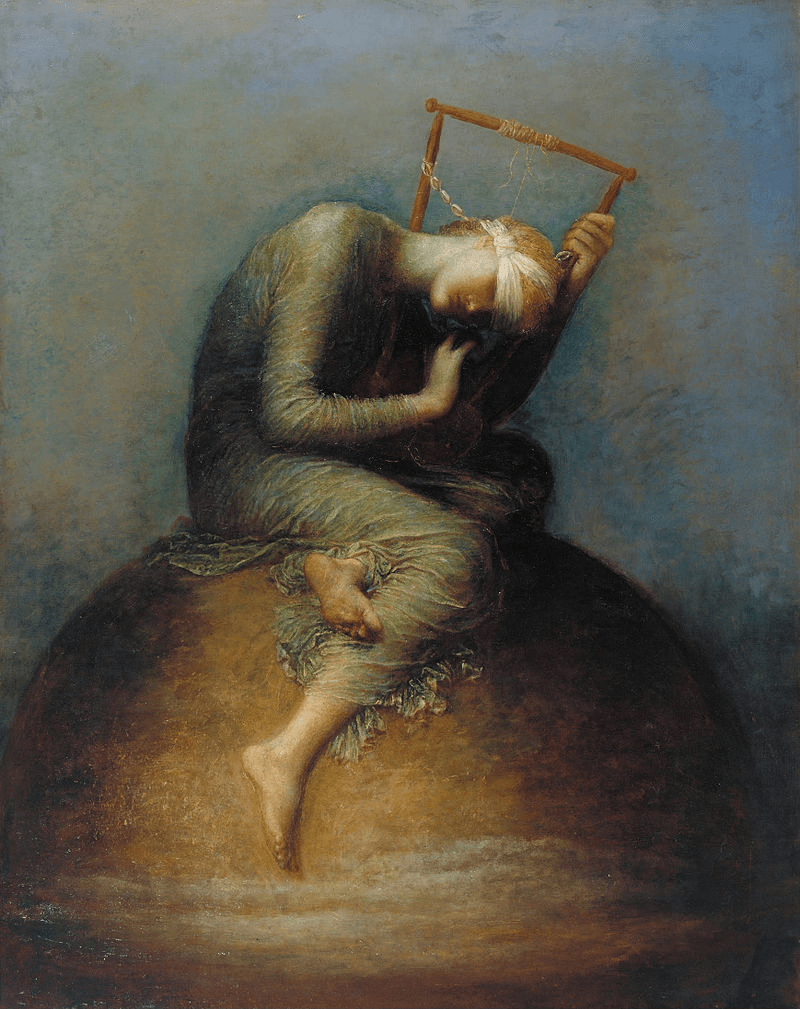
George Fredric Watts “Hope” 1886
Another way to approach a concept is to think about what it is not, what happens if we lose the balance between desire, inspiration, inevitable loss, failure, and pain? What happens when we strain too hard to eliminate uncertainty, or abandon all caution?
To desire without appreciation for the requisite effort or potential negative consequences is wishful thinking. It is my perception that hope is occasionally confused for this behavior, and I’ve been guilty of it myself, but I believe it is instructive to reconcile with the fact that wishful thinking is not hopeful, it is naive and potentially hazardous to ourselves and others.
To plunge into the unknown with reckless abandon despite knowing the potential for negative consequences is often used to evoke courage and valor. Young people are asked to read The Charge of The Light Brigade more than a century after it was written. The fact of the matter is that the charge was futile and wasn’t even the assault intended. There was a miscommunication in relaying the order. Not only did brave men lose their lives, but they did it for no appreciable benefit, and in pursuit of the wrong objective. Similarly, Pickett’s charge may or may not have been a tactical blunder, but it failed in its objective, and was done in defense of a reprehensible practice. I have clearly cherry-picked examples without much practical relevance in our daily lives, but I suspect we can all appreciate the fact that sometimes discretion is the better part of valor. The idea that walking a perilous path on blind faith is not a hopeful act is an interesting thing to write, but I think it’s true.
I suspect anyone who reads this will not struggle with these aforementioned hope adjacent behaviors. The more commonly recognized, and likely more pervasive forms of hopelessness are aggression, fearfulness, and grim determination.
To doggedly pursue desire without regard to the consequences has a mixed appreciation throughout history. We know it can lead to disaster, but we routinely honor those who persist despite negative personal or social consequences. We make movies about conquering heroes and almost always give the description of “The Great” to rulers who expand their territory with bloodshed. We often see disrupted personal lives as the price of greatness. Mozart, Beethoven, Newton, Einstein all had less than exemplary, or absent, personal relationships with spouses and family. In our own time consider the series The Last Dance about Michael Jordan and how his tremendous personal drive impacted and likely continues to impact his personal and professional relationships. Consider the contentious and increasingly violent nature of domestic politics. When everyone adopts a modified Barry Goldwater claim that extremism in defense of a position is no vice and moderation no virtue, then we encounter serious problems. I suspect I didn’t need to point out that unflinching aggression is not hopeful, but I’ve gone and done it anyway.
I recently re-read A Christmas Carol and as often happens when one re-reads a text, a passage stuck out to me more this time than in years past. Near the end of his travels with the Ghost of Christmas past Scrooge sees the end of his relationship with Belle.
“Another idol has displaced me; and if it can cheer and comfort you in time to come, as I would have tried to do, I have no just cause to grieve.”
“What Idol has displaced you?” he rejoined.
“A golden one.”
“This is the even-handed dealing of the world!” he said. “There is nothing on which it is so hard as poverty; and there is nothing it professes to condemn with such severity as the pursuit of wealth!”
“You fear the world too much,” she answered, gently. “All your other hopes have merged into the hope of being beyond the chance of its sordid reproach. I have seen your nobler aspirations fall off one by one, until the master-passion, Gain, engrosses you. Have I not?”
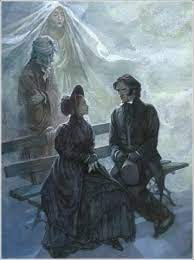
Charles Dickens’ condemnation of accumulation of wealth in the face of need is pretty explicit throughout the book, so featuring a conversation like this isn’t a surprise. Scrooge’s pursuit of wealth alienating the love of his life and driving him further away from the joy of Christmas is a wonderfully illustrative plot point in such a story. The thing I noted this year is Belle’s insight into Scrooge’s motivation for wealth accumulation. “You fear the world too much”. As she sees it Scrooge has not yet become greedy through unadulterated avarice. He knows how hard poverty can be and seeks to banish economic uncertainty from his life, “beyond the chance of its sordid approach”. His aims were relatable, at least in the beginning, but the methods used to address the desire have exacted a toll on him and his relationships. Fear has overrun hope.
This is something I can empathize with. For more than a decade I labored under not only the normal household debt of being a homeowner, but student loan debt equal in magnitude and with less favorable terms. I have a family and all the normal human needs that accompany that reality. I recognize the good fortune I enjoyed as a child, never knowing want and never experiencing a single day of uncertainty about the comforts we enjoyed as a family. Neither of my parents were ever involuntarily without work for their entire adult lives. Reasonable or not, I feel obliged to offer that same stability to my own family. Thus far, through a combination of hard work and massive quantities of good luck I’ve succeeded. I have a thriving practice where patients are willing to wait months to see me. My income is more than sufficient for our needs. We have no chronic illnesses or health concerns. We have set aside and made multiple provisions in case of rainy days. Yet I know, despite my decades of effort, all of that can be erased through forces beyond my control and it eats at me. I too fear the harsh realities of the world and what they can do to the life I’ve had the privilege to build for my family and me. Intellectually I accept that eventually, inevitably everyone I know and love including myself will suffer in some form and ultimately lose our lives. I cannot prevent all loss, but I still wish to forestall as much potential hardship as possible. I know that in uncertainty lies potential greatness, and yet I struggle and grasp for every bit of advantage and control I can in an effort to build a wall around that which I love. Is there a difference between the dutiful husband and father and the greedy miser? Is saving my excess wealth for a rainy day an act of responsibility, or a sign of hopelessness?
This past year two of my close friends’ wives have been diagnosed with cancer. I consider these women to be friends as well. On top of that, my cousin has also recently been diagnosed with cancer. I’ve lost loved ones before, some before what I felt was anything approaching an appropriate time. I have felt the uncertainty about the future, and the pain of loss disease can impose upon a family. It would be a lie to say they haven’t left their scars on my life and mind. Seeing the hopeful actions of these women and their families in the face of these challenging circumstances inspires me. I am privileged to associate with such brave and resilient people. It also makes me wonder, if I were faced with the same reality would I be equal to the task? Would I continue to grasp, or would I walk forward and reach out in hope?
Obviously this passage got to me. As Dickens points out so well, world weariness, and grim determination in the face of uncertainty may be pragmatic, but they are not hopeful and when all is said and done they are futile and potentially alienating and self-defeating. When you frame it like that, it’s really obvious Mark.
What then? Should I quit my job? Empty my accounts? Incur more debt? Reject all the habits and characteristics sharpened by the motto Be Prepared? These options are not appealing to me. I am on record as being pro-desire. The desires for self-preservation and security for self and kin group are pretty reasonable and compatible with the imperative of survival. So, it seems to me the relevant questions aren’t about the desire itself, but the motivation and methods. Consequently the useful questions are the ones we were taught in elementary school about writing any story: Who? What? When? Where? Why? and How? Honest answers to these questions, especially why and how, help us understand and assess the nature of our desires. We can realistically assess the probability of achieving our human desires, while also offering insights into the externalities and potential suffering associated with both success and failure. Hope is not fully characterized by the desire, nor the outcome, nor the uncertainty we face, it is the process by which we harness and navigate them. If true this would suggest not even the noblest of acts is inherently hopeful, as differences in motivation, and means of pursuit define an act as hopeful or hopeless.
In the early days of Christianity Paul of Tarsus kept up copious correspondence with converts and congregations he’d established around the Mediterranean world. It seems he felt the folks in Corinth had some misunderstandings about the utility and purpose of the various ways they manifested their conversion to the Christian message. He discussed the nature and purpose of things like prophesying about the future, speaking foreign and perhaps unknown languages, performing miraculous acts of faith, who held leadership roles, what he termed “spiritual gifts” in Chapters 12 and 13 of what we call The First Letter to the Corinthians (the language he uses in it indicates it was likely at least the second such letter 1 Cor 5:9). He argues that while each individual may display their belief in a unique way, the variety of gifts and types of people who made up the congregation were all necessary to make the whole, “Indeed, the body does not consist of one member but of many” (1 Cor 12:14 NRSV). He next argues that the acts of faith themselves are rendered meaningful not through their direct output, but by the intent with which they are employed and the benefit they have for the community, “If I speak in the tongues of humans and of angels but do not have love, I am a noisy gong or a clanging cymbal. And if I have prophetic powers and understand all mysteries and all knowledge and if I have all faith so as to remove mountains but do not have love, I am nothing. If I give away all my possessions and if I hand over my body so that I may boast but do not have love, I gain nothing.” (1 Cor 13:1-3 NRSV). Famously he follows this with a discussion of the characteristics of love, in some versions translated as charity, I believe the Greek word he uses is “agape” a divine form of love directed from the divine toward man, and ideally from man toward the divine, and also shared between humans. Relevant to our discussion he declares Love “hopes all things” (1 Cor 13:7 NRSV) and when our understanding expands and all is said and done only three virtues will remain: faith, hope, and love. (1 Cor 13:13 NRSV). I don’t intend to turn this into a lengthy theological discussion. My intent on citing this discussion is to note that Paul is teaching the idea that an act is not inherently good, or hopeful, or loving. An act is imbued with meaning by our intent, how we engage the decision making process, and how it fits into the greater context of our lives and relationships.
A person can certainly live providently in a hopeful fashion. Is she motivated by a desire for peace, fulfillment and joy with her friends and family, or does he want wealth, health, and security from the world? The wealthiest people in the world seem to always want more, yet there are many who are comfortable and at peace, appreciative of their modest means. There will never be enough to fill the voids of desire and uncertainty. Desire and uncertainty may indeed be the roots of inescapable suffering, but better understanding and refining our desires is a way of expressing a hope that the pain we endure may serve a worthwhile purpose. I agree with Paul that our most hopeful acts will be found serving needs greater than our own immediate cravings and anxieties. When we are motivated by love for our family, friends, community and fellow man we can embrace potential failure and uncertainty and act in hope. To me that is inspiring and worth cultivating and celebrating.

Every once in a while someone will point out that it is unlikely Jesus of Nazareth was born on the 25th of December in the year 1 A.D. They’ll also point out that the Romans already had 2 festivals in late December: Saturnalia and The Feast of Sol Invictus, and that church fathers may have been looking to slot in an important placeholder event as the empire converted to Christianity. That may or may not be true. The far more interesting thing to consider is just how many cultures around the world choose the winter solstice as a time to celebrate. Humans consistently choose the shortest, darkest days to hold extended feasts like Saturnalia, Yule, Yalda, Soyal, Inti Raymi, Dong Zhi, and The Twelve Days of Christmas. We also generally mark the beginning of our years, both solar and lunar, in these dark days. Why do we not celebrate like the ancient Mesopotamians and mark the new year, Akitu, with the return of spring and planting of the year’s crops? Why do we not celebrate the new year around the autumn harvest like Rosh Hashanah? I think the idea of celebrating in the face of darkness and uncertainty about the future year is a wonderful idea and expression of hope. Christians certainly have a very specific hope in mind when celebrating Christmas and as such it makes sense to celebrate the birth of light into a darkness both literally and figuratively. For the non-Christian this time of year can, and in my opinion should, still be a celebration of our individual and collective appreciation for the past year and hope for the future.
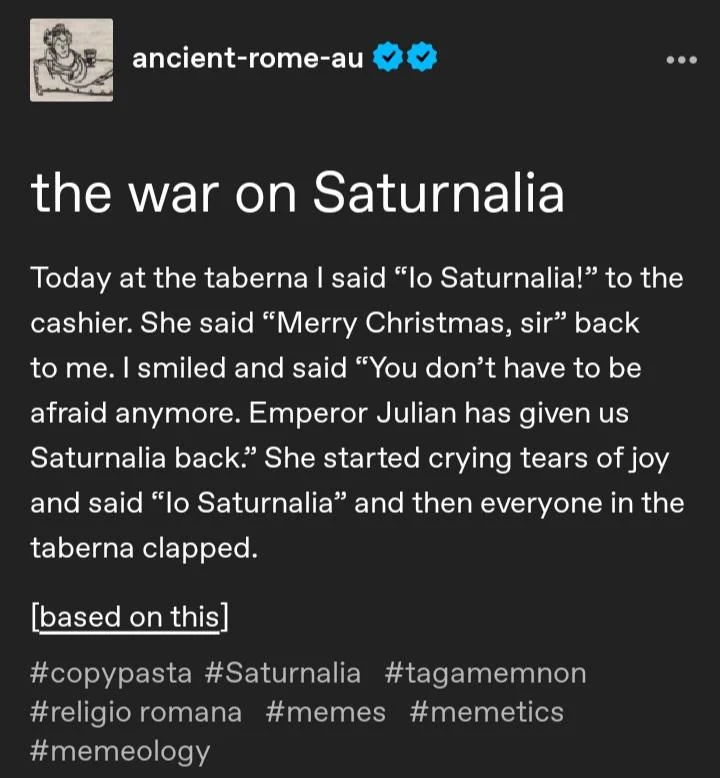
With that in mind Merry Christmas, Happy New Year, io Saturnalia, may your Yuletide be gay, and may there be a Festivus for the rest of us!
 MaximumKungFu