There’s a case to be made that I am a pretentious weirdo for constantly extolling the beauty and greatness of texts that are thousands of years old. Honestly, where’s the lie? I genuinely like the translations I discuss, but it would be disingenuous to claim that the historic esteem in which they are held wasn’t a major contributor to my motivation to read them in the first place. Perhaps this is a case where the exception proves the rule, but I found the Aeneid to be uninspiring and I don’t know that it’s worth the reader’s effort to explore. Before I get to my list of grievances, I will offer a brief summary and praise a few of its strengths.
The Rundown
The Aeneid tells the story of a group of Trojan refugees whose descendants will eventually found Rome. Our protagonist on the journey is Aeneas, a close relative (1st cousin once removed – his father was Priam’s cousin) of the Trojan royal family. He has a few cameos in The Iliad. In what is arguably a bit of foreshadowing, on both occasions he is in imminent danger and is saved by divine intervention. He is the son of an unlikely pairing of a mortal father, Anchises, and the immortal goddess Aphrodite, referred to by her Roman name Venus in this story. The narrative uses an extended flashback to relay key points of the story. Just like The Odyssey our hero relays his tale to a beautiful woman in whose kingdom he seeks refuge after a mishap at sea, but I’ll keep my summary in chronological order.
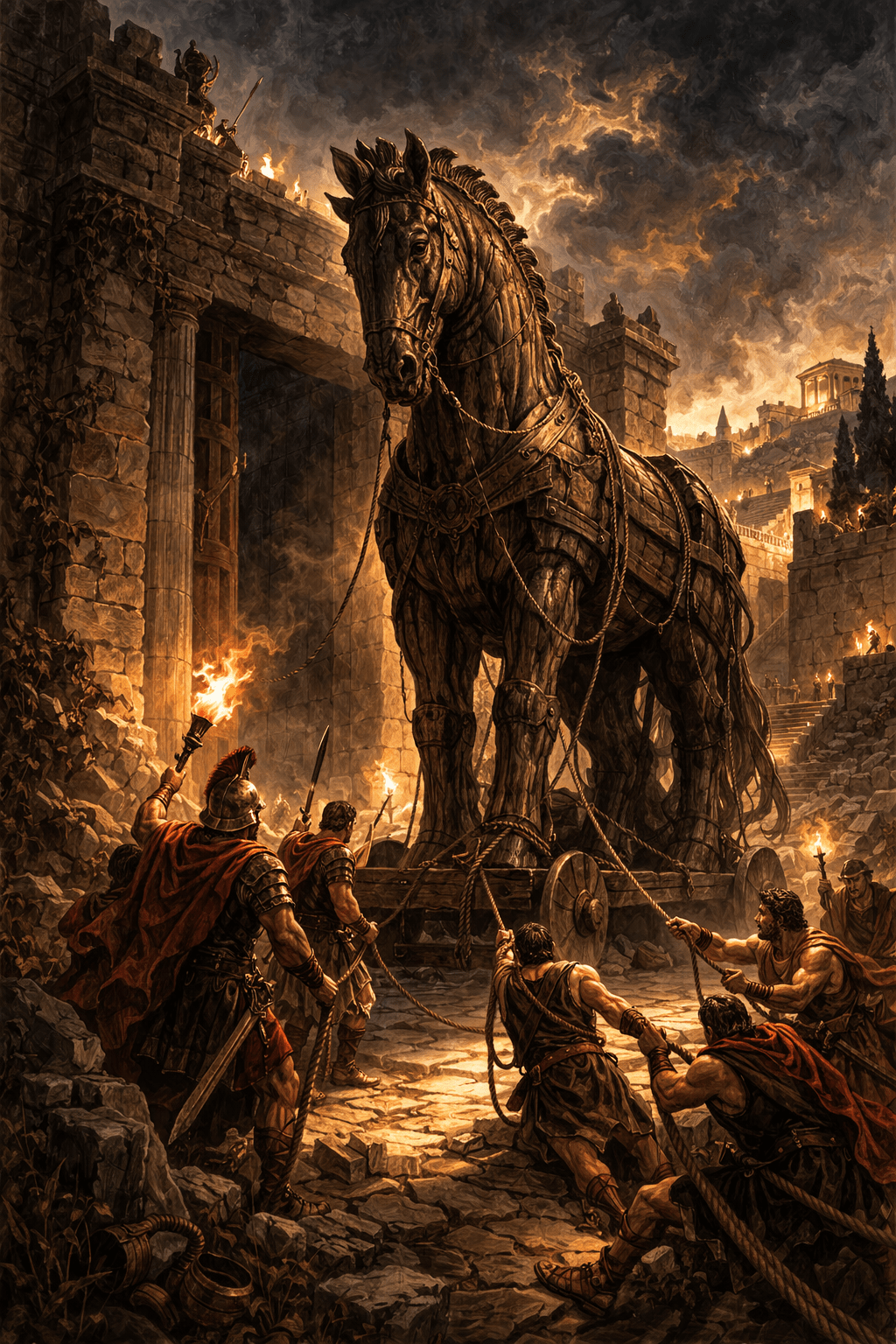
After 10 years of living on the beach the Greeks decide to try one last gambit to defeat the Trojans and hatch the famous Operation Trojan Horse. Aeneas tells of the back and forth among the Trojans about whether or not they should bring the horse into the city walls, and the logic which drives the fateful decision which in retrospect appears completely insane. After the Greeks emerge from the horse and open up the city gates to their comrades outside the walls, the sack of Troy begins. There’s a vivid action sequence of Aeneas deciding to gather his friends and family and flee rather than die in defense of a kingdom whose king has just been slaughtered before his eyes. He and his band seek a new home based on guidance received from not one, but two different oracles of Apollo. As always, there is a bit of difficulty deciding exactly what the oracles mean, then there’s a crucial lapse of memory on the part of Aeneas’ father that leads to a dead end, as well as the business of potential neighbors not wanting immigrants in their settled territory, so the group is forced to abandon several attempts at finding a new home. A story in which the hero is the head of a caravan of immigrants makes for interesting reading in 2026. Along the way they encounter some of the same perils and sea monsters as Odysseus, unlike Odysseus Aeneas doesn’t lose all of his men.
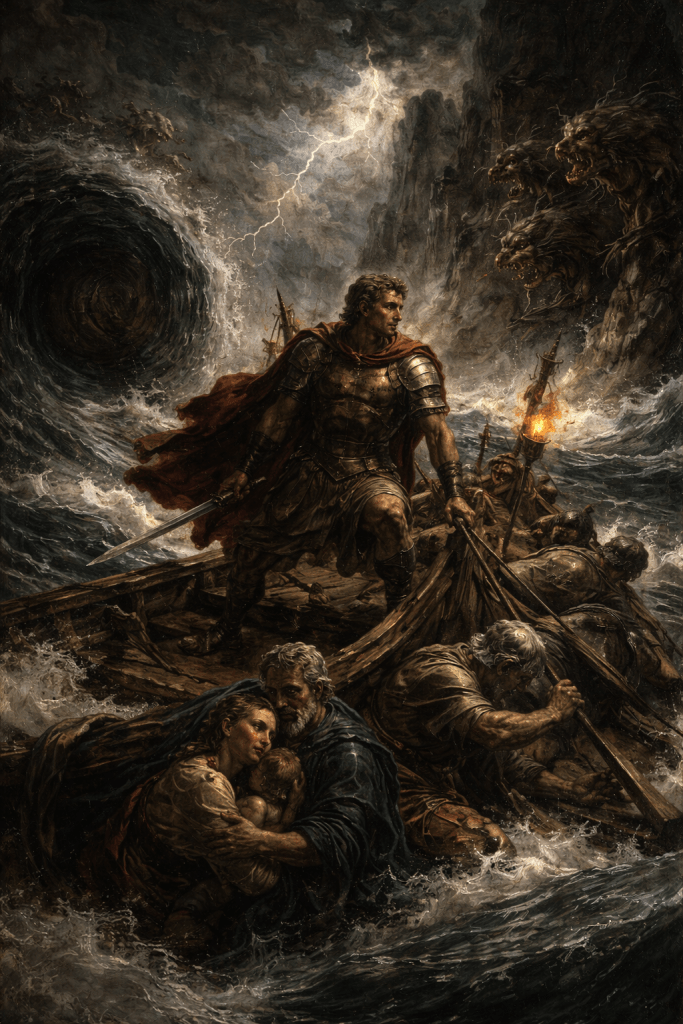
Good on ya bro. Eventually the group makes its way in the direction of the correct destination: Italy. On the final leg of their journey they’re blown off course and end up on the shores of Carthage.
There Aeneas meets Queen Dido. She has a similar story. Originally from Tyre, her brother killed her husband so that he could rule the city, so she and a group of followers fled and founded Carthage. More asylum seekers. They’ve built a thriving port and Dido has maintained her independence and authority by denying suitors from surrounding kingdoms. Venus arranges for Dido to fall madly in love with her special boy Aeneas to make sure he and his crew are welcomed. Shortly thereafter Aeneas and Dido consummate their relationship while seeking shelter in a cave during a rainstorm and they start “going steady”. After about a year at Carthage, Jupiter decides to remind Aeneas about his fate to found a city in Italy. Aeneas’ departure provokes a mixture of disbelief, disappointment, frustration, and intense feelings of betrayal and anger from Dido. As Aeneas and his men set sail she burns herself to death and curses Aeneas’ future city to be tormented by her own which conveniently accounts for the Punic Wars.
Aeneas and his men make a brief pit stop on Sicily to honor the one year anniversary of the death of Aeneas’ father and hold memorial games. There’s a mutiny against further travel and Aeneas decides to proceed to Italy with only the most capable warriors. However, before they can leave he descends to the underworld where he briefly communes with his father.
When the crew finally arrives on Italian shores they form an alliance with a king named Latinus, aka the Latins. He offers his daughter Lavinia to Aeneas in marriage. For a moment it appears they’ve reached their journey’s end. Alas, Juno awakens distrust for this outsider in Queen Amata, Lavinia’s mother. One of Lavinia’s rejected suitors, Turnus, leads a rebellion against Latinus at the urging of the Queen. The whole thing escalates further when a Trojan refugee accidentally kills a local celebrity deer (Bye Bye Lil’ Sebastian). This sequence precipitates a regional conflict in which Turnus and several other local kingdoms end up allied with the Latins against the men of Troy who find a sympathetic audience in the Arcadian kingdom. The whole thing seems blown way out of proportion to me, and it could be that this war represents inflammation of other latent regional conflicts, but Virgil doesn’t give us substantial evidence to suppose as much. A series of terrible battles ensues and ultimately Aeneas and his army besiege Latinus. The story abruptly ends after Aeneas kills Turnus in single combat. The narrative is incomplete as Virgil died during its composition. Hopefully with that outline when I discuss specific moments of the poem you’ll have a feel for why it matters even if you haven’t read it.
The Good
While I didn’t love the Aeneid as a whole I did like parts of the experience. First, I’m told the Latin verse is beautiful, and I believe it because some of the translated lines are also vivid and poetic.
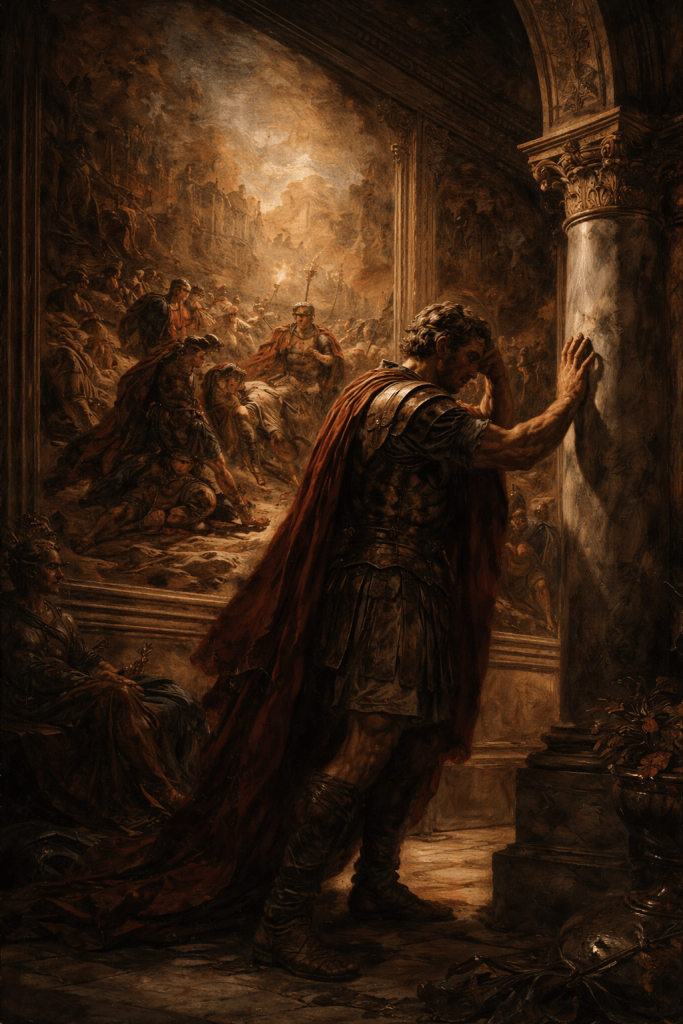
When he arrives at Carthage, Aeneas sees a series of murals depicting the events of the Trojan war and is overcome with emotion, “he fed his soul on empty pictures, sighing, weeping, his face a flood of tears as he scanned the murals of the Trojan War”.
During the description of their wanderings and failed attempts at founding a new Troy, Aeneas describes the time like this, “Time went by. The sun rolled through the year’s great circle, and winter roughened the sea with icy winds”.
After Dido and Aeneas begin their love affair and partnership ruling Carthage, there is disruption of the social and political balance that is described as being driven by the goddess Rumor, “Rumor, the swiftest of evils. She thrives on speed and gains power as she goes. Small and timid at first, she grows quickly, and though her feet touch the ground her head is hidden in the clouds”. The personification of the gods occasionally hits just right.
At the onset of war the Latins, “beat their plowshares into swords”. Nothing underlines the disruption and evils of war like the inversion of that allusion.
My favorite moment is a humorous one in which Virgil describes Aeneas and the boys inventing pizza. They’ve spent years crisscrossing the Mediterranean, after the catastrophic end of Aeneas’ and Dido’s relationship, and a brief trip to the realm of the dead that clearly inspires Dante’s Divine Comedy, a hardy contingent of the surviving Trojans finally arrive on the shores of Italy.
Aeneas and his captains, and fair Iülus (Aeneas’ son), reclined in the shade of a towering tree and spread out a feast on the grass below, heaping fruits of the field—Jupiter himself gave them this notion—on wheat flatbread to supplement the meal. When they had eaten everything else, their appetites drove them to break the scored, fateful rounds into sections and sink their teeth into the crusty bread. (7:130-140 Lombardo)
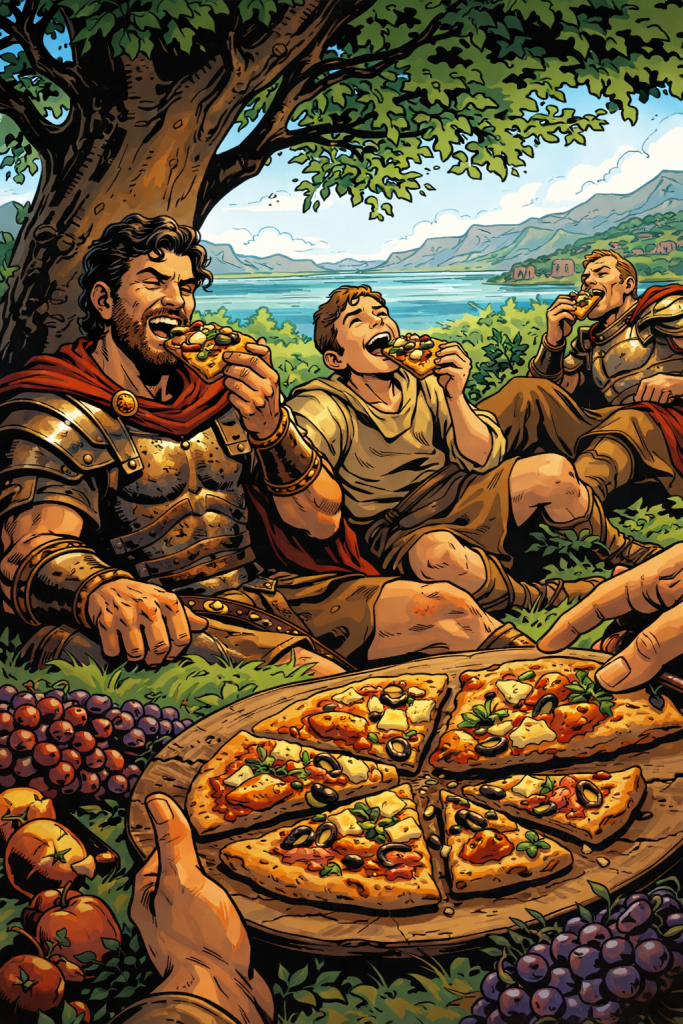
Dudes with the munchies eating sliced flatbread heaped with toppings. The Ninja Turtles would be proud. This is more suggestive of bruschetta, but I’m. It gonna let facts get in the way of a good time.
In addition to the beautiful language, The Aeneid is also a “tighter” story. It’s significantly shorter than either the Iliad or Odyssey, yet it is a “greatest hits” of Homer’s tropes and plots. It extends the mythical foundations of Rome from the traditional date of 753 BCE by about 500 years to a previously forgotten time well before the fratricidal story of Romulus and Remus, and connects the newly established Julio/Claudian Imperial dynasty to a Trojan demigod in just 12 books (about half the length of either of Homer’s works). That’s a substantial revisionist “glow-up” if you ask me.
It is the primary source for modern readers for what is arguably the most famous story about the Trojan War: the Trojan Horse. Virgil delivers a vivid picture of the fall of the city: an action filled sequence of flaming destruction, smoke-filled chaos, and wanton bloodshed. There’s a sea voyage similar to The Odyssey including a run-in with the Cyclopes.
There is a “star-crossed” love affair between Aeneas and Dido whose precipitous collapse accounts for the “future” rivalry between Carthage and Rome foreshadowed by her dying prayer, “This is what I pray for. these last words I pour out with my blood. And you, my Tyrians, must persecute his line throughout the generations—this your tribute to Dido’s ashes. May treaties never unite these nations, may no love ever be lost between them. And from my bones may some avenger rise up to harry the Trojans with fire and sword, now and whenever we have the power. May coast oppose coast, waves batter waves, arms clash with arms, may they be ever at war, they themselves and their children forever.”
Like the Iliad there are plenty of scenes of brutal combat spurred on by divine machinations where both heroes and villains fall to augment another’s glory.
The narrative is brisk compared to Homer; Aeneas is constantly propelled forward toward his destiny of laying the foundations of Rome with relatively few interludes or digressions. I suspect this is because The Aeneid was conceived as a written text which sets it apart from the other epics I’ve discussed which began their existences in the oral tradition. This means that Virgil could work and re-work the text to suit his agenda with linguistic economy rather than transcribing an inherited corpus of interconnected traditional tales. It reads much more like a modern novel and is therefore probably more enjoyable for a reader who is unfamiliar with ancient styles and conventions. What’s not to like?
The Bad
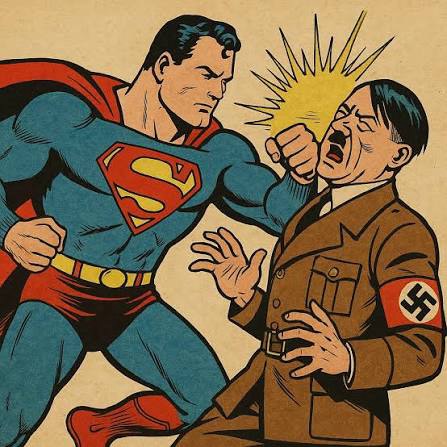
Single authorship has potential benefits for narrative construction, and it also offers clarity of context, purpose, theme, and message. These are also generally good things for reader comprehension, but in this case may detract from enjoyment. If one accepts that other epics (especially The Iliad and Odyssey) began in the oral tradition and were expanded and refined over generations, attributing a single specific context or intent to the final product is fraught with uncertainty. Yes, Homer (who ever that was) is attributed single authorship of The Iliad and Odyssey; someone had to sit down and write the versions we have for the first time (Homer is as good a name as any other for these purposes), so editorial choices were almost certainly made about content and word selection to convey desired tone, themes, and message, but even granting this reality we can question how much of the final product reflects the circumstances, point of view, and intent of the “author”, and how much was accrued over generations? It is impossible to know. My experience with Homer leads me to believe that The Iliad and Odyssey are first and foremost entertaining tales. The political, moral, or philosophical content is secondary or perhaps an unintentional byproduct. It seems to me that the ideas to which scholars and readers may gravitate more likely represent prevailing beliefs and customs of the age than an authorial agenda. Homer’s tales exemplify the virtues of Xenia not because Homer wanted to compose a morality tale and showcase a virtue, but because that is how the world was supposed to work and a hero or story that doesn’t exercise culturally relevant virtues would not land with the original audience. Modern American heroic epics generally assume the virtues of independence, liberty, and justice because a hero espousing wildly different ideals wouldn’t sell as well. A hero proclaiming “Truth, Justice and The American Way” has sold a lot of comic books and movie tickets not because of Superman’s virtue, but because he does so while punching NAZIs, flying, and making time run in reverse.
In the case of The Aeneid we know who Virgil was, when he lived, and how he was connected to the Imperial power structure, so we are in a much better position to speculate on how his personal, moral, and political perspectives may have influenced or be portrayed in the work.
Publius Vergilius Maro (Virgil) was born in 70 BCE in Cisalpine Gaul (northern Italy) in or near the city of Mantua. He was formally educated and eventually made his way to Rome where he was well acquainted with famous literary figures of his day like Horus and Varius Rufus. His major patron was Gaius Maecenas. Maecenas was a political advisor to Octavian, Julius Caesar’s grand-nephew and heir, who most know as Augustus. Historians traditionally identify him as Octavian before the battle of Actium where his forces defeated Marc Antony and Cleopatra, and as Augustus thereafter. Basically Octavian = Augustus = “Caesar Augustus”, yes THAT Caesar Augustus from Luke chapter 2. Although Augustus often eschewed the title emperor in favor of maintaining the fiction of continuing the Roman Republic styling himself merely as “princeps”, the first of all citizens; with the benefit of hindsight we can confidently and accurately describe him as Emperor of Rome. The point being that Virgil had a clear relationship to the forces that overthrew the Republic and launched the Empire.
Regardless of how one feels about this transition, or perhaps even how Virgil felt about it, we know who was “writing the checks” to support his professional endeavors and it is reasonable to assume his work aligns with support of the Emperor and his agenda. Virgil is reported to have personally performed passages from the poem for the Emperor during the composition process. The Aeneid is incomplete and Virgil asked for it to be burned upon his death, but Augustus ordered it published. While some have tried to read The Aeneid as being subversive to the emperor, Augustus and most readers since, have seen it as favoring the regime. Any subtextual meaning is fighting a major uphill battle when there are lines like these.
From this resplendent line shall be born Trojan Caesar, who will extend his Empire to the Ocean and his glory to the stars, A Julian in the lineage of great Iulus…Then war shall be no more, and the ages will grow mild. (1:342-346, 351 Lombardo)
But that he should be the one to rule Italy, a land pregnant with empire and clamorous for war, and produce a race from Teucer’s high blood, and bring all the world beneath the rule of law. (4:259-262 Lombardo)
This is the way to the stars, noble young hero, born of the gods and with gods to come in your line. All destined wars will justly subside under the descendants of Assaracus. Your fate is greater than Troy’s. (9:756-759 Lombardo)
There are other examples, but you get the point. Virgil isn’t lamenting the loss of Republican government or Senatorial checks and balances; he’s in the business of celebrating stability through military conquest and individual greatness (hallmarks of all heroic epic) in line with the burgeoning cult of the emperor as a living god. This isn’t surprising coming from someone who circulates in the highest rungs of imperial power. It also isn’t necessarily a bad thing. It’s just how it is. However, I don’t think we should ignore these facts when reading The Aeneid. Virgil made sure we didn’t. Consequently it is appropriate to interpret the major themes of the text through this lens as well, and when I do I find the poem wanting.
Virgil presents Aeneas as the father of the Roman people and a paragon of “Roman virtues”. This portrayal fits nicely within Augustus’ moral retrenchment efforts characterized by the use of censorship authority and legal reforms after his rise to emperor. The cardinal virtue used to describe Aeneas is Pietas. It is the root for our word piety and the poem makes clear the dutiful attitudes and behaviors that it inspires extend beyond reverence for the gods and encompasses familial obligations and duty to community as well. I don’t think anyone could read the Aeneid and credibly argue that Aeneas doesn’t check a lot of boxes in these areas.
During the sack of Troy, Hector comes to Aeneas in a dream and says, “Troy commends to you the gods of the city. Accept them as companions of your destiny and seek for them the great walls you will found after you have wandered across the sea.” Like the good polytheist he is, Aeneas awakes and literally gathers up his household gods and carries them with him across the seas to become the Roman Gods. This fact is mentioned anytime the setting of the story changes.
When he arrives on the shores of Italy, after he and boys invent pizza, he immediately offers up prayers, “Aeneas spoke and wreathed his temples with leaves. Then he prayed to the place’s indwelling spirit, and to Earth, first of the gods, and to nymphs and rivers yet unknown; then to Night and Night’s wheeling constellations, To Jove of Ida and the Phrygian Mother, and his two parents, one in heaven, one in Erebus below.”
Aenea’s transport of Trojan gods offers a convenient explanation for the wholesale adoption of the Greek pantheon into Roman myth, but there are some Roman deities who lack Greek cognates and Virgil uses Aeneas’ initial encounter with the native Latins to introduce some of these gods, “Their ancestors’ images, carved in cedar, lined the walls: aged Saturn, Italus, and father Sabinus, who first planted the vine, pictured holding his long pruning hook, and double-faced Janus—all of them standing in the vestibule.”
Later on, with war brewing between the Trojans and the Latins, Aeneas seeks allies among other people and he forms a bond with Evander, the king of the Arcadians. They meet just before an important annual festival, and of course pious Aeneas momentarily sets aside his need to prepare for war to join the feast. Evander also presents a portrait of piety as he welcomes Aeneas, “since you are here as friends, Celebrate with us this annual rite, Which may not be deferred, and join our feast…These solemn rites, this traditional feast, this altar sacred to a power divine do not come to us from some empty superstition, ignoring the gods of old. No, my Trojan guest, rescued from savage dangers, we observe this annual rite in memory of our deliverance.”
After the day of rituals celebrating Hercules’ defeat of a local monster, Evander leads Aeneas on a pilgrimage around many sites important to Arcadian history and worship. It just so happens that many of these places will be central features of Rome, “As Evander finished he pointed out the altar and what Romans call the Carmental Gate… Next he showed a vast grove, which Romulus later would make a refuge; showed him too the Lupercal, a cave beneath a cold cliffside… Talking in this way they came to Evander’s humble dwelling and saw cattle milling about in the Roman Forum and lowing in the fashionable Keels.” During this tour of past and future history they pass a hill, “bristling with thickets”, and we’re told, “Even then the religious power of this place awed the country folk; even then they shuddered at the woods and stones. ‘This grove,’ Evander cried, ‘this tree-crowned hill, shelters a god, although which god it is we do not know’”. Virgil’s Roman audience knows the answer. Virgil tells us this wild and powerful place is the Capitoline Hill, the future home of the Temple of Jupiter. Aeneas and his companions honor gods of past, present and future.
Aeneas goes to great lengths to honor and foster familial legacy. During the Sack of Troy, Aeneas literally and symbolically carries his heritage on his back as he gives an epic piggyback ride through the flaming chaos to his father Anchises. Books 5 and 6 of The Aeneid describe a journey from Carthage to Sicily to have funerary games to honor the first anniversary of Achises’ death. These games are followed by a trip to the underworld for him to commune with his dead father who died during the Mediterranean migration. The funeral games are an inferior version of Iliad Book 23, but the trip to the underworld was one of my favorite parts of the story. It had great Goonies, Indiana Jones energy. There’s a reason Dante reworked it a millennium and a half later.
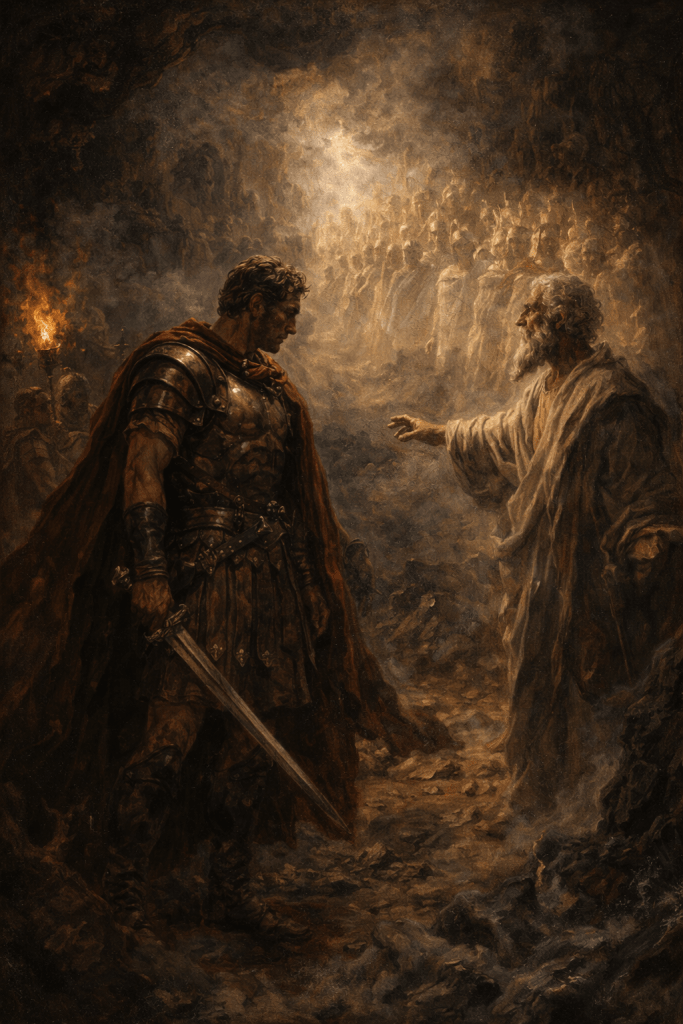
The power of Aeneas’s commitment to his father is underlined by the fact that these events immediately follow Aeneas’ departure from his study abroad year at Carthage, the termination of his relationship with Dido, and her subsequent suicide. When Aeneas arrives back on Sicily he gathers his men and opens the funeral games thus, “Great sons of Dardanus, my people born of the gods’ high race, a year of circling moons has passed since we laid in the earth the last remains of my divine father and hallowed his altars. And now, by my count, the day has come that I shall always keep as a day of mourning— as you willed, O Gods—and a day of honor. Were I spending this day as an exile in the Gaetulian Syrtes, or the sea of Argos, or in Mycenae itself, still I would fulfill my yearly vow with solemn rites and pile the altars high with offerings. But now we stand near my father’s bones, not without, I think, the will of heaven, carried here to a safe and friendly haven. Then let us all celebrate this day with joy, pray for favorable winds, and ask Anchises for his blessing. May I offer these rites year by year when I found my city, in temples consecrated to his memory.” Aeneas’ decree matches nicely with the traditional annual Roman festival of Parentalia (Feb 13-21) celebrating parents and ancestors. Another convenient ret-con by Virgil.
The Ugly
From examples like these and others Virgil gives Aeneas impeccable credentials as a pious pater familas to the Roman People. This feels like the Cherry Tree Chopping George Washington “I Cannot tell a lie” vein of hagiography. It is inspiring, but can also render the hero one dimensional and unrelatable for us mere mortals, but I think there’s more to critique in his case. The tense exchange between Aeneas and Dido when she confronts him about his intention to depart Carthage casts a shadow over Aeneas’ piety and other virtues.
Dido: Is it me? Is it me you are fleeing? By these tears, I beg you, by your right hand, which is all I have left, by our wedding vows, still so fresh—if I have ever done anything to deserve your thanks, if there is anything in me that you found sweet, pity a house destined to fall, and if there is still room for prayers, I beg you, please change your mind. It is because of you the Libyan warlords hate me and my own Tyrians abhor me. Because of you that my honor has been snuffed out, the good name I once had, my only hope to ascend to the stars. To what death do you leave me, dear guest (The only name I can call the man I once called husband)? For what should I wait? For my brother Pygmalion to destroy my city, for Gaetulian Iarbas to lead me off to captivity? If you had at least left me with child before deserting me, if only a baby Aeneas were playing in my hall to help me remember you, I wouldn’t feel so completely used and abandoned.
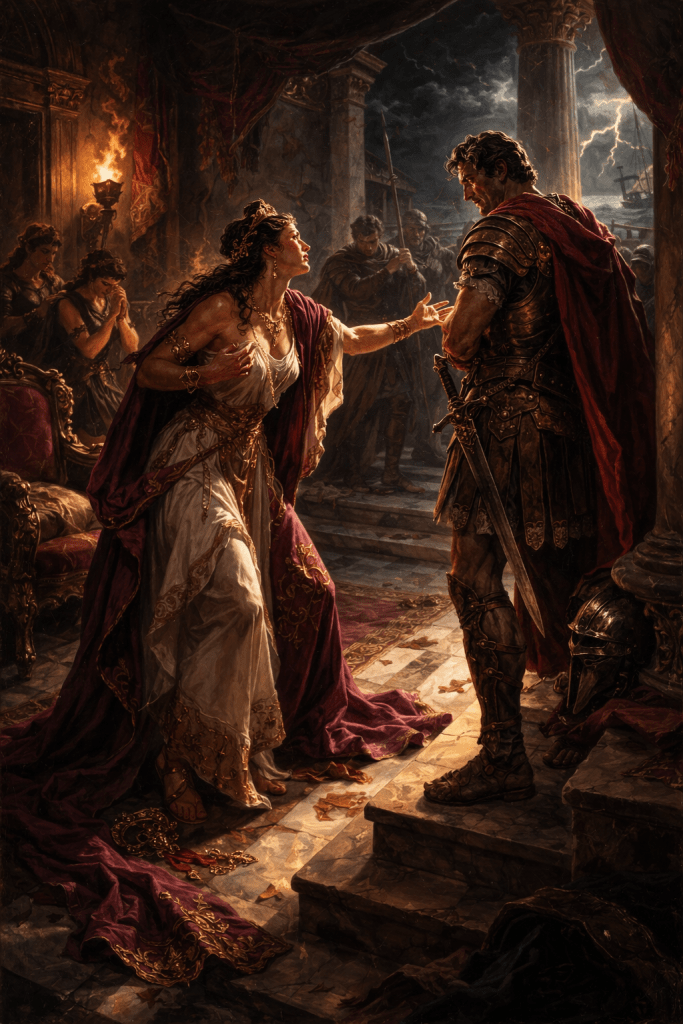
Here she confronts a man with whom she has been physically, emotionally, and professionally intimate for the past year. Virgil explicitly tells us no formal religious or legal ceremony was performed, yet Dido makes clear that she considers their partnership to be a marriage of sorts. She points out the personal and public perils which have been exacerbated by their relationship. Dido and her people are also refugees. They fled Tyre and founded Carthage after her brother killed her husband as part of a dynastic struggle. She made a vow of celibacy to her people and honored it when approached by local Libyan kings offering their sons in marriage. So long as she never wed she could maintain a balance in the power struggles with her neighbors. That fragile dynamic has been upset and now Aeneas is leaving. One could argue Dido should have been smarter, more discrete, or more strategic since she knew all this was hanging over her. However, Virgil makes it abundantly clear that her infatuation with Aeneas was the product of a conspiracy against her by Aeneas’ mother Venus. The entire Trojan war finds its roots in Venusian inspired counterproductive behavior, so this is kinda par for the course. The emotional and political peril aside, Aeneas’ response reveals a dark side to his unceasing piety.
Aeneas: If the Fates would allow me to lead my own life and to order my priorities as I see fit, the welfare of Troy would be my first concern, and the remnants of my own beloved people. Priam’s palace would still be standing and Pergamum rising from the ashes of defeat. But now the oracles of Gryneian Apollo, of Lycian Apollo, have commanded with one voice that the great land of Italy is my journey’s end. There is my love, my country. If the walls of Carthage, vistas of a Libyan city, have a hold on you, a Phoenician woman, why do you begrudge the Trojans a settlement in Ausonia? We too have the right to seek a kingdom abroad. The troubled ghost of my father, Anchises, admonishes me every night in my dreams, when darkness covers the earth, and the fiery stars rise. And my dear son, Ascanius—am I to wrong him by cheating him of his inheritance, a kingdom in Hesperia, his destined land? And now the gods’ herald, sent by Jove himself, (I swear by your head and mine) has come down through the rushing winds, ordering me to leave. I saw the god myself, in broad daylight, Entering the walls, and heard his very words. So stop wounding both of us with your pleas. It is not my own will—this quest for Italy.
Aeneas mounts an airtight defense of his decision vis-a-vis Roman pietas. He cites duty to the gods (gods’ herald, sent by Jove himself), country (why do you begrudge the Trojans a settlement in Ausonia?), and family (troubled ghost of my father… my dear son, Ascanius). One interpretation is that Aeneas’ actions are honorable and admirable because he’s sacrificing his own comfort and pleasure to fulfil his duties. This takes on an, “it’s not you, it’s me” approach to relationship termination. However, the salt in the wound here is that Aeneas admits that it’s not really “him”. He is sacrificing his own desires to move along to Italy, but even that isn’t really a reflection of his own will and judgment. Both Dido and founding Rome fall below a desire to have stayed at Troy (If the Fates would allow me to lead my own life and to order my priorities as I see fit, the welfare of Troy would be my first concern, and the remnants of my own beloved people). He doesn’t actually want any of this. She has gambled everything on him, and she ranks, at best, 5th place in Aeneas’ affections behind Troy, the gods, his son, and his people.
On one level this revelation transforms Aeneas into a tragic hero. He is driven forward by forces outside his control, a plaything of the gods and Fate enduring heartache, death, and destruction as he nobly pursues duty to gods, family, and country. First he loses his wife Creusa while fleeing Troy, never to be seen or heard from again. Then his father and many of his men die on their voyage across the sea. In this scene we’re barreling toward Dido’s suicide and generations of future wars between Rome and Carthage, and he is unknowingly moving toward a war with the Latins once he arrives in Italy.
However, other tragic heroes like Oedipus, Odysseus, Othello, Macbeth, and Hamlet carry similar burdens of death and destruction, but one key difference is that their tragedies are sewn by their agency and flaws of character and judgment, not their virtues. One thing that really rubs me the wrong way is that Aeneas passes the moral buck on his decisions. By claiming that his actions are dictated by surrendering his will to a revealed fate he deflects accountability for his choices. In Virgil’s text the end of Roman greatness appears to justify any means necessary to achieve it. From this moment forward the events of The Aeneid become increasingly violent, the moral clarity of the quest dims, the narrative takes a darker, bloodier turn, and the sympathies of this reader are tested.
Before arriving at Carthage the party tries and fails to found a city multiple times. The plight of refugees who repeatedly put down roots and are then forced to move to a new locale due things like crop failure and hostile NIMBY neighbors engenders compassion from the reader. In truth Aeneas is a very well drawn and sympathetic character through most of the first 7 books of the Aeneid. Once the party lands on the shores of Italy the clarity of purpose remains, but his character is almost entirely effaced. When he first meets the Latins, Aeneas is welcomed and offered the hand of Princess Lavinia in marriage suggesting a peaceful union and integration of the immigrants into local society. The outbreak of violence involves the machinations of Juno and the inflammation of jealousies and anxiety about the fitness of the Trojan refugees to make their new home in Italy.
“For Italy! Drive the enemy out! Turnus is here, a match for Teucrians [another name for Trojans] and Latins alike!”
Turnus is a local prince who had previously been in line for Lavinia’s hand in marriage and remains her mother’s preferred suitor. He initially leads an assault on Latinus to overthrow Lavinia’s father and is repelled, unfortunately while tensions are still high a Trojan accidently kills a favorite local deer which begins to turn public sentiment against them. After the respected elder Galeanus is killed by a Trojan while trying to calm things down, the tide of public opinion immediately shifts fully against the Trojans. In addition to the actual grievances of the local population against the Trojans, Turnus adds xenophobia in his calls for violence against the new arrivals.
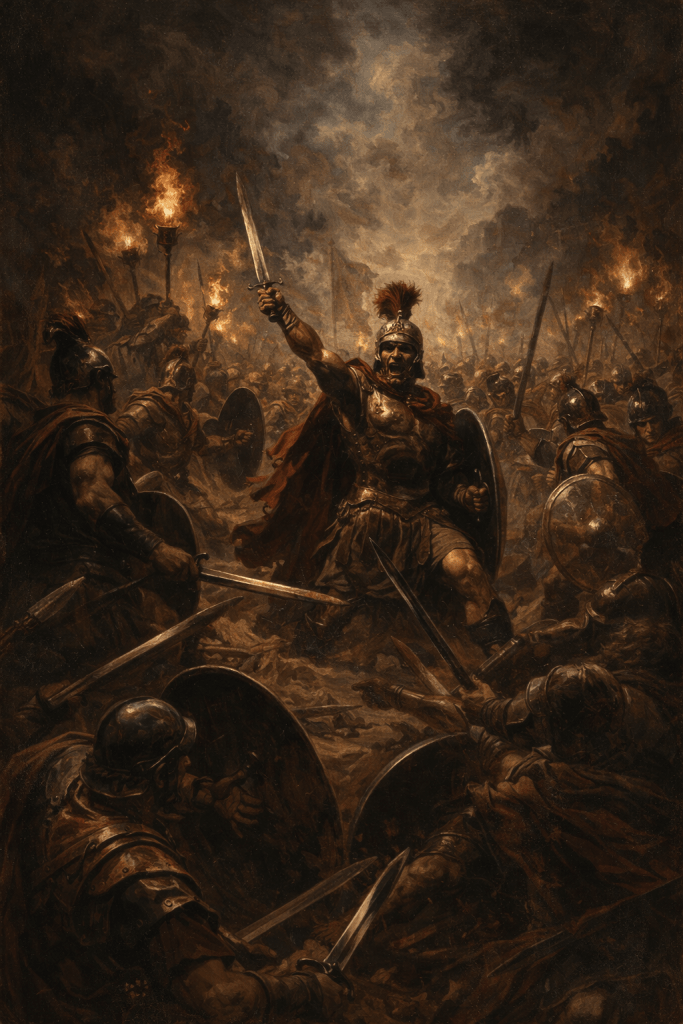
“Turnus was there, and amid the riot, the passions, and the shouts of ‘Murder!’ He multiplied their terror: “Teucrians (Trojans) are called in to rule! We are becoming Phrygian half-breeds, and I am shut out!”… And now their men were coming together from all sides, wearying Mars with their pleas. Defying the omens and the sacred oracles, their minds twisted, they all clamored for an unholy war. Latinus’ palace was soon besieged by an ugly crowd.”
Perhaps it’s that I’m writing this in February 2026, but a bunch of deaths triggered by someone inflaming tensions with a violent anti-immigration policy hits pretty close to home.
The Latin people reject the Trojan alliance and our wanderers are staring down the possibility of relocating once again. Because they feel like they have finally reached their prophesied home, the Trojans decide instead to form a new alliance with the Arcadians. The battles between the Latin and Arcadian/Trojan factions occupy the bulk of books 8-12 of the Aeneid. Like portions of The Iliad there are extended descriptions of individual combat featuring figures with little or no character development, frustratingly many of the combatants and victims mentioned appear nowhere else in the narrative. It makes me wonder if these names and characters would have meant something to the original audience, and my boredom during these scenes is just a byproduct of my cultural ignorance? The Aeneid’s final scene features one on one combat between Aeneas and Turnus to decide the fate of Lavinia and the Latin kingdom. This is similar to combats in The Iliad: Menelaus vs Paris and Hector vs Achilles. The final scene features Turnus begging for his life at the hands of Aeneas whose passions are inflamed because Turnus had killed his bestie Pallas and taken pieces of the young man’s armor for his own. The poem’s final lines read “seething with rage, Aeneas buried his sword in Turnus’ chest. The man’s limbs went limp and cold, and with a moan his soul fled resentfully down to the shades”.
Virgil died before the poem was completed so we can only speculate on which direction things would have gone after the battle was finally over. As I mentioned earlier, the descriptions of combat and the lists of who each person killed don’t hold entertainment value for me, so my negativity on this portion of the text may be inappropriate, but I can’t help but think that here we have a war precipitated by a guy who claims to not even want to be here. None of us can fully anticipate the results of our actions, but it seems to me that nothing would exemplify the transformation of virtue into vice more than someone blindly or begrudgingly pursuing a goal against their own judgment because of some sense of obligation or fate, and then having that thing result in a war that harms countless innocent people.
This brings me to my final complaint against Virgil and The Aeneid. Aeneas’ character is effaced by this pursuit of duty and destiny. We are left to wonder if his actions represent him and his character, or if he is only going through the motions of a cultural definition of duty? The closer he gets to his destiny, the less we see or hear about his personal emotional journey. His humanity is drained away. In one sense he, like so many killed in wars or conquest and other political conflicts, becomes a human sacrifice to the future glory of Rome. Absent is a description of the anguish or long-term scars he carries from the loss of his wife; he doesn’t build a shrine or re-route his journey to memorialize her. His response to abandoning his lover Dido in a precarious personal and political position feels muted at best. He seems unbothered at being at the root of so much bloodshed on the Italian peninsula. He transforms from a sympathetic leader trying to save the remnants of his people to a personal and emotional blank. I cannot recall any touching moments or verbal exchanges between Aeneas and his son Ascanius (aka Iulus).
Holding ancient writers to account for modern sensibilities may be unreasonable, but there is precedent for presenting a vulnerable hero in ancient epic. Achilles mourned his loss of status, his own mortality, and his companion Patroclus. Odysseus breaks down in tears during a celebratory feast at the song of a bard. Likewise, Gilgamesh mourns his mortality and loss of Ankidu. Rama spends the monsoon season mourning his wife’s kidnapping. Arjuna drops his bow in despair and refuses to fight against his extended family, teachers, and neighbors. It seems to me this isn’t a question of whether or not a military hero can be portrayed as experiencing pain at loss in an ancient epic, but for whom, and why he is shown to feel these things. Virgil vividly presents Aeneas’ inner turmoil on several occasions, most notably when he first arrives at Carthage and sees the murals featuring scenes from the Trojan War. Virgil can and does describe an emotionally competent hero, but his choices about when and why reflect cultural biases and a narrative agenda; the result being that Aeneas appears increasingly indifferent to human suffering as he draws closer to the actions which will lead to Rome’s foundation.
For me the last straw is how the blame for the war between the Trojans and Latins is shifted from the male dominated power politics and desire for glory, to a woman whose will is never entertained. As the armies gather for the siege of Latinus we’re told, “the final struggle summoned them all. The queen herself rode with a throng of women to the temple of Pallas on the high citadel, bearing gifts, and at her side, eyes lowered modestly, was the maiden Lavinia, the cause of all this misery.” Nothing seems more backward than to blame the young woman whose agency is culturally irrelevant for a conflict stemming from the choices of those deciding her fate. It’s maddening to also know that one of those men claims to have surrendered his own will. It’s a copout of epic proportions. A disappointing repudiation of agency and accountability.
Roman Pietas as a model for Duty
As someone who has tapped out thousands of words on the ethic of duty, why am I turning against it here? I think The Aeneid presents duty in terms that highlight my concerns about how the concept can be co-opted and used to manipulate. There are two obvious ways in which duty can be abused. First, by defining it in terms of cultural standards rather than individual practice of virtue in terms of personally important relationships, it can be used to induce an individual to repudiate their agency, deny their own conscience, and act against their better judgment as demonstrated in the character of Aeneas. This flaw can also be found in the presentation of duty in The Bhagavad Gita when Krishna uses the cultural standard of the Kshatriya caste to convince Arjuna that his duty is to fight a war against his judgment. Second, by connecting duty to a specific outcome which supersedes relationships it paves the way for a philosophy in which the desired ends are used to justify any means. Given its origin as a work composed to glorify the Roman Empire under the patronage of a Roman Emperor, this isn’t surprising. I don’t know whether or not Virgil’s presentation accurately represents Pietas as understood and practiced in the late Roman Republic/ Early Empire or at any other time, but I do feel comfortable saying it is not unique in this portrayal of duty. I also feel comfortable saying that I find it off-putting. As previously noted The Gita presented duty in a similar fashion, but it also discussed many other insights and arguments beyond caste duty that made it an interesting and enjoyable read, but the Aeneid’s descent into unfeeling violence really ruins the first half of the text for me. Homer grants glory for violent behavior, but also presents compelling counterpoints that this glory fails to resolve the existential conflict and emotional turmoil of those who obtain it. Virgil may or may not have had a similar trick up his sleeve that his death denied the audience, but as the text stands the latter half and ending leave a bad taste in my mouth.
In conclusion The Aeneid is a pretty good story; books 1-8 flow really well and are very entertaining, but the fact that it is highly derivative and destroys the sympathy the reader develops for the protagonist, and ends in a brutal slog of death and destruction ruin it for me. A revealing part of my experience is that while Homer’s Iliad and Odyssey are much longer, and The Iliad is just as violent, and The Ramayana is even longer, I plan to revisit these texts on a regular basis, but I do not anticipate returning to The Aeneid. Maybe I’m wrong about it, and I would be open to alternative interpretations but I think the history and trajectory of the prominence of the text is also telling. Through the middle ages The Aeneid, written in Latin, enjoyed acclaim in western Europe. For 1000 years The Aeneid was “The” classical era heroic epic. Since ancient Greek texts were “rediscovered” in the renaissance, Homer’s epics have displaced it. To me the reasons for this shift are clear. If you’re going to break down and read an ancient heroic epic, my advice would be to find a translation of Homer that works for you and enjoy it. Don’t bother with The Aeneid.
 MaximumKungFu