
Gandhi and The Gita
On 12 March 1930 Gandhi and 78 others began walking the 240 miles from the Sabarmati Ashram to the coastal village of Dandi. During his journey he taught his ideas of Satyagraha to crowds and thousands joined the march. After he arrived at the seashore on April 6th he boiled seawater and produced salt. This act was in direct defiance of a British Law (itself a continuation of a practice of the British East India company) that imposed a government monopoly on the collection and sale of salt. This well publicized event inspired many civil disobedience movements over the next four years against laws and taxes that were perceived as onerous and unfair. Over the next dozen years hundreds were killed or imprisoned while participating in non-violent protests against the British Raj. The salt march and other Satyagraha movements led or inspired by Gandhi did not have concrete results in terms of repeal of taxes or laws, nor did they lead directly to Indian self-rule or independence. It is fair to ask if these deaths represent wasted lives. Is it reasonable to sacrifice human life if it has no definite, or even a negative impact on advancing toward the desired goal? This is the exact question with which Arjuna wrestles at the beginning of The Gita.
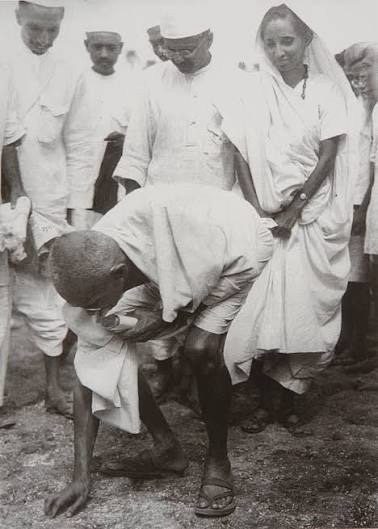
The historical judgment seems to be that these protests politically activated many Indians and galvanized public sentiment in favor of independence. They also garnered support for the Indian independence movement abroad. Internal British government documents reportedly suggest that these acts of civil disobedience demonstrated the truth of the familiar claim that government exists only by consent of the governed. The eventual withdrawal of the Raj suggests that a government predicated on the violent imposition of foreign rule that had previously put down several armed rebellions on the subcontinent was ill-suited to combat continuous, wide-spread, non-violent opposition. Gandhi’s Satyagraha protests may not have been sufficient to bring about Indian Independence, but there’s a case to be made that they were necessary components of the process.
Gandhi cited The Gita as inspirational in developing and practicing his non-violent philosophy. In my last journal I wrote over 8000 words discussing The Gita’s very explicit call to political violence; how does one reconcile these apparent contradictions? I haven’t spent enough time with Gandhi’s personal philosophy to know exactly how he did it, but I think the text lends itself to developing the type of perspective that is compatible with the Satyagraha movement.
A brief word on Satyagraha. The word was coined by either Gandhi himself, or perhaps one of his relatives, and is a compound of the Sanskrit “satya”, often translated as “truth” or “essence”, and “graha”, generally rendered “to seize” or “to hold”. As I understand it the idea was that once one grasped the truth, one had an obligation to hold to it regardless of consequences. He claimed that living in this way had power beyond mere performative self-righteousness or presentation of a “good example”. He seemed to believe that by demonstrating the truth clearly through one’s actions would not only inspire those who witnessed it, but would embarrass those opposing it and would constitute a form of “truth force” that would compel change.
“Truth (satya) implies love, and firmness (agraha) engenders and therefore serves as a synonym for force. I thus began to call the Indian movement Satyagraha, that is to say, the Force which is born of Truth and Love or non-violence, and gave up the use of the phrase “passive resistance”, in connection with it, so much so that even in English writing we often avoided it and used instead the word “satyagraha” itself or some other equivalent English phrase.” (M.K. Gandhi, Satyagraha in South Africa, Navajivan, Ahmedabad, 1111, pp. 109–10.)
“Its root meaning is holding on to truth, hence truth-force. I have also called it love-force or soul-force. In the application of satyagraha, I discovered in the earliest stages that pursuit of truth did not admit of violence being inflicted on one’s opponent but that he must be weaned from error by patience and compassion. For what appears to be truth to the one may appear to be error to the other. And patience means self-suffering. So the doctrine came to mean vindication of truth, not by infliction of suffering on the opponent, but on oneself.” (Gandhi, M.K. Statement to Disorders Inquiry Committee January 5, 1920 (The Collected Works of Mahatma Gandhi vol. 19, p. 206))
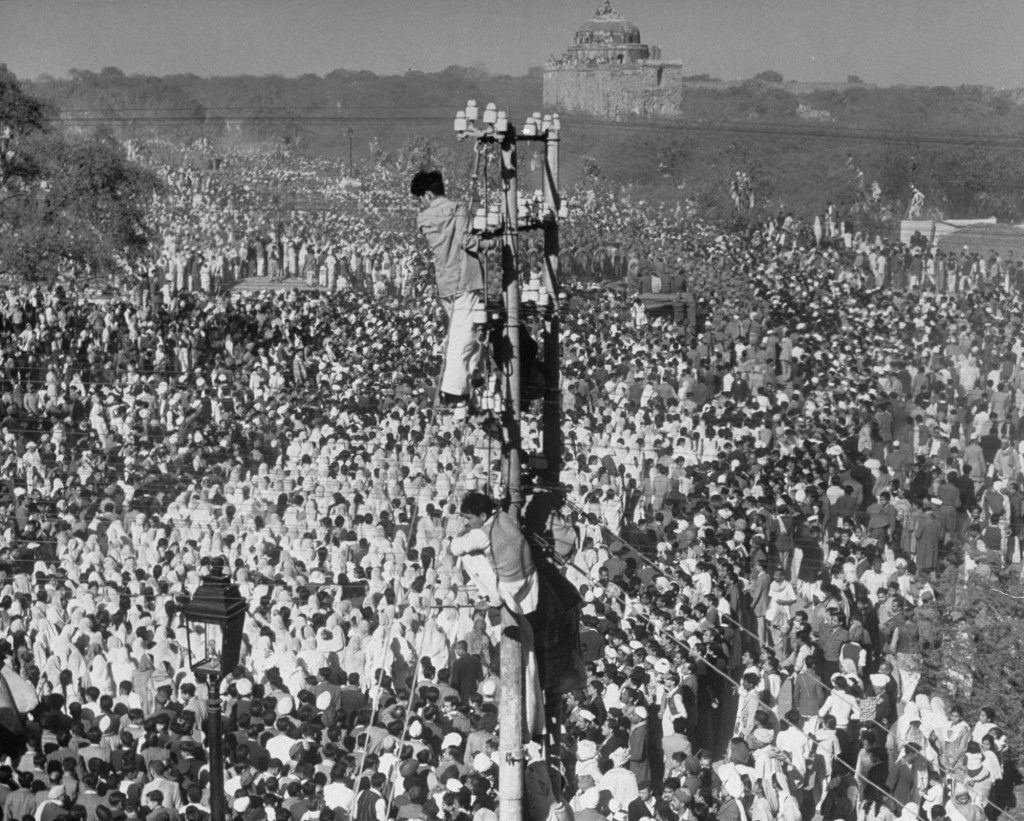
“Satyagraha is a weapon of the strong; it admits of no violence under any circumstance whatsoever; and it ever insists upon truth.” (Gandhi, M.K. “Letter to Mr. – ” 25 January 1920 (The Collected Works of Mahatma Gandhi vol. 19, p. 350))
He also perceived that the means by which something was accomplished were bound up in the end achieved. “If I want to deprive you of your watch, I shall certainly have to fight for it; if I want to buy your watch, I shall have to pay for it; and if I want a gift, I shall have to plead for it; and, according to the means I employ, the watch is stolen property, my own property, or a donation.” Gandhi rejected the idea that injustice should, or even could, be fought against “by any means necessary”— if you use violent, coercive, unjust means, whatever ends you produce will necessarily be imprinted by that injustice. Consequently, if we desire to live in a peaceful world, then we must use peaceful means to achieve our desired ends. Thus he adopted the principle of Ahimsa which has its roots in Vedic practice and finds expression in Hinduism, Buddhism, and Jainism. Ahimsa is often translated as non-violence, or non-harming. Vedic, Hindu, and Jain beliefs assert that everything possesses what some describe as a “divine spark” which unifies all of existence, and therefore to harm what one perceives as one’s opponent, is in fact to harm one’s self. This formulation elicits notions of spiritual harm that may not be quantifiable by humans but nonetheless carries a karmic weight which impacts one’s status now and in subsequent cycles of existence. In this teaching I think one can see a more “cosmic” formulation of Gandhi’s claim that the means and ends are bound together. Saying that the use of violence to achieve the desired end of self-rule sets the stage for a regime that employs violence as a means of control is another way of saying the harm you do to others is harming one’s self.
You don’t have to buy Gandhi’s arguments, but I would like to entertain the question of whether or not this operationalization of Ahimsa as Satyagraha is compatible with The Gita? If so, is there a more generally applicable formulation of the argument independent of the specific textual claims of The Gita? Spoiler Alert: I think the answer to both questions is yes. After 12,000 words the reader will not be shocked by this take. I believe four concepts from The Gita and dharmic faiths can be related to make this case: The Gunas, Yoga, the relationship between sacrifice and creation, and The Wheel of Dharma.
The Gunas and the Perils of Understanding Cause and Effect.
Accurately assessing cause and effect and using our judgments to make predictions are abilities with obvious advantages for both physical survival and social navigation. Composing testable hypotheses is an integral part of the scientific method whose discoveries have so thoroughly transformed the human experience. Of course not all of our assessments and predictions are accurate. Our penchant for inappropriately connecting cause and effect, believing correlation is in fact causation; for failing to account for all variables in our models, or any number of other errors have led to far too many blunders to catalog. Despite the fact that we are aware of historical failures and witness errors in others; we are rarely persuaded of the fallibility of our own judgments. Human minds are notoriously resistant to change, even (maybe especially) in the face of information that contradicts our views.
Why do we get so attached to our opinions and predictive models? I don’t know, but I suspect it has something to do with what some neurobiologists call the “Security of Motivation System”. Circuitry that connects sensory input, several regions of the brain, and the multi-system sympathetic “fight or flight” outputs. An alternative simplistic explanation is that Dopamine is one hell of a drug. Regardless of the exact mechanisms of how it is achieved, I don’t think it controversial to observe that humans have a tendency to develop some form of emotional attachment to our opinions and predictions.
In chapters 1 and 2 of The Gita, Arjuna observes that many of his extended family, friends, teachers, and neighbors stand on the opposite side of the battlefield. He can see how many individuals have been drawn into the conflict, and he knows a natural outcome of combat is death. He knows that the death of a warrior does not occur in a vacuum and that the consequences of the battle will extend beyond the immediate business of winning and losing. He can see the dominos falling:
“But we should know better, Krishna: clearly seeing the harm caused by the destruction of the family, we should turn back from this evil. When the family is destroyed, the ancient laws of family duty cease; when law ceases, lawlessness overwhelms the family; when lawlessness overwhelms the women of the family, they become corrupted; when women are corrupted, the intermixture of castes is the inevitable result. Intermixture of castes drags down to hell both those who destroy the family and the family itself; the spirits of the ancestors fall, deprived of their offerings of rice and water. Such are the evils caused by those who destroy the family: because of the intermixture of castes, caste duties are obliterated and the permanent duties of the family as well. We have often heard, Krishna, that men whose family duties have been obliterated must live in hell forever.” (1:38-44 Mitchell).
Arjuna can see that going to war will assign many, including himself, to “hell”. One might not expect a guy who is portrayed as a fantastically talented warrior to so readily advocate the conclusion that war is hell, but there it is. The specifics of his argument carry a lot of cultural baggage. The part about the evils of mixing castes rubs me the wrong way, but I think his analysis jives with the overall historical experience of war. His predictions understandably produce emotional despair, “Alas! We are about to commit a great evil by killing our own kinsmen, because of our greed for the pleasures of kingship. It would be better if Dhritarashtra’s men killed me in battle, unarmed and unresisting. Having spoken these words, Arjuna sank down into the chariot and dropped his arrows and bow, his mind heavy with grief”.
We all know Krishna convinces him to fight. One of the arguments Krishna presents is that Arjuna’s prediction is just that: a prediction, and that our ability to anticipate and judge the consequences of our actions is limited and can turn us away from proper behavior because we fear or desire a specific outcome. We are emotionally tied to a prediction not because we are committed to “being right” (that probably plays a part), but because we anticipate a specific result and cling to the illusion of control. If we can anticipate the future, then we can act in a manner to shape it. It might have something to do with why we love time travel dramas so much. (Dopamine is one hell of a drug).
Krishna offers his own version of the dominos falling by connecting our attachment to our predictions (clinging) to a loss of clarity and “insight” which I suspect is roughly equivalent to the Buddhist concept of “awakening”. In essence Clinging is how we stay in the realm of suffering, or “hell”.
“Clinging is born to someone who dwells on the spheres of the senses; desire is born from clinging; and anger is born from desire. Confusion arises from anger; and from confusion memory strays; from the fall of memory comes loss of insight; and one is lost when one’s insight is lost.” (2:62-63 Patton)
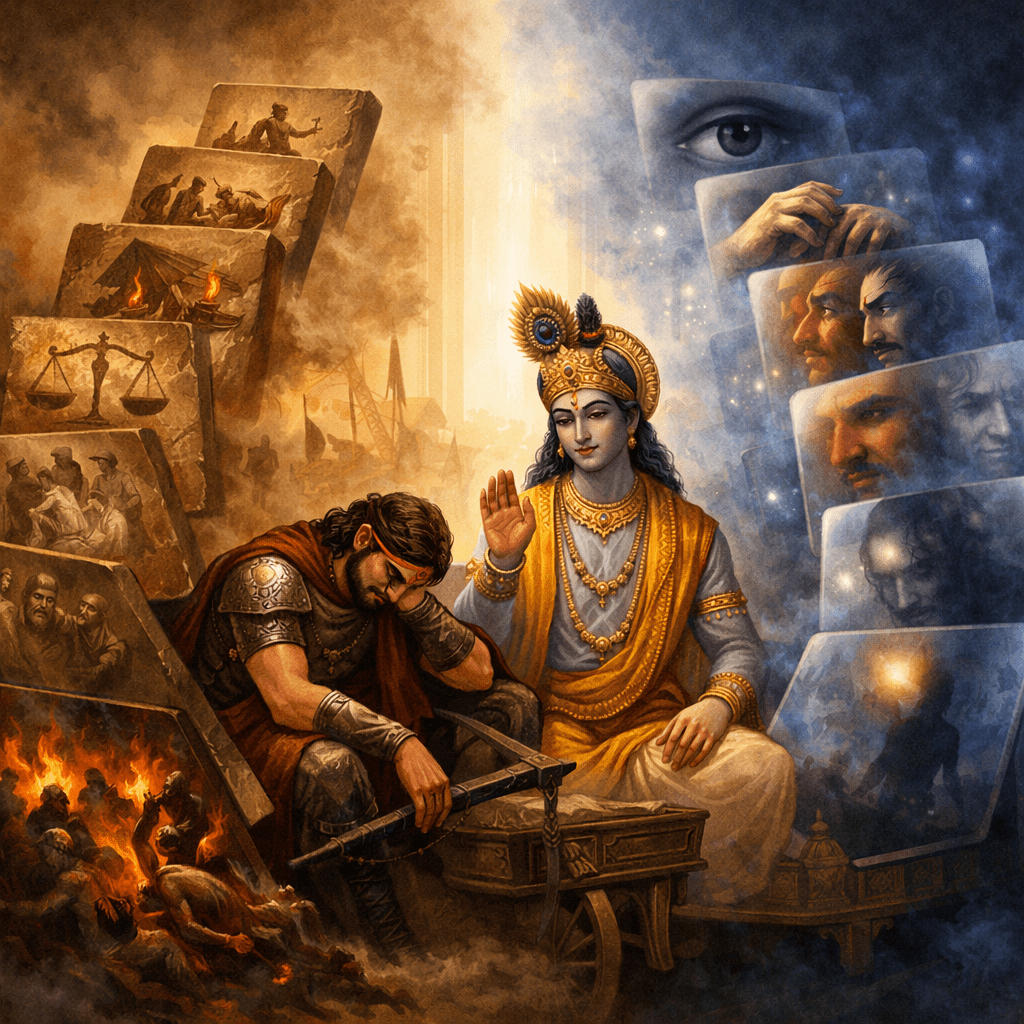
Arjuna argued the loss of caste dharma is what sends people to hell. Krishna counters that Arjuna’s fear of causing social disruption actually leads him to abandon his own caste dharma. If he goes to battle all those dominos may fall, but if he, a member of the kshatriya caste, refuses to fight, then his choice constitutes an abandonment of his caste dharma. His proposed solution results in the exact problem he seeks to avoid. Arjuna is using his observations “senses” to make a prediction. He clings to a desired outcome and is therefore confused and frustrated and seeks an alternate path rather than following the path of traditional understanding (memory). Krishna claims the confusion and anguish Arjuna experiences are byproducts of his misplaced belief that he can accurately predict the outcome of his actions and his desire to achieve or avoid a specific end.
For years I was perplexed by the forbidden nature of “the fruit of the tree of the knowledge of good and evil” in the Book of Genesis. What sort of being would want to deny his children or creations an understanding of good and evil? As someone who no longer subscribes to any form of Yahwehism, it’s not really any of my business. But as someone who spent the better part of the first 40 years of my life ensconced in it I can’t help but wonder if forbidding the fruit of “knowing” good and evil isn’t about denying useful knowledge, but a warning against trusting our abilities to judge and act based on our assessments and predictions?
Predictions, Attachments, and The Gunas
The exact relationship between human consciousness and physical reality is the source of ongoing debate and speculation, but Krishna observes “Passion and hatred abide in the place between a sense and its object” (3:48 Patton), and “Desire dwells in the senses, the mind, and the understanding; in all these it obscures wisdom and perplexes the embodied Self.” (3:40 Mitchell). I interpret these lines to mean that physical reality simply is, but our experience is a product of the perspective through which we view it. There’s certainly a better, more informed description of The Gunas out there, but from the context I get from The Gita, I would define The Gunas as naturally emerging manifestations of emotional attachments or aversions which develop in response to one’s perception of existence as mediated by our sense of physical reality.
“There is no being on earth, or in heaven, or among the gods- no being who is free from these three gunas born of nature” (18:40 Patton)
“The wise man knows that when objects act on the senses, it is merely the gunas acting on the gunas; thus, he is unattached. Deluded by the gunas, men grow attached to the gunas’ actions” (3:28-29 Mitchell)
“Learn the enemy here on earth: it is desire and anger; the guna of rajas, or passion, is their source. As fire, bearer of oblations is covered by smoke, and as a mirror is covered by dust, and as an embryo is covered by the womb, so this wisdom is covered by this. The wisdom of the wise is covered by this eternal enemy; covered by a fire in the shape of desire, a fire which is always hungry.” (3:37-39 Patton)
Krishna describes 3 Gunas: Rajas, Tamas, and Sattva.
“Sattva: untainted, luminous, free from sorrow, binds by means of attachment to knowledge and joy.
Rajas: marked by passion born of craving and attachment; it binds the embodied Self to never-ending activity.
Tamas: ignorance-born, deludes all embodied beings; it binds them by means of dullness, indolence, and sleep.” (14:6-8 Mitchell)
Krishna describes behaviors motivated by a desire to control. Rajas, “the eternal enemy”, is presented as an unquenchable fire that obscures judgement. He describes Tamas as a withdrawal from engaged thought and action into an “absence of light, absence of exertion, neglect, and confusion” (14:13 Patton). However, Sattva is set forth as a middle path in which one acts in pursuit of “Light”, “Joy”, “Insight”, and “Wisdom”. One takeaway here is that The Gita proposes a path that recognizes that our attachment to control manifests as both desire and fear, and these attachments can drive us to evil through action and disengagement (16: 6-24), and points toward finding a balance of acceptance without resignation.
“That insight which distinguishes exertion from inertia; that to be done from that not to be done; that to be feared from that not to be feared, is Sattvic” (18:30 Patton).
The Gita acknowledges the concept of action as distinct from craving, thirst, and desire; the former is possible and necessary even while renouncing the latter.
“The person who does what must be done, and does not resort to the fruit of action, is a renunciant and practitioner of yoga, not the one without a fire and without rituals… no one becomes a practitioner of yoga without giving up purposeful intent. Action is the method for the sage wanting to rise toward yoga” (Patton 6:1-3).
Yoga: Acceptance without Resignation
The statement “acceptance without resignation” is both profound and trite. I think it contains genuine insight into a balanced approach to the uncertainty of life, but offers no concrete ways of achieving or maintaining an equilibrium. Fortunately, The Gita has more to offer. If we acknowledge that we cannot change the past, and we seek to transcend our proclivity for predicting the future and the miscalculation that follows, but do not resign ourselves to disengagement, then the obvious place to focus is on the present (3:4). Arjuna and Krishna discuss the principles of Yoga as shorthand for this concept.
Several verses in The Gita describe meditative practices of Yoga with which we are all more or less familiar: sitting upright in quiet solitude (6:10-11), singularity of focus (6:12-13), and finding a place of peace through physical and mental restraint (6:14-15). However, these verses occur in the context of Krishna expanding Arjuna’s understanding of Yoga. They are immediately followed by statements like, “Yoga is not about eating too much, nor is it about not eating at all. It is not about the practice of sleeping too much, nor is it about keeping awake (6:16).
Linguists suggest that via the hypothetical proto-indo-european language, the Sanskrit “yoga” shares its roots with the English word “yoke”, and that yoga can be appropriately translated as discipline. Body position, observing stray thoughts, focusing on the breath: the practices of mindfulness employed in an effort to be present “in the moment” all serve the greater goal of eliminating attachment to the past and future.
While The Gita recognizes the traditional practices of Yoga as viable means of renouncing attachment to desire, it also admits that such practices could also be hollow, and the actions could be performed while attached to desires it was meant to reject (17:18-22). Krishna teaches that the heart of Yoga, and the route to reconciling it with an active participation in life, is that its customary practices are but one manifestation of the principle, and that Yoga is characterized by restraint of emotional connection to things beyond one’s control and renunciation of attachment to the outcome of one’s actions.
“This is true yoga: the unbinding of the bonds of sorrow. Practice this yoga with determination and with a courageous heart. Abandoning all desires born of his own selfish will, a man should learn to restrain his unruly senses with his mind” (Mitchell 6:23-24).
A similar formulation is given later,
“Wisdom is better than practice, and focused mind is better than wisdom. Letting go of the fruit of action is better than focused mind. From letting go, peace soon comes… The one in whose presence the world does not tremble, and who does not tremble in the presence of the world, who is free from pleasure and impatience, fear and anxiety, is dear to me.” (Patton 12:12,15).
Transcendence Through Discipline
Arjuna eventually asks the direct question, “how does one transcend the three gunas? (14:21), Krishna responds in a variety of ways, but most consistently offers comparisons between behaviors that typify the three gunas.
“Fearlessness, purity of heart, dwelling in the yoga of knowledge, giving, self-restraint, sacrifice, recitation, penance, straightness; non-violence, truth and calmness, renunciation, slander-shunning, compassion, freedom from all lusts, gentleness, modesty, steadiness; vigor, patience, courage, cleanliness, absence of malice and of pride; these qualities endow those born to a divine fate” (16:1-3 Flood)
Krishna categorizes these virtues as disciplines of body, speech, and thought.
“Honoring the gods, the priests, the teachers and sages, purity, nonviolence, chastity, uprightness— all this is control of the body. Speaking the truth with kindness, honesty that causes no pain, and the recitation of scripture— this is control of speech. Serenity, gentleness, silence, benevolence, self-restraint, purity of being, compassion— this is control of the mind.” (Mitchell 17:14-16)
These descriptions are contrasted with a vivid vision of those who lack this type of discipline.
“With no end of anxious thoughts, clinging to an end which is dissolution, their highest goal is the enjoyment of desire. Without a doubt of their truth, they are bound by a hundred snares of hope; their highest goals are anger and desire; they seek hoards of wealth in mistaken ways, for the enjoyment of desire. ‘This has been gained by me today! And I will get this desire- a desire which carries the mind like a chariot. This wealth is also mine, and so will this be mine! This enemy has been struck down by me, and I will strike others too! I am the lord, the one who enjoys, fulfilled, strong, and happy. I am rich and well born; who else is there like me? I will sacrifice; I will give; I will be joyful! Thus say those confused by ignorance. Wandering away with many thoughts, they are covered by a net of confusion. Clinging to the enjoyment of desire, they fall into an impure hell.” (Patton 16:11-17)
In this description we see common human foibles of possession, violence, oppression, and self-satisfaction. Two images that are particularly striking to me are “bound with a hundred snares of hope” and “clinging to the enjoyment of desire”. These images emphasize that the negative attributes aren’t only born out of a desire to oppress and abuse, but spring from the best of intentions with heartbreaking regularity.
Krishna recognizes that humans naturally resist self-restraint, and the immediate results of our actions may not always be to our liking, but instructs that adopting these virtues will ultimately benefit us, “The happiness which comes from long practice, which leads to the end of suffering, which at first is like poison, but at last like nectar—this kind of happiness, arising from the serenity of one’s own mind, is called sattvic.” (Mitchell 18:36-37).
Creation through Sacrifice – “This world does not belong to those who do not sacrifice”
Encouraging the cultivation of virtue is hardly ground breaking stuff, but I think this is where the Vedic creation story of the Purusha informs this concept of Yoga and its connection to creating a favorable experience through our actions without clinging to the immediate outcomes of our behaviors. Without repeating a story I’ve discussed twice in other contexts, The Purusha is a short Vedic hymn that describes the creation of the entire universe, including humans and gods, brought forth from the body of a sacrificed celestial being. Krishna highlights the connection between sacrifice and creation several times in his discussion with Arjuna.
“Except for action whose end is sacrifice, the world is bound by action; without clinging, perform action towards this end of sacrifice… In ancient times, after he created sacrifices along with humans the lord of beings said: ‘You shall create through this!”… By this [sacrifice], may you cause the gods to be; and may the gods cause you to be. As you both sustain each other, you will reach the higher good… The one who enjoys what is given by them but does not give to them is a thief” (Patton 3: 9-12)
Alternatively translated: “The whole world becomes a slave to its own activity, Arjuna; if you want to be truly free, perform all actions as worship.” (Mitchell 3:9)
This proposed literal connection between sacrifice and creation is extended to the moral dimension.
“For the one who is free, whose clinging is gone, and whose thought stands firm in wisdom, actions performed for sacrifice dissolves altogether” (Patton 4:23)
“When a man has let go of attachments, when his mind is rooted in wisdom, everything he does is worship and his actions all melt away. God is the offering, God is the offered, poured out by God; God is attained by all those who see God in every action.” (Mitchell 4:23-24)
Several verses follow that cite vedic and meditative yoga practices that can be performed as sacrifices and concludes, “all these knowers of the sacrifice have their evil deeds consumed by sacrifice. Best of the Kurus (Arjuna), this world does not belong to those who do not sacrifice” (Patton 4:30-31)
These may seem like esoteric connections, but Krishna later comments on the practical reality that our beliefs, attitudes, and actions essentially create the existence we experience:
“Those whose wisdom is taken away by this desire or that desire take refuge in other gods… The ones who worship those gods go to the gods” (Patton 7:20, 23)
“Those who know the Vedas and drink Soma, cleansed of their evils seek heaven, and offer to me with sacrifices. They reach the pure world of Indra, and enjoy the divine pleasures of the gods in heaven. When they have enjoyed the wide realm of heaven, when their merit is gone, they enter the mortal realm. Then, following the dharma of the Vedas, they desire their desires. They get what comes and goes.” (Patton 9:20-21)
“Those who choose gods go to the gods. Those who choose ancestors go to the ancestors. Those who honour the ghosts go to the ghosts.” (Patton 9:24-25)
“Faith is a person’s core; whatever his faith is, he is.” (Mitchell 17:3)
My own experience aligns with these claims. Our experience of life: our habits, relationships, and communities are, in part, an emergent property of our individual and collective beliefs and actions. One conception of devotion and worship is that our choices constitute sacrifices to the gods we choose to worship. In other words we sacrifice our impulses and desire for control as a form of worship in an effort to create the life and world we aspire to inhabit. We sacrifice things like dishonesty, selfishness, cruelty and a bit of independence to the god of healthy relationships, whatever her name may be. We sacrifice fear, laziness, and comfort to the god of ambition. Etc. etc. Returning to Gandhi: he believed you couldn’t worship the god of peace and liberty without sacrificing violence.
In my readings of ancient texts libations and other offerings to the gods are generally accompanied by prayers expressing human desires. Another common feature of these texts is that the gods do what they want regardless of human desires and offerings. Despite Achilles’ prayers to Zeus, Patroclus dies beneath the walls of Troy. Ankidu dies and rots while Gilgamesh prays for his recovery. On the other hand there is the prototype of sacrificing to the gods without fully comprehending what is being asked or expecting a specific outcome. The obvious precedents here are Abraham’s willingness to sacrifice Isaac and Jesus praying before his crucifixion (Luke 22:42).
Yoga as existential response to Camus’ absurd
Conceiving self-discipline as a form of sacrifice, not as a self-development tool, can set the stage for not getting what we want in response to our decisions. The world may or may not change. My earnest efforts may be greeted by silent indifference. Why bother? How do we reconcile this reality with a belief in creation through sacrifice?
One possibility is to view sacrifice as a faithful expression of optimism. By sacrificing for what I believe now, small changes will accumulate and lead to large scale shifts at some point in the future. I may never personally experience the change, but someday, someone will. This, of course, is a form of clinging. It remains results oriented and seeks validation in events in the future beyond one’s control. This view aligns with Krishna’s description of the Guna of Rajas.
There is a complex interplay between belief, behavior, perception and interpretation of experience. By changing my behaviors and attitudes in accordance with my beliefs my experience and life change. The wider world in some nebulous future may or may not change in response to my behaviors, yet my lived experience is altered. Anyone who has experienced an “awakening”, change of heart, conversion, enlightenment, repentance, or personal growth has experienced this.
Let’s say for example that I believe in representative democracy and constitutional government. If I vote for people who represent my points of view, if I write to inform my representatives what I think, if I engage local leaders and attend meetings, freely express my contrarian views through protest, and respond when summoned for jury duty, then even if/when public policy differs from what I think is best, I am living a life consistent with my beliefs. Not getting what I want is one of the prices of the democratic process. Regardless of electoral results or policy decisions my experience is that of a citizen engaged in the principles of a constitutional democracy.
If you want to live in a world which elevates the values of kindness, and service, and then you spend years of your life engaged in acts of service and kindness, then your experience is transformed despite any cruelty and indifference of the world around you.
Similarly, if you live under the thumb of a monarchy that employs violence and inequitable tax policy to oppress, but you wish to live in a more peaceful and just country, then walking to the ocean and preparing salt from sea water transforms your experience of life. Punishment and prison may follow, but your opponent cannot force you to behave contrary to your principles.
You can refuse to sit at the back of the bus. You and your friends can occupy every stool at the Woolworth’s lunch counter. Change may or may not come, but by living a life that accords with your convictions regardless of the response, your personal experience is bent into alignment with your vision.
This is difficult. Gandhi’s followers, Satyagrahi, underwent special training. As did the student organizing committees that launched the most famous civil rights protests. Holding to virtue in the face of evil or violent opposition, especially with the backing of state authority requires discipline. Yoga.

Acceptance without resignation. Action unattached to outcome. Creation through sacrifice. Holding to the truth you know. Satyagraha.
“When his mind has become serene by the practice of meditation… he knows the infinite joy that is reached by the understanding beyond the senses; steadfast, he does not fall back from the truth.” (6:20-21 Mitchell)
Checks and Balances: Krishna’s Theophany revisited
There are several ways this sort of unwavering commitment to principle can go sideways and I spent much of my last essay covering one of them, and I don’t really feel like exploring it in more breadth or depth here because I’d rather point out one potential check on such behaviors set forth in The Gita. In discussing the changes to the practitioner of discipline and sacrifice Krishna asserts:
“The man who sees me in everything and everything within me will not be lost to me, nor will I ever be lost to him. He who is rooted in oneness realizes that I am in every being; wherever he goes, he remains in me. When he sees all beings as equal in suffering or in joy because they are like himself, that man has grown perfect in yoga.” (6:30-32 Mitchell)
“The one who sees the highest lord abiding alike in all beings… that one truly sees” (13:27 Patton)
These verses cast a different light on the chapters where Krishna reveals himself as synonymous with the entirety of being and the cosmos. Humans are generally self-centered and seeing ourselves in those with whom we interact and the world we inhabit ideally helps us develop empathy and compassion. Arjuna expresses this when he responds to the theophany:
“If, thinking you a human, I ever touched you or patted your back or called you “dear fellow” or “friend” through negligence or affection, or greeted you with disrespect, thoughtlessly, when we were playing or resting, alone or in public, I beg you to forgive me, immeasurable” (11:40-41 Mitchell)
It’s one thing to honor a powerful being, but if Krishna represents the unity of matter and energy (E=mc^2) that form the entire universe, and the wise appreciate that this unity not only connects them to space and time, but to all life including those with whom we strenuously disagree, and we understand that we are all subject to clinging desires and fears, then hopefully we develop some measure of understanding, patience, and compassion for our shared plight. I think Krishna implies this idea before his transfiguration when he attempts to describe the reality of what he represents and its implications and declares:
“When I dwell in human form, the confused ones have contempt for me” (Patton 9:11)
If blindness and confusion result in disrespect, and contempt, it stands to reason that understanding and clarity should result in mutual respect and compassion.
This call to compassion is not unique, and it’s fairly ubiquitous in epic poetry and wisdom literature. Job’s “Fear of The Lord”, Homer’s Xenia, and now Hinduism’s Dharma, all present this same lesson through different cultural lenses. Since it’s Christmas and I was raised in the Christian tradition I can’t help but hear these same concepts echoed later during a Passover meal when another incarnate deity attempted to give his followers a greater vision of the unity of being and their place in it, then instruct them about how that knowledge should shape their behavior:
Philip said to him, “Lord, show us the Father, and we will be satisfied.” Jesus said to him, “Have I been with you all this time, Philip, and you still do not know me? Whoever has seen me has seen the Father. How can you say, ‘Show us the Father’? Do you not believe that I am in the Father and the Father is in me? The words that I say to you I do not speak on my own, but the Father who dwells in me does his works. Believe me that I am in the Father and the Father is in me, but if you do not, then believe because of the works themselves. Very truly, I tell you, the one who believes in me will also do the works that I do and, in fact, will do greater works than these… They who have my commandments and keep them are those who love me, and those who love me will be loved by my Father, and I will love them and reveal myself to them.” Judas (not Iscariot) said to him, “Lord, how is it that you will reveal yourself to us and not to the world?” Jesus answered him, “Those who love me will keep my word, and my Father will love them, and we will come to them and make our home with them… If you keep my commandments, you will abide in my love, just as I have kept my Father’s commandments and abide in his love. I have said these things to you so that my joy may be in you and that your joy may be complete. “This is my commandment, that you love one another as I have loved you. No one has greater love than this, to lay down one’s life for one’s friends. You are my friends if you do what I command you. I do not call you servants any longer, because the servant does not know what the master is doing, but I have called you friends, because I have made known to you everything that I have heard from my Father. (John 14:5-12, 21-23, 15:10-15 NRSV)
In these verses I see expressions of the great unity of being: “I am in the Father and the Father is in me” and creation through discipline and sacrifice as worship: “the one who believes in me will also to the works that I do and will do greater works”, and “if you keep my commandments, you will abide in my love… so that my joy may be in you and that your joy may be complete”.

Arjuna’s response to this greater vision is also echoed in the New Testament:
“Then the king will say to those at his right hand, ‘Come, you who are blessed by my Father, inherit the kingdom prepared for you from the foundation of the world, for I was hungry and you gave me food, I was thirsty and you gave me something to drink, I was a stranger and you welcomed me, I was naked and you gave me clothing, I was sick and you took care of me, I was in prison and you visited me.’ Then the righteous will answer him, ‘Lord, when was it that we saw you hungry and gave you food or thirsty and gave you something to drink? And when was it that we saw you a stranger and welcomed you or naked and gave you clothing? And when was it that we saw you sick or in prison and visited you?’ And the king will answer them, ‘Truly I tell you, just as you did it to one of the least of these brothers and sisters of mine, you did it to me.’” (Matthew 25:34-40)
The Eschatology of The Gita
Occasionally Jesus’ followers would pose questions that evince controversy about exactly what type of “kingdom” Jesus was setting up. Was his role as Messiah to overthrow Roman rule and establish a new realm where he would reign like the Davidic rulers celebrated from their past? Or was his kingdom otherworldly? Would he rule in the here and now, later in a separate celestial realm, or perhaps descend to Earth from above? Two thousand years later the Christian tradition continues to ponder these questions.
In a similar vein Krishna repeatedly addresses the promised benefits of a life of discipline, devotion, and action. Krishna’s greatest claim is that adherence to dharma is the path to liberation (moksha) from the cyclical nature of existence (samsara). Within the Hindu tradition, release from endless rebirth into this world of suffering is the ultimate goal. This type of liberation strikes me as conceptually analogous to interpreting the Christian gospel as a blueprint for a sociality not of this world, but of something in the future.
Alternatively, much of Krishna’s verbiage is in the present tense with the implication that the “ultimate release” is simply a de facto by-product of living a liberated life here and now, “Rebirth is conquered here in this world by those whose minds abide in that sameness” (5:19 Patton). Enlightened liberation is not a state to be achieved, but a way of being. Something like “The Kingdom of God is among you” (Luke 17:20) or “realizing your Buddha Nature”. As a person who describes himself as “religious, but not spiritual” I gravitate toward this interpretation.
The Wheel of Dharma
I’ll close by considering the oft used image of the wheel of dharma. The wheel is the central focus of the flag of the nation of India, and shows up in iconography of dharmic religions of Hinduism, Buddhism, and Jainism. There are two relevant features of the wheel that I think make it a great visual metaphor for dharma. First, the unity of the machine. A wheel has several parts. It needs a rolling surface, but a rolling surface must be supported by something like spokes. Of course a rolling wheel is only useful if the mechanical advantage can be harnessed and attached to a load, so a wheel needs a hub and an axle. Without all the constituent parts the wheel is not a revolutionary technology. (See what I did there?) Mahayana, a popular form of Buddhism, can be translated as “great vehicle”. Discipline, Devotion, and Action are all necessary to practice Dharma. The Wheel of Dharma is presented as the interdependent practices by which we move our lives forward.

The second feature of the wheel I find interesting is its motion. The most obvious being that a wheel rotates around a central focus. The beliefs, priority, and vision for our lives create provide the focal point for disciplined thought and behavior. However the more interesting motion to consider is the movement of a point on a rolling wheel. With respect to the axle, it constantly circles, endlessly repeating the same path. An apt metaphor for samsara. But relative to the space through which the wheel moves, the point rises and falls in a semi-circular fashion and forms a cycloid. It also moves continuallyQ forward. The wheel is how we live our lives constantly running around in circles, sometimes rising, and at others falling, but in so doing we also make progress toward something new and hopefully better.
In Conclusion
The text of The Gita offers multiple avenues of interpretation that could lead to a justification of violence or heroic non-violence that have and continue to inspire folks from a variety of backgrounds. I think abstracting the teachings, and claims of The Gita readily leads to a “process based” approach to life. Arjuna, and by extension the audience is encouraged to act in accordance with virtues and duties regardless of anticipated outcome. There are obvious dangers in acting “on principle” at all times, but there’s also an obvious philosophical appeal to deontological belief systems. If one seeks liberation, then the natural step is to adopt behaviors of liberation regardless of how the world responds, and thus we see how Gandhi and those who cite the Gita in similar endeavors reach their conclusions.
Beyond the political implications of liberation through non-violence I think the insights about the strengths and weaknesses of the human mind as a prediction engine, and how our frequently counterproductive desires for control, certainty, and specific outcomes in the future can be mitigated through a disciplined approach to life has obvious potential value for the individual. I even think the concept of the cyclical nature of life and escaping certain patterns and habits to move forward has utility separate from accepting a doctrine of transmigration of the soul/ reincarnation. A while back I was introduced to Portia Nelson’s “An Autobiography in Five Short Chapters” and I think about it often. I suspect it may be the most concise description of the interaction of The Gunas, Yoga, and The Wheel of Dharma as I understand them in practice.
Autobiography in Five Short Chapters
1. I walk down the street.
There is a deep hole in the sidewalk.
I fall in.
I am lost.
I am helpless.
It isn’t my fault.
It takes forever to find a way out.
2. I walk down the same street.
There is a deep hole in the sidewalk.
I still don’t see it.
I fall in again.
I can’t believe I am in the same place.
It isn’t my fault.
It still takes a long time to get out.
3. I walk down the same street.
There is a deep hole in the sidewalk.
I see it there, I still fall in.
It’s habit.
It’s my fault.
I know where I am.
I get out immediately.
4. I walk down the same street.
There is a deep hole in the sidewalk.
I walk around it.
5. I walk down a different street.

 MaximumKungFu