
In a dissenting opinion regarding the constitutionality of the death penalty Supreme Court Justice Henry Blackmun famously wrote “I shall no longer tinker with the machinery of death”. Taking a life is appropriately recognized as the most severe penalty we impose for criminal behavior. So severe that whether or not it is a fitting punishment regardless of the crime is a matter of ongoing debate, hence Justice Blackmun’s statement. With due respect to him and his opinion, I think the hard truth is that tinkering with the machinery of life and death is a requisite part of membership in civil society. The real question is: will our tinkering increase or decrease its killing power? Allow me to explain.
Until September 10th this essay was going to be a series of questions and speculations about why the heroic epic genre holds such a prominent place across world culture. I had a sudden change in plans. I never engaged with Charlie Kirk or his ideas, but from what I gather he and I disagree on most “hot button” political issues. Yet, for some reason his murder has saddened me more than I could have anticipated. I don’t think I’m shocked in the pearl clutching sense. The frequency of murders conducted by men wielding guns in this country is well documented. There were at least two campus shootings on September 10th alone. One could reasonably argue the sadness I should feel for the children who died in Denver should be twice as profound. I’m ashamed to admit that this type of violence has also become so frequent as to feel commonplace and that as a defense mechanism I often don’t allow myself to dwell too much on it.
Perhaps it’s the fact that the murder occurred on a campus with which I have a passing familiarity; a campus that was the focus of a local political firestorm 20 years ago while I was in graduate school, and the alleged shooter is from the area where I currently reside that really got to me. Maybe it’s the fact that a few months ago my own children were briefly in harm’s way during a police shootout with one of my neighbors who, because of a prior offense, wasn’t supposed to possess a firearm much less a high-powered semi-automatic rifle capable of firing over a hundred rounds in rapid succession thus keeping the police at bay. Certainly part of it is the ability to focus on a single victim. What’s that famous quote from Stalin about a single death being a tragedy, but a million deaths being a statistic? The intense media coverage certainly has something to do with it. Bottom Line: this one bothered me far more than most.
The exact motives of the murder may or may not be fully revealed as evidence is gathered and a trial proceeds, but based on who Charlie Kirk was: his public persona, his job, his alignment with certain policy positions and politicians, and the context in which he was killed, I think it reasonable to assume his death is a manifestation of political violence. I am not certain that we are experiencing a clear increase in frequency or severity of political violence, but I know that I find the fact that murder is part of our public discourse to be discouraging and heartbreaking. So I’m gonna write about it.
Violent Politics and Ancient Literature
Lest we fall into the trap of believing our present situation represents some form of moral failing that is uniquely modern, allow me to argue otherwise. Let’s consider late 5th century BCE Athenian democracy. By the 450s BCE Athens had used its power and wealth to assert hegemony over The Delian League; the military coalition of city-states initially developed to defend against Persian invasions. They gradually dominated the finances of the league, then influenced (some might say interfered with) the domestic affairs of smaller cities and even led several campaigns forcing regime change; installing democracies in place of monarchies. Their growing political and military influence, especially naval supremacy, resulted in Athens becoming a central player in a trade network that further enriched the city and extended their power and influence.
In his funeral oration following the opening battles of the Peloponnesian War, Pericles described Athens’ perceived greatness at length:
“I will speak first of our ancestors, for it is right and seemly that now, when we are lamenting the dead, a tribute should be paid to their memory… By their valor they will have handed down from generation to generation, and we have received from them a free state. But if they were worthy of praise, still more were our fathers, who added to their inheritance, and after many a struggle transmitted to us their sons this great empire. And we ourselves assembled here today, who are still most of us in the vigor of life, have carried the work of improvement further, and have richly endowed our city with all things, so that she is sufficient for herself both in peace and war… Our form of government does not enter into rivalry with the institutions of others. Our government does not copy our neighbors’, but is an example to them… Because of the greatness of our city the fruits of the whole earth flow in upon us; so that we enjoy the goods of other countries as freely as our own.”
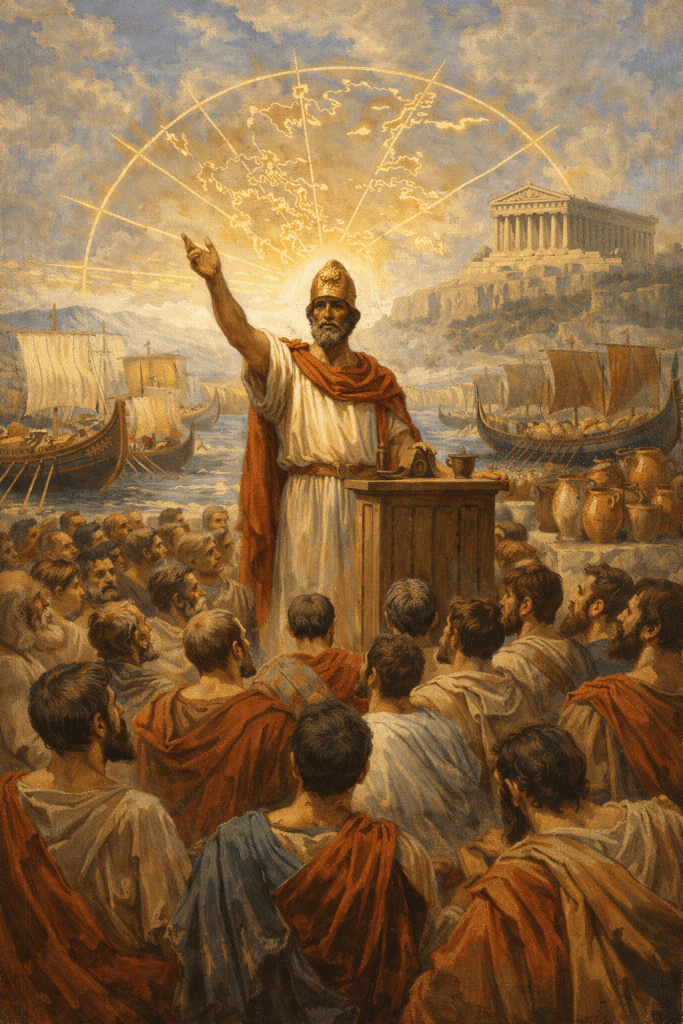
Athens leveraged victory over an aggressive foreign adversary into military, political, and economic dominance of their world. They attributed their success to their own fortitude, moral rectitude, and political system. Sounds like something Ronald Reagan or really any modern US president could have said. Right?
However the ancient truism that “mo money, mo problems” was also in effect. Athenians at the time knew and commented upon this truth.
“There’s an ancient saying, old as man himself: men’s prosperity never will die childless, once full-grown it breeds. Spring from great good fortune in the race comes bloom on bloom of pain- insatiable wealth!” Agamemnon (Aeschylus 458BCE Fagles translation 744-750)
As the purview of Athenian democracy grew from managing domestic affairs to maintaining their local ecosystem, the political and economic stakes of their elections changed and factional divisions began to dominate their politics. On more than one occasion these factional divides blossomed into violence against individuals and the state. In 411 BCE, shortly after the financial and military blunder of the Sicilian campaign, a group usually called “the four hundred” assaulted The Athenian “boule”, the democratically elected governing council in the course of their duties, and installed an oligarchy. During their brief rule several democratic leaders were assassinated. The ancient Greeks coined a term for this type of internal conflict: Stasis. Google’s Gemini defines the term as “civil strife or internal conflict within a city-state (polis), often characterized by violent factionalism between different social or political groups, and leading to bloodshed and external intervention”. The ongoing public drama of the latter-half of the 5th Century contributed to the Peloponnesian War which ended with Sparta imposing the rule of “the 30 tyrants” over Athens.
The rise and fall of Athenian power and democracy in 5th century BCE was the backdrop of much of what we call classical Athenian culture. The works of Aeschylus, Sophocles, and Euripides were written during this century. Plato lived during the height of the political dysfunction, chaos of war, and tyrant rule. These experiences are directly reflected in his dialogues, especially The Republic. This is all to say that political violence is not isolated to radicalized terrorist groups, or the overthrow of tyranny by patriots. Political violence erupts even in wealthy democracies enjoying post-war economic booms wielding major foreign influence with the ability to impose their will on their neighbors and allies. It turns out that even in our dysfunction, we are not unique snowflakes.
Before I pontificate further, allow me to develop a working definition of political violence for the purposes of this essay. In my opinion political violence need not be motivated solely by factional contention. Democrat vs Republican electoral politics certainly inspire animosity, but I think the term has broader application. I also believe it extends beyond any specific policy agenda. Protests or acts informed by a goal that turn violent certainly count as political violence, but I think there’s even more to it. I would submit that violence motivated by a conflict of values within the public sphere regardless of how inarticulate the argument, or poorly considered the act are manifestations of political violence. I would argue this is distinct from other forms of violent crime because it is not motivated primarily by personal gain. I distinguish it from inter-personal violence because it is not driven primarily by individual animosity in an established relationship. There are probably several other categories of violence and room for overlap between categories, but this broad description will suit my purposes.
Why is this essay appearing in your series on The Bhagavad Gita? What does any of this have to do with an ancient Indian epic? Plenty. One unavoidable truth is that The Gita offers an explicit endorsement of an act of political violence. Recall that The Gita opens on a battlefield lined by thousands of warriors. In the moments before the armies clash a single chariot ventures into the middle of the field and two men debate whether or not it is appropriate to engage in war. To be certain: an unusual time and place for such a debate, but dark moments of the soul rarely keep bankers’ hours. I think it’s pretty admirable for Arjuna and Krishna to have the presence of mind to pause right before a battle, even though it has been on the horizon for the better part of a two decades, and reflect on whether or not it is wise to proceed. By definition the genre of heroic epic celebrates the exploits of the warrior class and generally there is an implicit assumption that violent conflict resolution is a viable, and even an honorable or desirable option. Gilgamesh, Homer’s Iliad and Odyssey, The Ramayana, The Aeneid, and modern action movies all adopt this paradigm. I think the American Bard Todd Snider offers a trenchant commentary of the subject in his song Tension:
“After the bad guy killed off all the under-developed characters, the good guy put a bullet right through his head. The screenwriter stood up and told us that all the loose ends had been tied up; justice is irrelevant; violent problems require violent solutions, because in America we like our bad guys dead. It’s called box office baby. It’s bigger than The Stones”
The point being that The Gita is not unique in presenting violence as a moral virtue, but it takes the uncommon step of offering an explicit argument rather than accepting a tacit assumption. This begs the follow-up questions, “what are its arguments?” and “should we accept them?”. Let’s jump in.
The Divine Call To Arms
In the opening chapters of The Gita, Arjuna articulates a series of reasons against his participation in the battle.
- He recognizes that the war’s victims will not be isolated to those killed on the battlefield.
“Even if they [his opponents] are blind to the consequences of the family’s destruction, of friendships lost to treachery, how are we not to comprehend that we must turn back from evil? The wrong done by the destruction is evident, for with the family destroyed its eternal laws perish; lawlessness overwhelms the whole family… Men whose familial laws have been obliterated are damned to dwell eternally in hell” (1:38-44 Flood)
- He recognizes that the victors will be bloodstained ever after.
How will I fight these honourable men? Better to eat beggar’s food than to kill these great-souled teachers here on Earth; for if I killed these teachers I would eat food covered in blood. Even after we’ve killed them we would not want to live!” (2:4-6 Patton)
“Out damn spot!” (Macbeth act 5 scene 1)
- He even questions the perceived benefits of victory.
“The ones on whose behalf we long for kingship, delights and pleasures – these are the very ones drawn up in battle, giving up life-breath and wealth!” (1:33 Patton)
“It grieves me that as we intend to murder our relatives in our greed for pleasures, kingdoms, we are fixed on doing evil.” (1:45 Flood)
“My own nature is struck by pity, and a sense of wrong, and my mind is clouded as to dharma; I don’t see what would take away my grief – even though I might gain opulent and unrivalled kingship here on Earth, or even lordship of the gods.” (2:8-9 Patton)
Following this argument against war Arjuna drops his bow and collapses in the chariot (1:47) and concludes, “I will not fight!” (2:9)
I find his rationale compelling. How does Krishna persuade him to change his mind?
Beyond killing friends and neighbors, Arjuna outlined a sequence of adverse consequences of battle whose ultimate end would be the abandonment of personal, familial, and caste dharma. (1:40-44)
One argument Krishna offers is that Arjuna, by virtue of his birth into the Kshatriya caste, has an obligation to wage war.
“Nor should you tremble to perceive your duty as a warrior; for him there is nothing better than a battle that is righteous… If you turn from righteous warfare, your behavior will be evil, for you will have abandoned both your duty and your honored name. People will speak of your disgrace forever, and an honored man who falls from honor into shame suffers a fate much worse than death.” (2:31, 33-34 Flood)
Krishna, who we know is an avatar of the god Vishnu, argues Arjuna not only should, but has a moral duty to engage in battle. Arjuna argued that engaging in battle would disrupt the performance of dharma, and Krishna points out that refusing to fight is a voluntary abdication of Arjuna’s personal dharma. A choice to not fight constitutes the exact thing he says he fears. Damned if you do, and damned it you don’t.
I considered not presenting the other part of Krishna’s argument because I dislike it so much, but here I go. Krishna claims death is merely an illusion representing a misunderstanding about the nature of being and a necessary part of the cyclical nature of existence.
“You speak as if with words of wisdom, but you have mourned that which is not to be mourned. Wise men mourn neither those whose life-breath is gone, nor those whose breath remains… Just as childhood, youth and age exist in the body of the embodied self, in this way, one takes on another body. Those who see clearly are not confused by this…The one who perceives the self as a killer, and the one who perceives the self as killed: neither of them know that this self does not kill, nor is it killed. The self is not born nor does it ever die. Once it has been, this self will never cease to be again. Unborn, eternal, continuing from the old, the self is not killed when the body is killed… Just as one throws out old clothes and then takes on other, new ones; so the embodied self casts out old bodies as it gets other, new ones.” (2:11, 13,19-20, 22 Patton)
This is consistent with Hindu teachings of transmigration of the soul. It also has potentially disgusting applications. One could easily envision a twisted logic that killing someone is actually morally “good” because you’re hastening their departure from Samsara. Every time I come across this argument in the Gita I feel obliged to underline it and write something like “this is terrible”, or “dangerous idea”. I don’t have a tally, but it’s sprinkled in often enough that it’s not a mistake, one-off, or fringe view that got interpolated into the text.
I mentioned that these arguments are presented by a god with Krishna serving as an avatar of Vishnu. It turns out that in The Gita, Krishna is more than “just” a god when he presents this argument. In the middle of the text, he reveals himself as the entirety of the universe: he is existence and non-existence, he is the physical reality and the natural forces that create and sustain life.
“I am the ritual and the worship, the medicine and the mantra, the butter burnt in the fire, and I am the flames that consume it. I am the father of the universe and its mother, essence and goal of all knowledge, the refiner, the sacred ‘Om’ and the threefold Vedas. I am the beginning and the end, origin and dissolution, refuge, home, true lover, womb and imperishable seed. I am the heat of the sun, I hold back the rain and release it; I am death and the deathless, and all that is or is not.” (9:14-19 Mitchell)
“I am the Self. I dwell as the refuge of all beings, and I am also the beginning, middle and end of beings” (10: 20 Patton)

In a long series of examples he claims to be specific manifestations of general concepts, as well as the general principles from which they arise. Thus he presents himself as the embodiment of the greatest claim of late Vedic / Upanishad Hinduism: that Atman (the individual soul) and Brahman (the ultimate reality of the universe) are one and the same. The idea being that we are deceived by our perceptions, and the things we conceive as separate entities or dualities are (is? I’m not sure about appropriate subject verb agreement for this claim) actually one great unity. He claims that to understand, accept, and act upon this truth is to know Him and achieve liberation.
“Among the great lights I am the sun (10:21)… Among the mountains, I am Meru (10:23)… Among the waters, I am the ocean (10:24)… Among purifiers, I am the wind… Among rivers, I am Ganges (10:31)… I am death, who seizes all, and the beginning of that which will be (10:34)… Among those who cheat, I am risk (10:36)… Among rulers with the sceptre, I am authority. Among those who want victory, I am wise conduct. Among hidden things, I am silence. Among the wise, I am wisdom. Among all beings I am the seed. There is no creature that would be without me… there is no end to my divine forms (10:38-40)”
Consequently, the audience is confronted with the claim that the very fabric of reality and the ultimate truth of existence argues that Arjuna must act against his own judgment, accept his duty, and fight.
Does that strike you as strange? What sort of god commands his creations to kill his other creations? Or in this case “his divine forms”. In my limited survey of religious thought: many of them do it at some point. Side stepping that minefield and focusing on the specifics of Hinduism: the argument that Krishna’s duty is to fight has its roots in one of the creation stories of The Rig Veda. The Purusha describes the creation of the universe drawn from various body parts of a dismembered celestial being. Among other things it accounts for varna/ castes which continue to influence Indian culture. The Kshatriya or warrior caste is drawn from the being’s arms (get it?), so they are the ones who get things done. A portion of an individual’s duty/dharma is determined by their caste, so in that sense Arjuna was “born to do this”.
The Double-Edged Sword
Western culture has its own versions of the Kshatriya caste. In many myths, kings and heroes are described as demigods claiming divine heritage which not only accounts for their amazing abilities, but endows their descendants with a right to rule. Roman culture had the patrician class. Medieval Europe had the three estates and the divine right of kings. The warrior class often coincides with the ruling class. Modern American democratic republicanism features universal suffrage and espouses meritocratic ideals, so class rigidity may feel foreign; a relic of an unenlightened past. However, a quick survey of US Presidents may reveal a latent reverence for warriors as leaders: George Washington, William Henry Harrison (famous for leading troops at the battle of Tippecanoe in the war of 1812 – “Tippecanoe and Tyler Too!”), Andrew Jackson (War of 1812 – Battle of New Orleans), Zachary Taylor (Mexican-American War), Ulysses Grant (Civil War), Theodore Roosevelt (Spanish-American War), and Dwight Eisenhower (WWII) spring immediately to mind. The list of Presidents who served in some capacity is much longer. I’m old enough to remember a lot of political hay being made of Bill Clinton’s lack of military service in 1992 and 1996. Presidential approval ratings typically go up during wars in which we are perceived as “winning”, and quagmires like Korea, Vietnam, Afghanistan, and Iraq have been reflected as deflations in public opinion about the chief executive. I would submit that the business of the current President summoning and speaking to an unprecedented meeting of all high ranking commanders from every branch of the military at Quantico, VA on September 30th 2025 smacks of a septuagenarian President who avoided service due to bone spurs trying to appear like a strong warrior. Bottom line: humans have and continue to dig the warrior class and seem to want them to lead their groups. Leaders use their prior service as a credential for competence, and those lacking these bona fides seek to cloak themselves in military imagery. Is this apparent attraction to a violent warrior class as leaders reasonable?
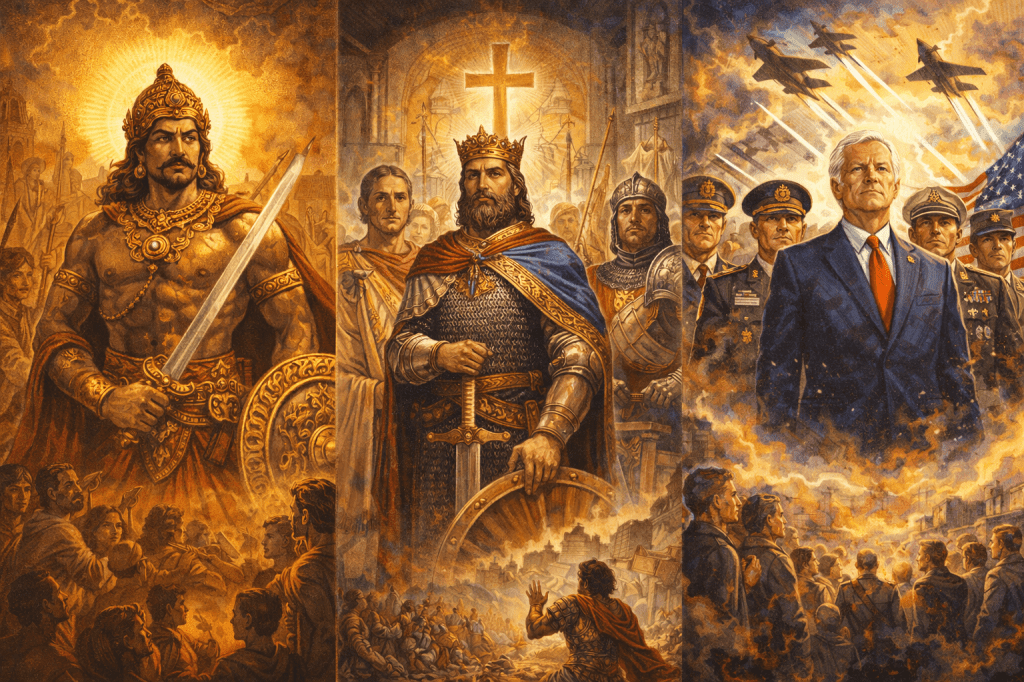
One might cite discipline and managing complex operations as hallmarks of executive function and desirable qualities for a leader. Sacrificing personal safety to “a greater cause” manifested by facing danger and death in service to the group offers concrete proof of “where someone stands” in terms of commitment and gives substance to words like duty, honor, and patriotism; a very obvious means of “putting your money where your mouth is”. I’m sure these aspects play a role in our attraction to warriors as leaders, and I suspect there’s something even more basic.
The truth is the world can be a dangerous place. Mitigating threats to one’s physical well-being is a shared, universal priority. Gains in productivity that come from cooperation and division of labor are clear advantages to living in a group. It stands to reason that having a subset of people within a community that employ a well developed executive skill set and a proficiency for combat in service of the group would be advantageous. Groups that engender and reward this sort of behavior may be better at self-preservation in the face of threats and therefore propagate this form of cooperation and organization through the ages. However, being on the front lines of conflict is notoriously perilous and threatens the promulgation of the subset of the population with the martial skillset. Therefore it makes sense that willingly engaging in combat would be accompanied by prestige and privilege within the group that makes the risk worthwhile. Consequently, it seems likely a dynamic between group survival, martial prowess, and social esteem naturally leads to a favorable view of the warriors among us. Hence, the widespread, cross-cultural phenomenon of the heroic epic genre which consistently highlights the virtues of the warrior class.
I ventured down that speculative rabbit hole because a reader could argue that Krishna and The Gita aren’t suggesting that violence is inherently good, but that a specific type of person has a duty under specific circumstances to wage war. Arjuna and his brothers are forced into violence on several occasions during the Mahabharata and the phrase “cruel Kshatriya dharma” is often invoked when they embark on these exploits. The Pandavas appear to recognize that violence shouldn’t be undertaken lightly, and despite their brilliance in the martial arts, they don’t seem to relish it. They are simply doing their duty to their family, hosts, and communities. Andromache is not gawking at the carnage of battle, but weaving (the most appropriate duty of a woman in Homeric Greece) when Achilles and Hector are dueling outside the walls of Troy, and rises in fear when she hears an outpouring of grief in the city and says to herself, “I’m afraid Achilles has cut off my brave Hector and has put an end to my husband’s Cruel courage. Hector never held back safe in the ranks; he always charged ahead”. This view of violence as a specific duty lines up with further teachings by Krishna:
“When Prajapati brought forth life, he brought forth sacrifice as well… Nourish the gods with sacrifice, and they will nourish you as well. By nourishing each other, you will realize the highest good… One who enjoys such gifts without repaying them is just a thief. One who in this world does not turn the wheel, thus setting it in motion, lives uselessly, a sensual, malicious life” (3:10-16 Flood)
“Better one’s own dharma, even if ineffective, than the dharma of another practiced well!” (3:35 Patton)
Thus we’ve partially redeemed the Gita’s call to violence through a more nuanced reading of the text, but we all know what happens when you cut off one head of the hydra…
If we accept that some have a duty to engage in violence, new disturbing questions sprout about the prerogatives of war-making. How does one define the warrior caste? Is it a birthright? An intermittent divine dispensation? Is it a calling one can pursue? To whom do we grant the ability to dispense violence? To what extent do we give them agency in its exercise? How do we restrain the guys with the weapons and authority to wage war if and when we disagree with their judgments or become the targets of their violence? Granting the privilege of violent behavior is like opening Pandora’s Jar, or releasing the genie from the lamp, or squeezing a tube of toothpaste. Pick whichever metaphor you like, once it is released, the peril and irrevocability become obvious, and the method of containment is not.
A Long Train of Abuses:
The US Declaration of Independence argues “That whenever any Form of Government becomes destructive of these ends, it is the Right of the People to alter or to abolish it, and to institute new Government…. But when a long train of abuses and usurpations, pursuing invariably the same Object evinces a design to reduce them under absolute Despotism, it is their right, it is their duty, to throw off such Government, and to provide new Guards for their future security”. Most of us know the Declaration of Independence for its philosophical claims of self-evident truths, unalienable rights, and consent to be governed, but the bulk of the text is a list of grievances against King George III of England.
Esoteric things that are totally foreign to us like: “He has endeavoured to prevent the population of these States; for that purpose obstructing the Laws for Naturalization of Foreigners… He has kept among us, in times of peace, Standing Armies without the Consent of our legislatures. He has affected to render the Military independent of and superior to the Civil power. For cutting off our Trade with all parts of the world… For depriving us in many cases, of the benefits of Trial by Jury. For transporting us beyond Seas to be tried for pretended offences… He has excited domestic insurrections amongst us” just to cherry-pick a few. So they faced a dilemma much like Arjuna. Arjuna and his family had survived an assasination attempt, had literally been cheated out of house and home and sent into exile for 13 years, and then prevented from returning home despite their compliance with the terms of their deportation. How should one counter such intransigence? History and sad experience tells us that violence is occasionally necessary for self-preservation and an effective tool for overthrowing oppression, yet it is also one of the primary means of tyranny. Violence is a tool, and as such it can be used in the service of liberation or oppression, it can move us closer or further from our individual and collective goals. We celebrate and despise it. I believe this understanding of violence is the most appropriate time possible to invoke the “double-edged sword” metaphor.
Violence and The Law
It is this Gordian Knot of managing the utility of violence the Founders and Framers™ of the American Republic sought to untangle when they declared Independence and adopted constitutional government. I think an argument can be made that one of the fundamental projects of government and civilization is maximizing collective non-violent conflict resolution. It is really difficult to have peace, order, and otherwise enjoy one’s liberty under constant threat of violence. After all, “life” was the first “unalienable right” listed in the Declaration of Independence. In the interest of establishing justice and forming a “more perfect union” the preamble to the US Constitution says its goals are ”to ensure domestic tranquility“ and “provide for the common defense”. These words speak to a desire for stability through peace rather than conflict.
If we look back at the genre of heroic literature, heroics are necessary because the conflicts being navigated are recalcitrant to legal remedy. The Trojan War happened because Paris and the city of Troy refused to honor customs of Xenia, and the only power greater than a polis or kingdom was a military coalition. Accordingly, a thousand ships were launched. Hello NATO. Agamemnon, a “king of kings” exercised his authority to enforce his petty and vindictive desires. Achilles had no source of arbitration against Agamemnon except to employ violence himself or withdraw from combat and allow his absence to be felt. His refusal to fight led to the accumulation of a significant body count, an existential threat to the Greek forces, and eventually Agamemnon capitulated. Achilles’ persistent rage then led to an unprecedented killing spree on the plains of Troy. Odysseus killed over 100 unwanted guests who refused to depart despite the repeated requests from the householders (Penelope and Telemachus) and the local council of elders. As I discussed in detail during that series, the Oresteia confronts the endless cycle of violence engendered by retributive bloodshed via the divinely inspired invention of a jury trial. Even in ancient fiction, law is presented as the means of circumscribing violence.
Exiting the realm of myth and literature: Hammurabi’s famous “eye for an eye” law code was full of provisions about making restitution without perpetuating violence. Only about a dozen of the 282 laws prescribed direct retaliatory punishments. To be clear there was plenty of maiming for other offenses, but many of the laws prescribe fines for crimes like breach of contract, and in some cases even assault. “Eye for an eye” was the law when a member of one stratum of society assaulted another member of the same class. However, there were what we might consider “progressive” laws that prescribed hefty fines on upper class citizens for harming or disabling lower class citizens. An upper class citizen would owe something on the order of 5 years pay (1 Mina of gold) for breaking the bone or blinding a member of the lower class (law 198), breaking a tooth would cost ⅓ of a Mina of gold (law 201). The obvious fact is that you don’t need a written law if retaliation is the remedy for conflict. The punishment is pre-determined by the crime. By definition law sets the limits and parameters of reprisal and generally mitigates rather than perpetuates violence.
Law employs a combination of social approbation and an agreed upon punishment to disincentivize anti-social behavior, but also limits violent reprisals and their fallout. Returning to the quote I used to open this essay. The use of the death penalty enjoys plenty of historic precedent, but has come under fire for a variety of reasons. Its deterrent value is questionable. It costs more than long-term, even lifelong incarceration. To me the most compelling argument against state sponsored killing is the potential misapplication of the death penalty. What is the acceptable rate of false conviction in death penalty cases? I’m sure there are plenty of other good reasons a person could cite for wanting to avoid “tinkering with the machinery of death”. The point is that like war, the death penalty is state sanctioned violence rather than prevention, and these exceptions rightly endure scrutiny and debate about how, when, and why they are used. The same is true of law enforcement tactics and behaviors. Discussions about these concerns often take the form of policy debates, but I think there is an element of violation of first principles involved as well. The state resorting to violence as a means of conflict resolution (especially within its own borders) undermines one of its essential functions.
The Politics of Curbing Violence
If we accept that one of the functions of government is to curb violence, then one metric of the success of the state is how much violence we endure and commit. This may explain why trotting out crime statistics is an effective political strategy regardless of how dubious the claims politicians make about them. I think it unreasonable to expect any state to achieve the unlikely outcome of zero violence. Consequently, we seek a trend toward an acceptable goal. What level and types of violence are acceptable, and for what purpose are matters of personal taste and public debate. When I started the essay with the claim that to live in civil society is to tinker with the machinery of death: these types of questions are what I had in mind. This debate is modeled by Arjuna and Krishna in the chariot.
Returning to focus on political violence, what governmental or social features encourage or curb political violence? Unsurprisingly there are a lot of theories and opinions on the subject. Given my own lack of expertise and familiarity with rigorous data on the subject I’ll stick to the thing I know best and in which I have the greatest faith on these matters: The US Constitution. It also happens to be the most practical and relevant approach to this discussion since it is the framework within which we (aspire to) operate.
There are two features of The US Constitution that I believe are particularly relevant to curbing violence: It forges a national identity centered on The Rule of Law, and it codifies an ongoing conversation about what those laws are and what they mean.
The Sacred Dance
In my opinion, one of the most important things the US Constitution does is outline a national identity independent of race, religion, language, or ethnicity.
We the People of the United States, in Order to form a more perfect Union, establish Justice, insure Domestic Tranquility, provide for the Common Defense, promote the General Welfare, and secure the Blessings of Liberty to Ourselves and our Posterity, do ordain and establish this Constitution for the United States of America.
Our founding document proclaims that the thing that makes us Americans is a collective commitment to national unity, justice, domestic tranquility, common defense, general welfare, and liberty. I will briefly observe that many focus almost exclusively on liberty as the defining American ideal, but there are several competing concepts in tension here. I’ll return to how we address those tensions shortly.
Another key component to the national identity proposed by the preamble is that we work toward these ideals through the constitution itself. American identity is about forging a nation through the rule of law. “The Rule of Law” is just a phrase, so I’ll define what I think it means here: a system that holds individuals and institutions, both public and private, accountable through impartial application of laws with transparent methods of defining those legal standards. Basically a systematic approach in which all are subjects to the law. I used “subjects to” not “subject to” on purpose here to distinguish it above the whims or prejudices of a king, president, other office holder or official. This feels obvious when you spell it out, yet very few humans have lived under such a system. The Rule of Law is an obvious and agreeable concept when one can invoke it in one’s own interest or against one’s opponents, but history shows that it is tempting to abandon it when one perceives unaddressed injustice, systemic failure, or if one has the opportunity to wield authority that could bypass the system. There is a long catalog of challenges to, and erosion of, our collective commitment to the rule of law over recent decades in the United States. I will avoid the temptation to list the failures that bother me the most here, but rest assured I get very frustrated and animated when confronted by our imperfect commitment to these principles.
In Sophocles’ Oedipus, the title character clearly moves away from his stated commitment to justice and toward tyranny when he falsely accuses, then threatens to kill his brother-in-law Creon for treason without any proof of his guilt. The Chorus of Theban Elders faces a crisis that threatens the polis. They sing about their grief as the commitment to law is so brazenly discarded by the interests and desires of a single man:
“Great laws tower above us, reared on high born from the brilliant vault of heaven… Pride breeds the tyrant, violent pride, gorging, crammed to bursting with all that is overripe and rich with ruin… But if any man comes striding high and mighty in all he says and does, no fear of justice, no reverence for the temples of the gods- let a rough doom tear him down, repay his pride, breakneck, ruinous pride! If he cannot reap his profits fairly, cannot restrain himself from outrage- mad, laying hands on the holy things untouchable! If all such violence goes with honor now; why join the sacred dance?”
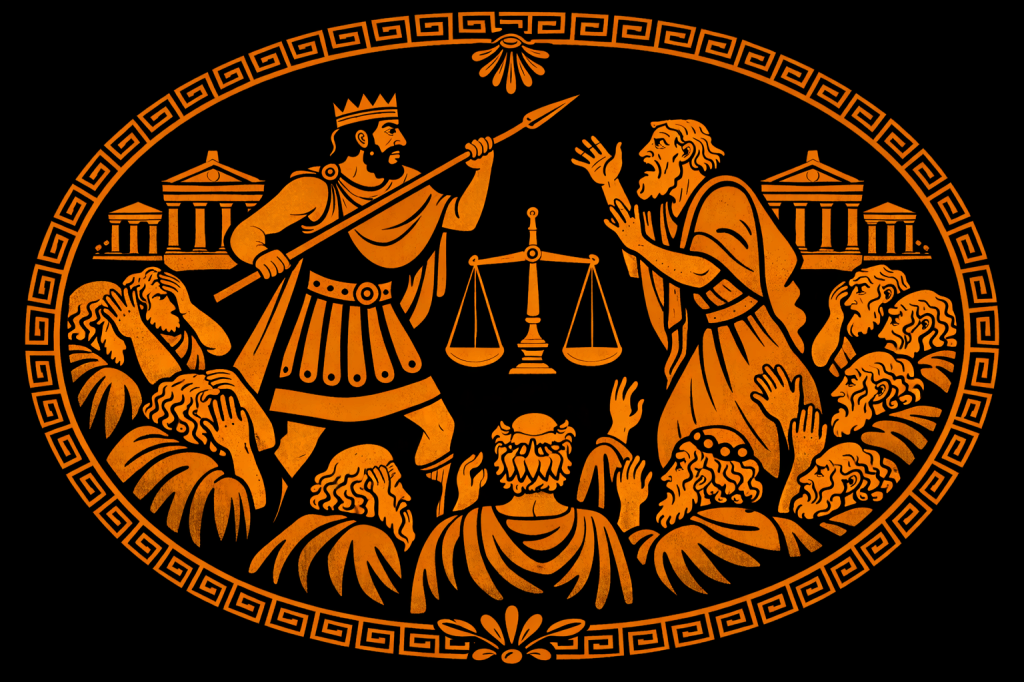
The truth the chorus recognizes here is that communities are home to diverse interests resulting in a host of movements in the public sphere. These disparate motions function well when they are restrained and subject to law. A form of coordination develops and a community thrives when all “join the sacred dance”. However, law is a concept invented by humans; it has no independent reality outside our shared commitment to it, so if that commitment erodes enough, if we refuse to be subjected to constraints, then coordination falters and there’s a good probability that chaos ensues.
How do we inspire folks to participate in the “sacred dance”? Implied in the term is a reverence for the origin and nature of the laws in question. The Theban Elders proclaim that their “great laws” were “reared on high from the brilliant vault of heaven”. Consider for a moment the fact that many foundational legal documents ensconce themselves in myth and religious imagery. The prologue of Hammurabi’s code cites divine sanction for its laws:
“Then Anu and Bel called by name me, Hammurabi, the exalted prince, who feared God, to bring about the rule of righteousness in the land, to destroy the wicked and the evil-doers; so that the strong should not harm the weak; so that I should rule over the black-headed people like Shamash, and enlighten the land, to further the well-being of mankind… When Marduk sent me to rule over men, to give the protection of right to the land, I did right and righteousness and brought about the well-being of the oppressed.”
In Ancient Athens jury trial was invented by Athena (their patron deity). The Decalogue of Exodus carries divine sanction. The Declaration of Independence invokes a creator endowing humans with unalienable rights.
We believe in laws the same way we believe in the gods. I won’t get into the establishment clause of the First Amendment, but there is a popular notion that in these United States our laws should be separate from the divine. This is famously a matter of debate which I will conveniently skirt here. I am of the opinion that the sacred need not issue from the divine and that we choose to render something sacred through a process of personal and collective commitment. Every moment and choice in a life of limited duration is a form of human sacrifice. We make something sacred by consciously sacrificing our lives to it. We make the dance sacred by choosing to dance.
This opinion fails to respond to the question of how we inspire folks to make that sacrifice. I don’t know the answer, but my experience with the American Civil Religion, prior participation in a religion that inspires deep and abiding commitment, and a prolonged dive into world myth leads me to believe it has something to do with how we tell our story. I think we can tell a version of our story that both inspires and demands our best despite recognizing our follies. It seems to me our two major political parties seem divided on the question of how to address our past and present follies with the result that their versions of The American Story seem uninspiring to those not closely aligned with their ideologies. Can this situation be rectified? Probably. Will it? I have no clue. All I can do is hope and join in the sacred dance myself.
Good Faith Negotiation
Taking a brief glance beyond U.S. history one example of ongoing negotiation is The Magna Carta. One of the great heritages of the English speaking world is the formal restraint on authority in the Magna Carta. Specifically during the Plantagenet dynasty. Famously, English nobles sought to curtail perceived abuses of King John (the phony king of England of Robin Hood fame). He signed it, and immediately ignored it. That day at Runnymede in 1216 didn’t instantly transform England or the monarchy. The real heritage is the precedent and the fact that many kings were forced to re-issue Magna Carta and other formal declarations of limitations on royal authority and/charters of rights for generations. There was an ebb and flow of the extent of these restraints depending on political realities of the times, but formal institutional structures like parliament eventually emerged. When English kings negotiated in good faith ( Edward I, Edward III and Henry V’s track records of using parliamentary negotiations is a reasonable example) compromises that supported royal agenda while preserving other national interests were frequently found. While kings who failed to engage the process claiming divine privilege or failed to abide by compromises were repeatedly thwarted in their goals (John, Henry III, and culminating in supremacy of parliament in the deposition of Edward II). These formalized facets of governance were carried forward into diverse expressions of constitutional government in the modern world. Despite our attachment to specific dates as markers of transition; transformation of public policy and practice is not a single event (1066, 1776, 1789, 1919 etc.), but an ongoing negotiation.
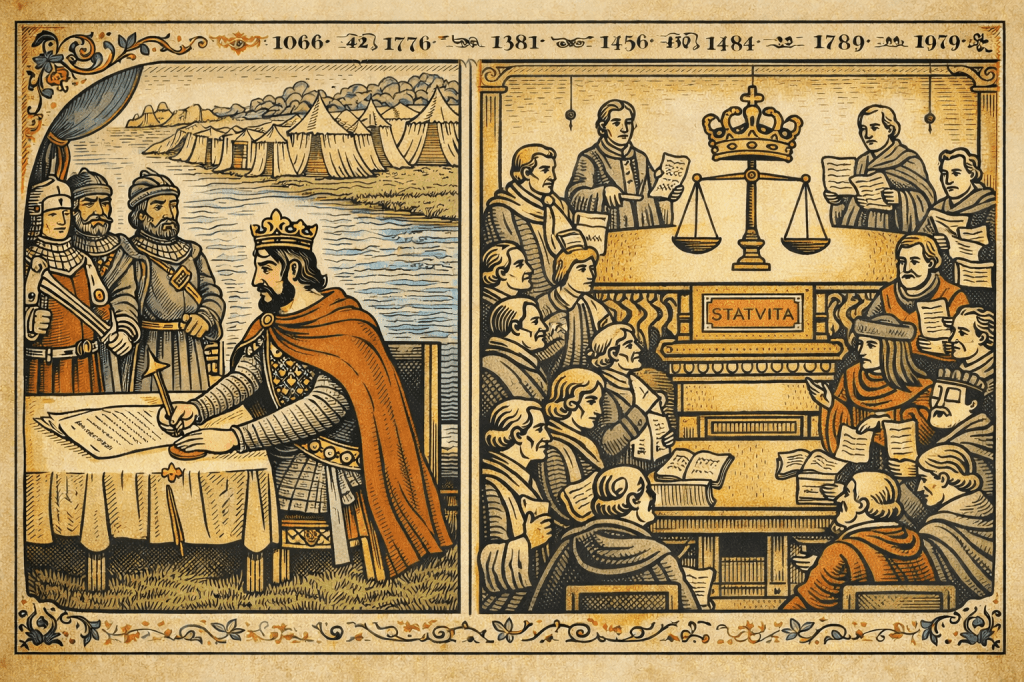
The Constitution has a lot to recommend it as a government document, but in its original form it had some objectionable features. Most noteworthy: It allowed for slavery and counted enslaved humans as only 60% of a person for purposes of counting population. It also had a narrow definition of voting rights. However, it had a built-in feature for self-correction and we have used that mechanism to make 27 amendments to it. The idea of “what the Framer’s™ meant” carries major currency when discussing The Constitution. The Framers™ meant to codify slavery. The Founders® meant to deny women and non-white, non-property owning men the vote. They intended that senators be appointed by state legislatures, not by a general election. By design the original document lacked the Bill of Rights. Some argued that listing rights was unnecessary (Federalist 84). We amended it. We abolished slavery (13), and extended voting rights several times (15, 19, 24, & 26) . We granted the government the ability to tax our income (16). We decided to outlaw the transportation and sale of alcohol (18) and then changed our minds back 16 years later (21). We codified key elements of our concept of the rule of law (4, 5, 6, 7, 8, and 14). The point is our founding document recognizes that the meaning of the key elements of American Identity put forth in the preamble: national unity, justice, domestic tranquility, common defense, general welfare, and liberty are subject to ongoing negotiation; so any static interpretation of how we live those values is at odds with our founding document. I feel like I offered my critique of strict conservatism as a political philosophy in my series on The Oresteia so I won’t repeat it here, but I steeply discount claims based on historic authority. A democratic republic featuring a constitution that can be changed is, by design, an ongoing negotiation about what that republic and constitution stand for. Anyone who has told a child to “use your words” to diffuse a violent confrontation over a toy is expressing a faith in dialogue as a form of non-violent conflict resolution. Our methods of dialogue are undergoing major changes, and like our shared commitment to The Rule of Law, our public use of good faith negotiation seems to have eroded significantly in recent years. I don’t know how to fix these things on a system level, but I do believe engaging in honest conversation and debate is one of the essential motions of the sacred dance of state.
The Price of Departure
I have not and will not dispute that there are egregious individual and institutional failures of The Rule of Law and good faith negotiation in the United States recently. It’s disheartening and sometimes infuriating. However, when we choose to depart from the path of dialogue and commitment to shared goals, values, and principles; when we choose to abandon the features of a government that exists in part to curb violence, we will inevitably find ourselves on the path of political violence.
Famously “we don’t negotiate with terrorists”. When we label a person or organization as terrorists we accept that there’s no shared commitment to principles and values, thus no productive dialogue can be had, and violence is an acceptable recourse. This is how you justify invading multiple countries, get involved in two simultaneous land wars in Asia, and end up occupying hostile territory for the better part of a decade. It’s how you tear a country apart over something as reprehensible as slavery. It’s how you kill tens of thousands of women and children in a war started by a terrorist act. Abandoning law and dialogue is a bloody, expensive, and exhausting decision. One that often ends when folks change their minds and decide that negotiation is actually possible.
If we accept the first sentence of the preamble to the US Constitution, “We the People… do ordain and establish”, that our law is a reflection of our collective will, a reasonable measure of our collective commitment to its stated goals and the effectiveness of our dialogue is the amount of violence in which we engage as a nation and citizens. Consider the violence associated with protests against police brutality, and the assault on the US Capitol January 6, 2021. If people felt like their grievances could or would be addressed at the ballot box or legislative process would they have resorted to violence? By definition they lacked faith in those institutions. If they felt that the public discourse was taking their concerns seriously would they have left their homes to take to the streets and engage in violent acts? People who believe in the responsiveness of the system will engage the system. That engagement can, and should involve public assembly and protest (what’s the point of a first amendment if you never use it?); it doesn’t need to include violence. We have addressed many potential sources of violence through negotiation over the past 250 years, and I believe we are still capable of doing so. Violent conflict may be an occasional necessary evil (we’ll consider this question more closely in the next part of the series), but it can and should be avoided when possible. In my opinion that belief should motivate anyone who believes in civilization and government. This sounds obvious, but at this point I’m not certain it is.
If one is willing to accept this perspective the obvious follow-up question is: what non-violent methods of conflict resolution can one use when navigating conflicts characterized by asymmetries of power, intransigence of the opposition, a lack of shared principles or values, or some other impediment to change or negotiation? If our heroes have traditionally been characterized by violence, is it possible to construct a compelling narrative to honor a different model? Two of history’s most prominent examples of employing non-violent tactics to effect meaningful political change when facing these types of challenges are Ghandi and Martin Luther King Jr. As noted in my first journal, both were inspired directly or indirectly by The Gita. Thus the subject of my final essay will be an exercise in examining a story in a genre that encourages violence to extract a message that inspires a non-violent approach.
I’ll close by saying that I may not have agreed with much or anything Charlie Kirk said. He may have been the great example of Christian charity some make him out to be, or he may have been the fear mongering hate machine others describe. I suspect he was somewhere in between. Either way he didn’t deserve to be shot and killed. Just like Melissa Hortman didn’t deserve to die for her government service. My neighbor recently fired over 150 rounds at members of the St George Police department. His bullets passed through the fences, windows, and walls of several homes in my neighborhood. Miraculously nobody was injured or killed. He came out of that violent conflict alive, will stand trial, and answer to the the law for his actions. As it should be.
 MaximumKungFu