
In the first half of the Iliad, Homer creates dramatic tension between the historic role every audience member knows Achilles plays in the Trojan war and the fact that he is now sitting on the sidelines with a declared intention to return home. What will entice him to return to battle? Does his rage subside? And if so how? How does one mend a broken relationship? Achilles claims to have lost faith in the ideals that he previously took for granted. Where does one go from there? He’s been repeatedly warned against giving into his quick temper, but in his anger he has extracted a solemn oath from Zeus himself that the master of the thunderbolt appears to be making good on, does Homer intend to present his audience with a positive portrayal of implacable anger? A lot of things happen in the second half of the Iliad, but I’m gonna focus primarily on the pivotal events of Books 16 and 22 in this essay.
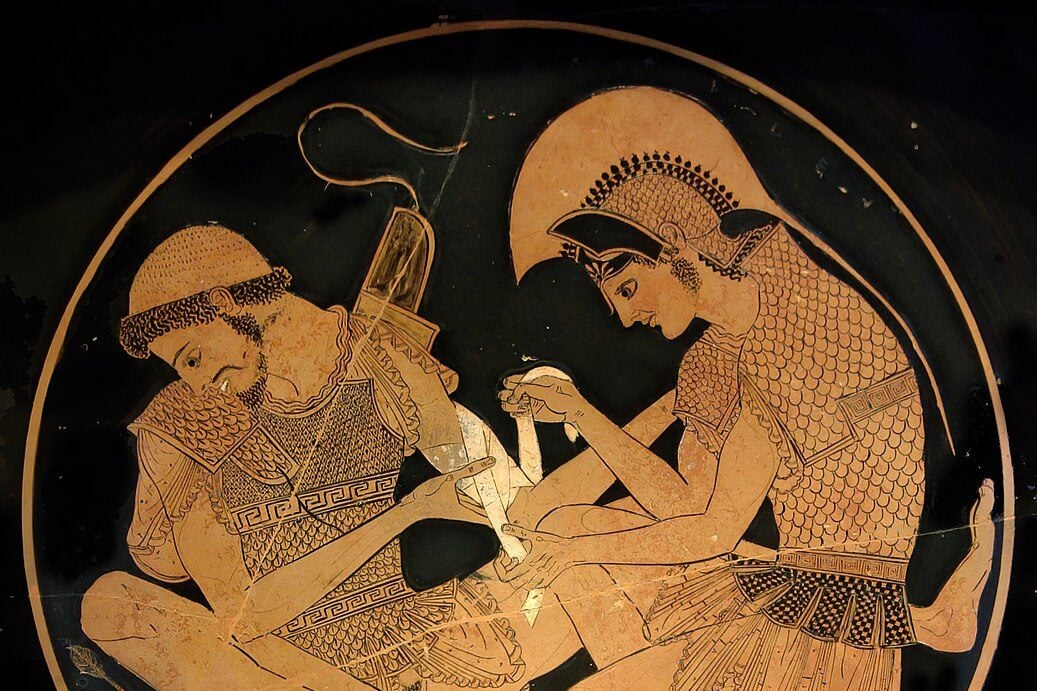
After Achilles refuses to accept Agamemnon’s gifts to return to battle he doesn’t leave like he said he would. He declares instead that he will rejoin the fighting only when the Trojans break through Argive fortifications and set fire to his own ships. There’s a fair amount of back and forth on the battlefield and a few attempts by other Olympians to impose their designs upon the outcome, but the will of Zeus will not be denied and the Trojans eventually breach the wall, advance through the Argive encampment and begin to attack the Greek ships.
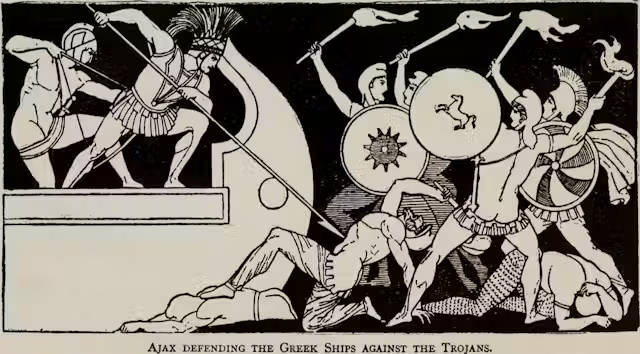
Similar to the crisis in Book 9, nearly the entire executive leadership team of the Achaeans has been injured and are unable to mount an effective defense or counter attack. Achilles’ best friend Patroclus is sent out on an errand and comes across several wounded or dying comrades. His compassion demands he stop and do his best to comfort them and he is brought up to speed on events while applying salves and poultices to those that have had to fall back from the front lines, and he’s actually in the shelter of Eurypylus when Hector and the Trojans come pouring into camp. Homer’s description of the intense hand-to-hand combat is vivid and Hector is the first Trojan to fight his way onto the top of a Greek ship the triumph he feels is plain
Hector held fast, he never let go of the high stem, he hugged its horn, arms locked in a death-grip, crying out to Trojans, “Bring fire! Up with the war cries, all together! Now Zeus hands us a day worth all the rest, today we seize these ships— they stormed ashore against the will of the gods, they came here freighted with years of pain for us, and all thanks to our city elders. What cowards! Whenever I longed to fight at the ships’ high stems the old men kept me back, they held the troops in check. Oh but if Zeus’s lightning blinded us those days, it’s Zeus who drives us, hurls us on today!” The harder he cried the harder his forces charged against the Argives”….
So they fought to the death around that benched beaked ship as Patroclus reached Achilles, his great commander, and wept warm tears like a dark spring running down some desolate rock face, its shaded currents flowing.
Achilles wants to know why his friend is crying and Patrochlus responds:
Spare me your anger, please—such heavy blows have overwhelmed the troops.
Our former champions, all laid up in the ships, all are hit by arrows or run through by spears.
There’s powerful Diomedes brought down by an archer, Odysseus wounded, and Agamemnon too, the famous spearman, and Eurypylus took an arrow-shot in the thigh … Healers are working over them, using all their drugs, trying to bind the wounds—
But you are intractable, Achilles!
Pray god such anger never seizes me, such rage you nurse.
Cursed in your own courage!
What good will a man, even one in the next generation, get from you unless you defend the Argives from disaster?
You heart of iron! He was not your father, the horseman Peleus—Thetis was not your mother.
Never.
The salt gray sunless ocean gave you birth and the towering blank rocks—your temper’s so relentless.
But still, if down deep some prophecy makes you balk, some doom your noble mother revealed to you from Zeus, well and good: at least send me into battle, quickly.
Let the whole Myrmidon army follow my command— I might bring some light of victory to our Argives!
And give me your own fine armor to buckle on my back, so the Trojans might take me for you, Achilles, yes, hold off from attack, and Achaea’s fighting sons get second wind, exhausted as they are …
Breathing room in war is all too brief. We’re fresh, unbroken. The enemy’s battle-weary— we could roll those broken Trojans back to Troy, clear of the ships and shelters!“
Homer uses this conversation to re-center the audience’s attention. The focus for the past 6 books has been on the physical battlefield, and now we’re reminded of the psychological war in the heart and mind of Achilles. Patroclus was in the room when Achilles revealed the extent of his disaffection to Odysseus, Phoenix, and Ajax, and clearly he overheard the bit about the prophecy of Achilles’ death. He confronts his friend directly wondering if the fear of death is what keeps him away from the fight.
Achilles replies to the accusation and request:
No, no, my prince, Patroclus, what are you saying?
Prophecies? None that touch me. None I know of.
No doom my noble mother revealed to me from Zeus, just this terrible pain that wounds me to the quick— when one man attempts to plunder a man his equal, to commandeer a prize, exulting so in his own power. That’s the pain that wounds me, suffering such humiliation.
That girl—the sons of Achaea picked her as my prize, and I’d sacked a walled city, won her with my spear but right from my grasp he tears her, mighty Agamemnon ,that son of Atreus!
Treating me like some vagabond, some outcast stripped of all my rights …
Enough.
Let bygones be bygones now.
Done is done.
How on earth can a man rage on forever?
Still, by god, I said I would not relax my anger, not till the cries and carnage reached my own ships.
So you, you strap my splendid armor on your back, you lead our battle-hungry Myrmidons into action!
Achilles takes pains to clarify to Patroclus, facing his own death is not the issue, but the fact that by taking Briseis from him Agamemnon violated the social contract that bound men at arms together. Something breaks in Achilles here. The days of carnage haven’t swayed his resolve, but seeing his best friend in genuine distress seems to soften him. Zeus has granted his desire to have the entire Achaean army suffer, nonetheless he realizes the impotence of his rage. The suffering of others has neither mended his wound nor given him satisfaction, and he sees now the negative impact of these things on those he loves. He acknowledges this yet will not return to fight until his own ships are threatened, but Patroclus is free to go forth in combat with the Myrmidons.
This my friends, this is what I believe is what one would call hamartia, the critical decision where Achilles misses the mark. He recognizes the harm his decision has inflicted upon his comrades, and desires to mitigate the damage he has done/ is doing, but cannot bring himself to release his spiteful resolve and return to combat. He half-asses it. He sends his best friend and all his men into battle, but holds himself back. The potential for regretting this decision is painfully obvious to the audience. If you genuinely believe Zeus himself is responsible for turning the tide of battle the way that it has, and you have also said that you will not enter the fray until your own ships are burning, and your ships are conveniently placed at the far end of the beach away from the main encampment so its likely your ships will burn only once everything else is destroyed or seriously damaged, then what do you suppose the likely fate of your friend and men will be prior to you taking up arms? We all see it coming. It may be that Achilles feels he is honor bound to maintain his promise to not return to battle as he declared his intention before the entire army and reiterated it to the embassy offering amends; regardless we see how his pride sets him up for a precipitous fall.
To reinforce the ominous feeling we all harbor regarding this decision Homer has Achilles offer up a prayer to Zeus for Patroclus’ safe return.
“King Zeus—If you honored me last time and heard my prayer and rained destruction down on all Achaea’s ranks, now, once more, I beg you, bring my prayer to pass!
I myself hold out on shore with the beached ships here but I send my comrade forth to war with troops of Myrmidons— Launch glory along with him, high lord of thunder, Zeus!
Fill his heart with courage—so even Hector learns if Patroclus has the skill to fight his wars alone, my friend-in-arms, or his hands can rage unvanquished only when I go wading in and face the grind of battle.
But once he repels the roaring onslaught from the ships, let him come back to me and our fast fleet—unharmed— with all my armor round him, all our comrades fighting round my friend!”
So Achilles prayed and Zeus in all his wisdom heard those prayers. One prayer the Father granted, the other he denied.
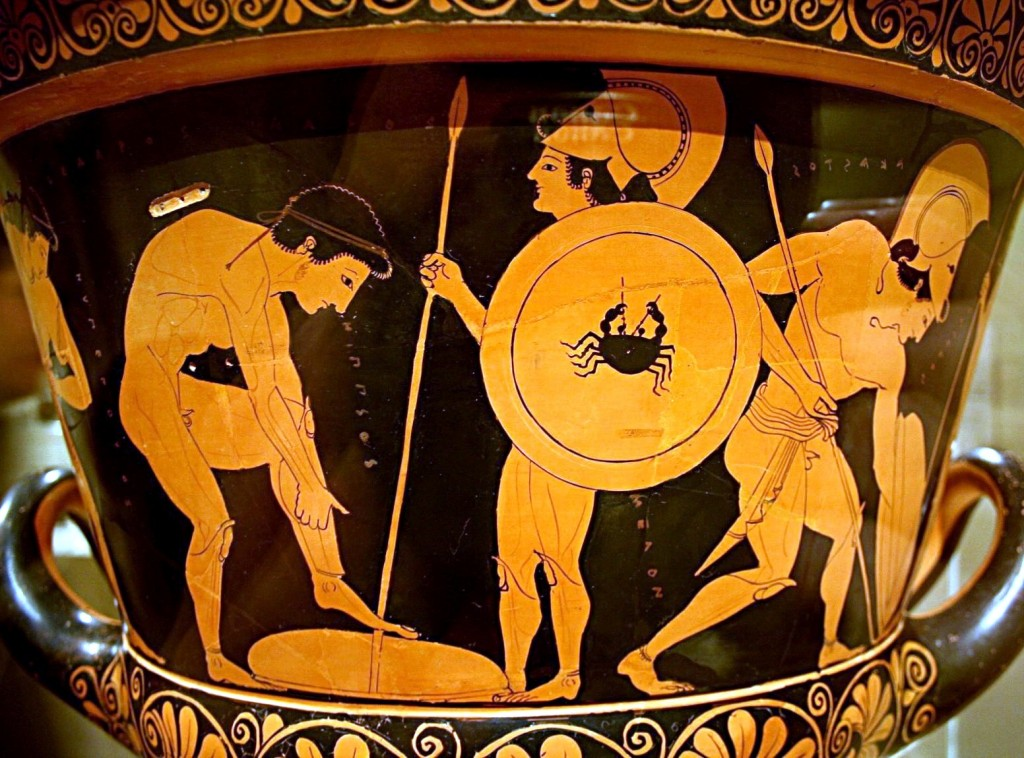
Patroclus and The Myrmidons rush forth in an effort to save the Argive camp. Patroclus is magnificent. The fear and panic induced by the mere sight of a man in Achilles’ armor is nearly enough to turn the tide of battle, for the apparel oft proclaims the man, but Patroclus is no geek off the street, he’s handy with the steel (bronze) if you know what I mean, and he embarks on one of the more devastating aristeias of the Iliad. An aristeia is basically the slow-motion action montage of epic poetry. The hero is described dressing for battle, and then watch the hell out. Patroclus drives the Trojans off the ships, out of the camp, back across the embankment and other fortifications, and all the way to the very walls of Troy. Only with the aid of Apollo is Patroclus stopped by the Trojans. After the distant deadly archer mortally wounds him, like 3 Trojans stab him and he dies, just as we knew he must. Book 17 describes the fight between Greeks and Trojans over Patroclus’ body and Achilles’ armor. Hector ends up with the armor, but Menelaus is able to bring the body back.
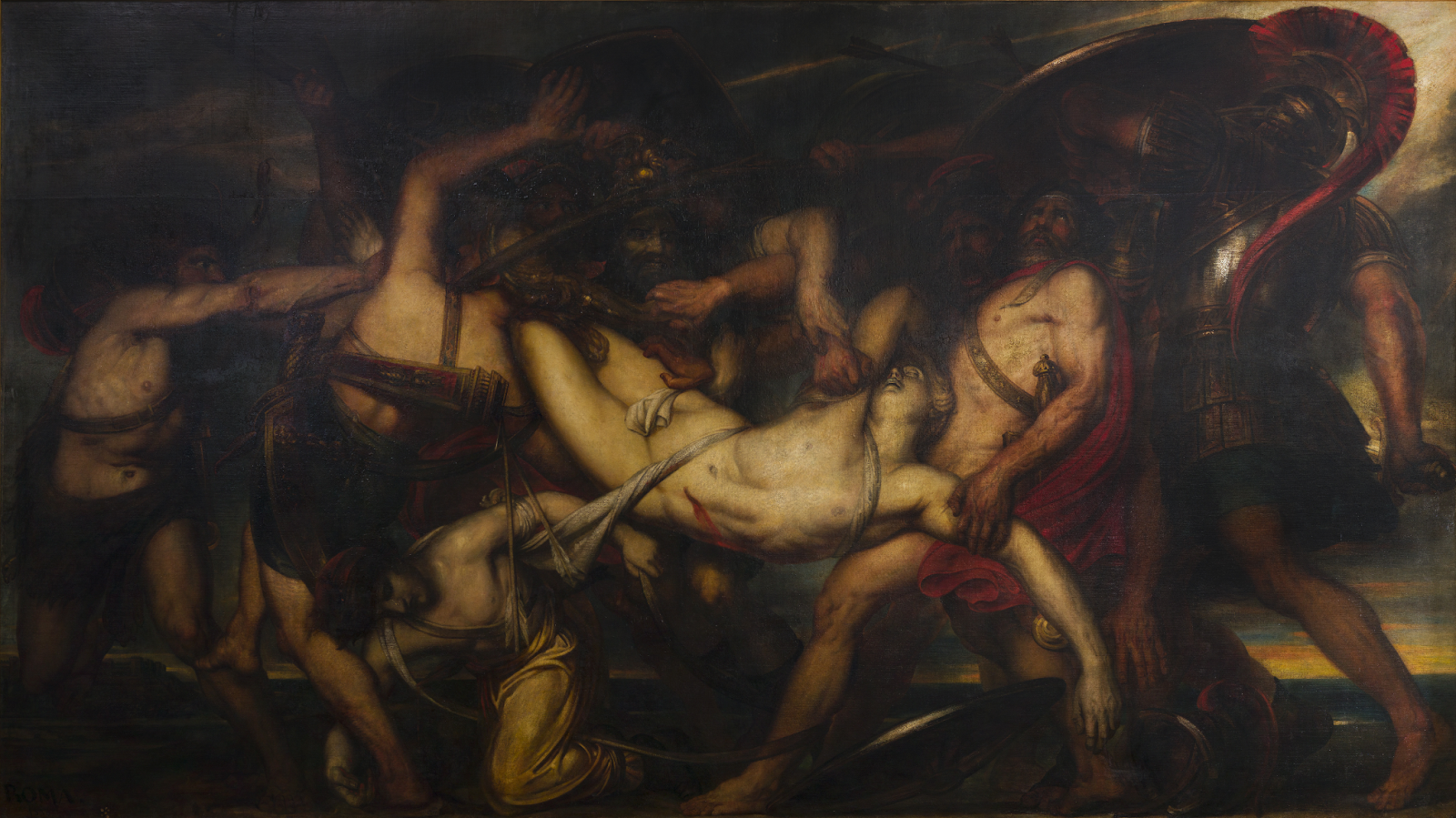
The death of Patroclus is a devastating blow to Achilles. When he learns what has happened he cries out in despair and his mother comes rushing to his side:
I’ve lost the will to live, to take my stand in the world of men—unless, before all else, Hector’s battered down by my spear and gasps away his life, the blood-price for Patroclus,
But Thetis answered, warning through her tears, “You’re doomed to a short life, my son, from all you say!
For hard on the heels of Hector’s death your death must come at once—”
“Then let me die at once”—Achilles burst out, despairing—“since it was not my fate to save my dearest comrade from his death!
Look, a world away from his fatherland he’s perished, lacking me, my fighting strength, to defend him. But now, since I shall not return to my fatherland … nor did I bring one ray of hope to my Patroclus, nor to the rest of all my steadfast comrades, countless ranks struck down by mighty Hector—
No, no, here I sit by the ships … a useless, dead weight on the good green earth—
No man my equal among the bronze-armed Achaeans, not in battle, only in wars of words that others win.
If only strife could die from the lives of gods and men and anger that drives the sanest man to flare in outrage—bitter gall, sweeter than dripping streams of honey, that swarms in people’s chests and blinds like smoke—just like the anger Agamemnon king of men has roused within me now …
Enough.
Let bygones be bygones.
Done is done.
Despite my anguish I will beat it down, the fury mounting inside me, down by force.
But now I’ll go and meet that murderer head-on, that Hector who destroyed the dearest life I know.
For my own death, I’ll meet it freely—whenever Zeus and the other deathless gods would like to bring it on!
In his book Achilles in Vietnam this is the moment Jonathan Shay identified as the fulmination of the self-inflicted moral injury Achilles suffers. He recognizes how his failure to fulfill his obligations to his friend and comrades has resulted in irreparable harm and it sends him into an emotional tailspin.
On one level it’s easy to see that his own pride has led him to the precipice of the emotional abyss he’s falling into. He is the one who implored the gods to bring humiliation and defeat to those he considered friends. He got exactly what he asked for. That’s pretty much a universal lesson about wish fulfillment by supernatural means see: Aladdin, The Monkey’s Paw, Wonder Woman 1984, and Spider-Man: No Way Home.
If we attempt to have a bit of empathy for Achilles we recall he has engaged in a war knowing he will die. He has risked his life on the front lines for 9 years winning riches that have mostly been taken by a man who sits back at basecamp. The woman he loves was taken from him by that same guy, the guy whose decision brought plague upon the entire army. None of his comrades stood up for him while Agamemnon violated well established cultural mores by taking Briseis from Achilles. His grievances weren’t all rooted in vanity were they?
Achilles didn’t kill Patroclus. Achilles didn’t force him to come to Troy. He certainly didn’t force him to the field of battle. Achilles loaned Patroclus the armor that had shielded him for a decade. Before his departure Achilles gave Patroclus very explicit instruction not to pursue Hector all the way to the walls of Troy. Nonetheless, Patroclus fought him there and met his end in the shadow of Troy’s walls. Apollo, Hector, and several other Trojans killed Patroclus, not Achilles, but if you’ve ever been involved in a root cause analysis of a failed system, or felt culpable for a tragedy yourself, then you know Achilles’ mind is filled with regret and “what ifs”. That sort of guilt can easily lead to perseveration and rumination. Achilles has said “Enough. Let bygones be bygones. Done is done.” twice now, but Homer makes certain the audience knows letting go of the sort of anger and guilt Achilles now bears isn’t as easy as repeating a three line mantra.
What’s Achilles’ next move? What does a bronze age warlord do when his best friend has been killed? There’s a reason Achilles is known as the greatest warrior in the Achaean army, and Homer is about to show us why. Some say revenge is a dish best served cold. Immediately following his big blow-up with Agamemnon, Achilles had an impulse to draw his sword and kill him on the spot, but he was constrained by Athena the goddess of strategy. Satisfying his desire for revenge in a slow and painful decimation of his betrayers has backfired cataclysmically. Achilles now copes with his grief by doing what he does best. He’s gonna kill a lot of folks, and he will not rest until Hector is dead.
Before then, for me at least, neither food nor drink will travel down my throat, not with my friend dead, there in my shelter, torn to shreds by the sharp bronze … You talk of food? I have no taste for food—what I really crave is slaughter and blood and the choking groans of men!“
In conversation and storytelling, restlessness is often used in a figurative sense. The restlessness of Achilles is pointedly literal. He announces his intention to return to battle. His mother makes him promise that, because Hector took his armor after killing Patroclus, he will not engage until he has new armor. This new suit is fashioned overnight by Hephaestus, but Achilles does not sleep. He makes peace with Agamemnon and the other Achaean captains. Uncharacteristically, Agamemnon makes good on the offer Achilles had previously rejected. The gold, women, and other prizes promised are brought out and presented to him. He accepts them but he exhibits no satisfaction in the honors, and refuses food and drink. Even though Briseis is brought back and Agamenon swears an oath that he has not had any intimate contact with her, Achilles refuses sleep and female companionship, he spends all night crying over Patroclus’ body. Prior to Patroclus’ death he and everyone else thought he was consumed with anger and rage, but now Homer makes clear Achilles is earning his epithet of being godlike, his hatred transcends the basic human needs and motivations for food, wealth, honor, repose, and reproduction. This is rock bottom for Achilles, this is what alienation and despair look like.
This is also a great answer to the question: why did the Trojan war last 10 years? Homer’s explanation is that the army was severely mismanaged for a decade by a greedy, fickle leader, and the only reason the stalemate caused by his bungling was broken was the failed challenge from Achilles and the aftermath that draws Hector, the greatest hope for Troy, out into open battle. All the death, devastation, and destruction lead to this moment where the true champions of each side finally meet face to face.
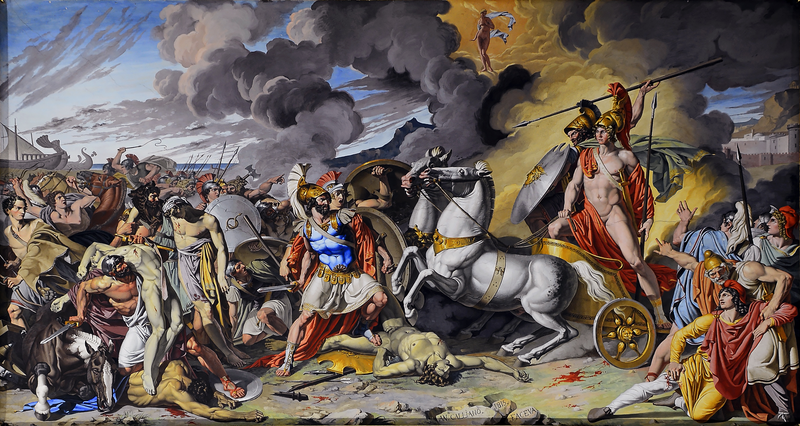
The next day, Achilles, sporting his new armor with a shield symbolically depicting the entirety of human life and endeavor, takes the field.
The glory of armor lit the skies and the whole earth laughed, rippling under the glitter of bronze, thunder resounding under trampling feet of armies.
And in their midst the brilliant Achilles began to arm for battle…
A sound of grinding came from the fighter’s teeth, his eyes blazed forth in searing points of fire, unbearable grief came surging through his heart and now, bursting with rage against the men of Troy
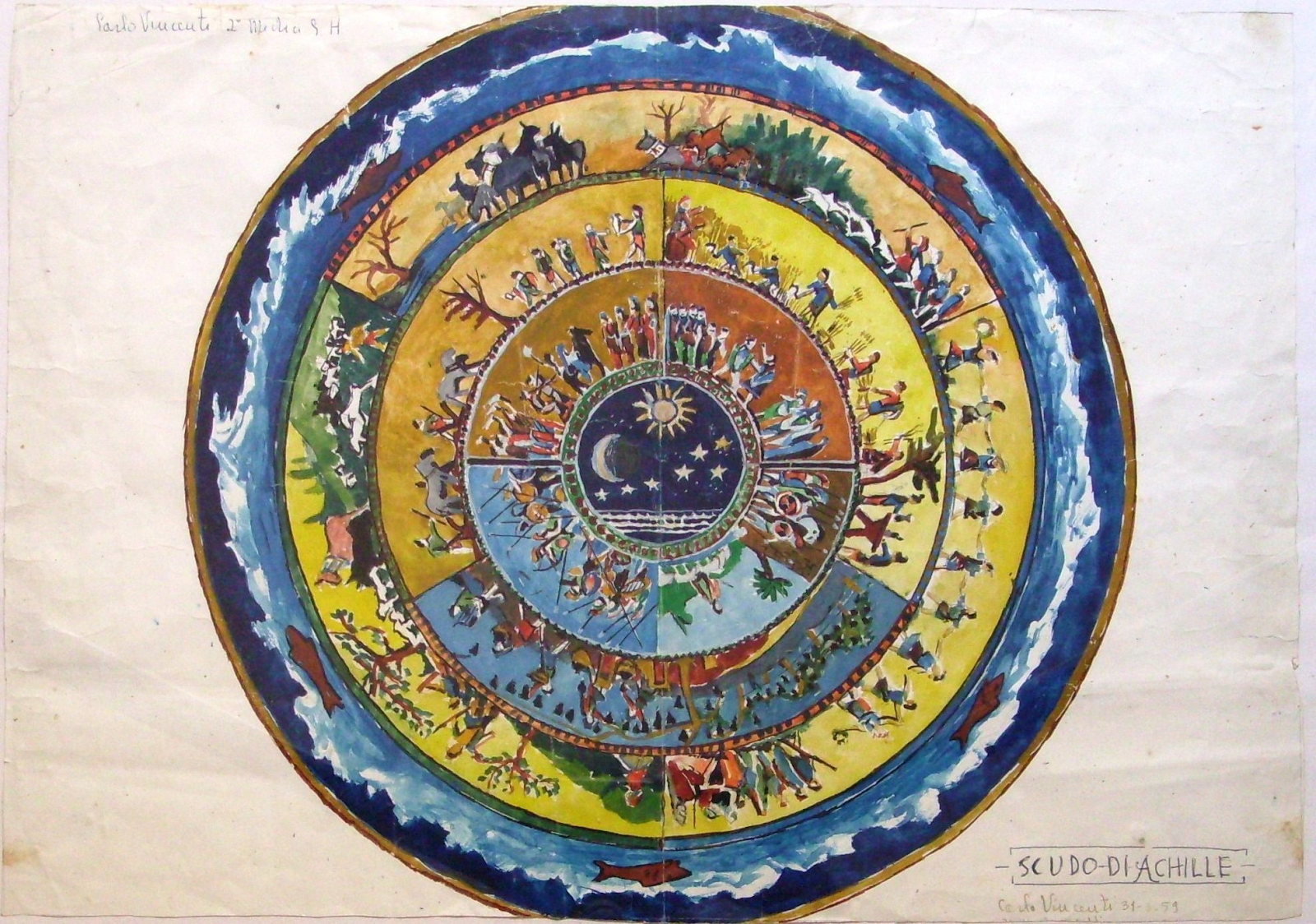
He is pitiless. He takes no prisoners. When his victims beg for mercy his reply is “Come, friend, you too must die. Why moan about it so? Even Patroclus died, a far, far better man than you.” His overwhelming power draws multiple gods to confront him simultaneously. The river Scamander is choked with the bodies of the dead and rises up against him. With the aid of a few deities who’ve sided with the Achaeans, he advances steadily up the plain. All the Trojans except Hector retreat to safety within the city walls. Apollo tries to draw Achilles away to buy time for the Trojans; in return Athena appears in disguise to keep Hector from retreating. The confrontation between Achilles and Hector is a little anti-climactic by comparison. Hector is clearly frightened and knows he will lose. He runs around the city walls multiple times trying to draw fire from troops stationed above onto Achilles, but his attempts fail and ultimately he turns to fight. He attempts to extract a promise that the winner will not attempt to loot or desecrate the body of the loser:.
I swear I will never mutilate you—merciless as you are—if Zeus allows me to last it out and tear your life away.
But once I’ve stripped your glorious armor, Achilles, I will give your body back to your loyal comrades. Swear you’ll do the same.
Of course the audience and Achilles know that only the day before Hector engaged in prolonged bloody combat in an effort to drag Patroclus’ body back to Troy, the exact opposite of the oath he attempts to extract from Achilles, and the Swift Runner is having none of it.
A swift dark glance and the headstrong runner answered, “Hector, stop! You unforgivable, you … don’t talk to me of pacts.
There are no binding oaths between men and lions—wolves and lambs can enjoy no meeting of the minds— they are all bent on hating each other to the death.
So with you and me. No love between us.
No truce till one or the other falls and gluts with blood Ares who hacks at men behind his rawhide shield.
Come, call up whatever courage you can muster.
Life or death—now prove yourself a spearman, a daring man of war!
No more escape for you— Athena will kill you with my spear in just a moment.
Now you’ll pay at a stroke for all my comrades’ grief, all you killed in the fury of your spear!”
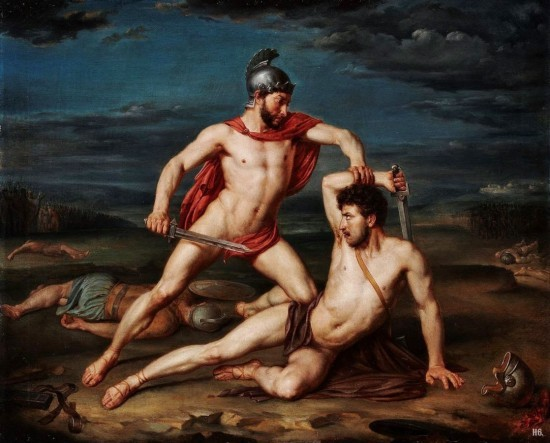
The final exchange between the two combatants highlights the inhuman depravity of Achilles’ rage.
“Hector—surely you thought when you stripped Patroclus’ armor that you, you would be safe!
Never a fear of me—far from the fighting as I was—you fool!
Left behind there, down by the beaked ships his great avenger waited, a greater man by far— that man was I. And I smashed your strength!
And you—the dogs and birds will maul you, shame your corpse while Achaeans bury my dear friend in glory!”
Struggling for breath, Hector, his helmet flashing, said, “I beg you, beg you by your life, your parents— don’t let the dogs devour me by the Argive ships!
Wait, take the princely ransom of bronze and gold, the gifts my father and noble mother will give you— but give my body to friends to carry home again, so Trojan men and Trojan women can do me honor with fitting rites of fire once I am dead.”
Staring grimly, the proud runner Achilles answered, “Beg no more, you fawning dog—begging me by my parents!
Would to god my rage, my fury would drive me now to hack your flesh away and eat you raw—such agonies you have caused me!
Ransom? No man alive could keep the dog-packs off you, not if they haul in ten, twenty times that ransom and pile it here before me and promise fortunes more—no, not even if Dardan Priam should offer to weigh out your bulk in gold!
Not even then will your noble mother lay you on your deathbed, mourn the son she bore … The dogs and birds will rend you—blood and bone!”
Once Hector is killed Achilles hitches his body behind his chariot and drags the corpse around the city. His behavior is an affront to common decency and the honorable treatment of one’s enemy that has been attested to multiple times previously in the Iliad.
There are many vivid descriptions of death in The Iliad. In less gruesome descriptions darkness swirls about them or manifests in their eyes. In other deaths men’s intestines spill out, or their brains explode out of their skulls following spear thrusts, blood and bile pour out of a variety of natural and unnatural orifices. There is certainly room to interpret the Iliad as a celebration of violence and martial prowess. By one count 255 named heroes are killed. Homer typically devotes at least a paragraph to describing the lineage and accolades of the man killed. The pursuit of Timé and Kleos which motivates the conflict is granted by Homer and the Iliad. Ignorant school children like myself learn “The Iliad is the story of the Trojan War” 3,000 years after it was composed and recorded. It’s impossible to actually read the text and not be impressed or overwhelmed by the sheer volume of graphic violence. Hand to hand combat fills entire books. I felt like Books 5-8 and 10-15 were very long slogs. There are moments of reprieve, but one could be forgiven for interpreting the entire thing as a celebration of violence and “bravery” informing a toxic version of masculinity that is not foreign in the 21st century.
Clearly, I disagree with this assessment. At the very least it is incomplete, or one among several possible interpretations. I suspect all of the violence of the Iliad, especially the destruction accompanying the aristeia of Achilles serves as a vivid reminder of the price of giving primacy to rigid interpretations of honor, glory, and conflict resolution through violence. Reconsider the opening lines of the poem, “ Rage—Goddess, sing the rage of Peleus’ son Achilles, murderous, doomed, that cost the Achaeans countless losses, hurling down to the House of Death so many sturdy souls, great fighters’ souls, but made their bodies carrion, feasts for the dogs and birds” these lines don’t cast these events in a positive light. Consider the underlying sources of strife and conflict driving the violence. Pride, ambition, and reputation are the reasons so many are dead. Consider how exacting revenge upon Hector affects Achilles. If The Iliad is a celebration of honor and glory garnered through violence, how should Achilles feel when he is welcomed back to the army with lavish gifts and feasts? What should striking down the man who killed his best friend do for his emotional state? It stands to reason that Achilles should feel some measure of satisfaction. He’s acknowledged as the greatest of the Achaeans, he’s got a piece of the game, he’s the chosen one, he has killed the crown prince and only hope for his enemy, now there is no other one, after avenging the death of his friend he remains miserable, betrayed by his desires.
Achilles led them now in a throbbing chant of sorrow, laying his man-killing hands on his great friend’s chest:
“Farewell, Patroclus, even there in the House of Death!
Look—all that I promised once I am performing now: I’ve dragged Hector here for the dogs to rip him raw— and here in front of your flaming pyre I’ll cut the throats of a dozen sons of Troy in all their shining glory, venting my rage on them for your destruction!”
So he triumphed and again he was bent on outrage, on shaming noble Hector—he flung him facedown in the dust beside Patroclus’ bier….
Later, everyone celebrates the triumph over Hector, except Achilles.
They hung on his words, complied, rushed to prepare the meal, and each man feasted well and no man’s hunger lacked a share of the banquet.
When they had put aside desire for food and drink each went his way and slept in his own shelter.
But along the shore as battle lines of breakers crashed and dragged, Achilles lay down now, groaning deep from the heart, near his Myrmidon force but alone on open ground where over and over rollers washed along the shore.
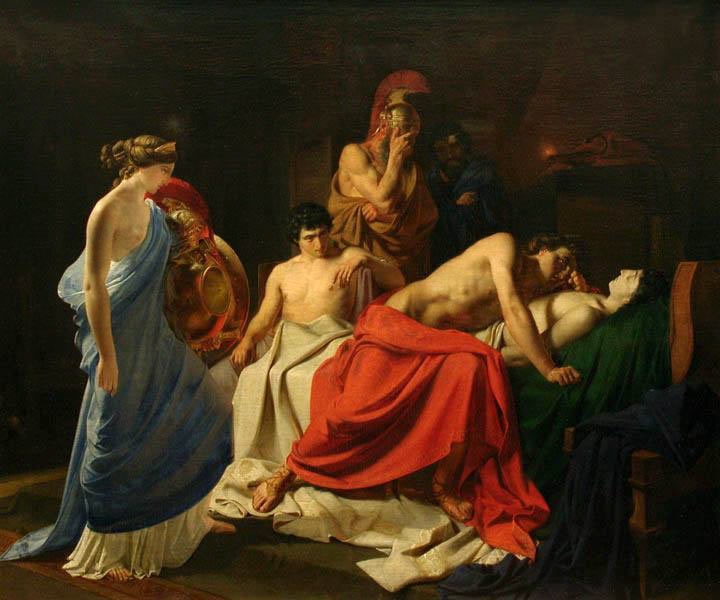
He continues to refuse food, drink, and sleep. His life is prolonged only because his mother occasionally slips nectar and ambrosia into him when he momentarily passes out from exhaustion. He never retires to his tent and the woman he loves. Every day he once again hitches Hector’s body to his chariot and drags him around the Greek camp. He leaves the corpse for the dogs and vultures to desecrate. It’s only through divine intervention that Hector’s body is preserved. Achilles is trapped. He cannot let go of his hatred. Despite giving full voice to all his rage, he is trapped, still just a rat in a cage.

 MaximumKungFu
Leave a Reply